Effects of sevelamer hydrochloride and calcium carbonate on renal osteodystrophy in hemodialysis patients
- PMID: 18199805
- PMCID: PMC2396748
- DOI: 10.1681/ASN.2006101089
Effects of sevelamer hydrochloride and calcium carbonate on renal osteodystrophy in hemodialysis patients
Abstract
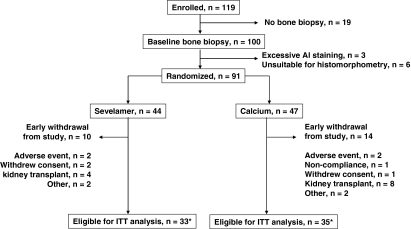
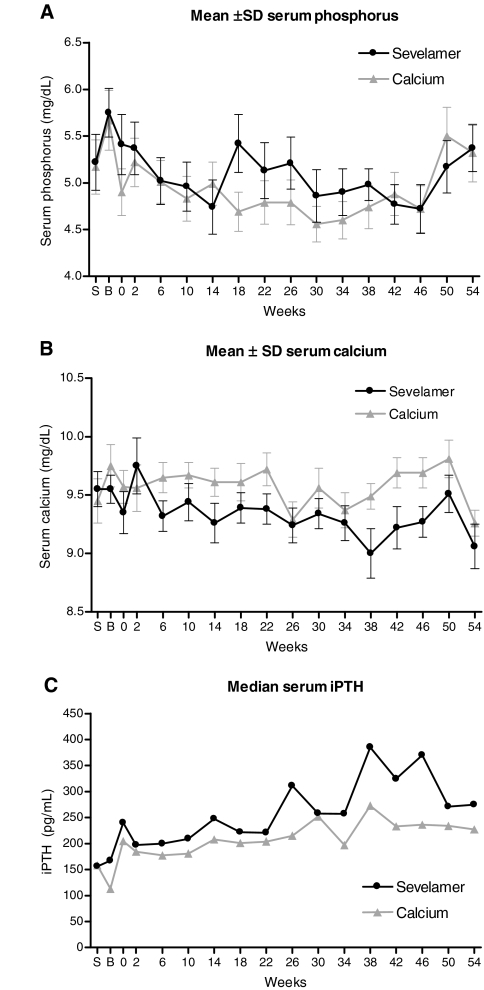
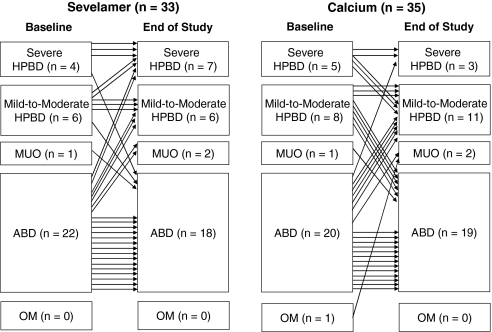
Disturbances in mineral metabolism play a central role in the development of renal bone disease. In a 54-wk, randomized, open-label study, 119 hemodialysis patients were enrolled to compare the effects of sevelamer hydrochloride and calcium carbonate on bone. Biopsy-proven adynamic bone disease was the most frequent bone abnormality at baseline (59%). Serum phosphorus, calcium, and intact parathyroid hormone were well controlled in both groups, although calcium was consistently lower and intact parathyroid hormone higher among patients who were randomly assigned to sevelamer. Compared with baseline values, there were no changes in mineralization lag time or measures of bone turnover (e.g., activation frequency) after 1 yr in either group. Osteoid thickness significantly increased in both groups, but there was no significant difference between them. Bone formation rate per bone surface, however, significantly increased from baseline only in the sevelamer group (P = 0.019). In addition, of those with abnormal microarchitecture at baseline (i.e., trabecular separation), seven of 10 in the sevelamer group normalized after 1 yr compared with zero of three in the calcium group. In summary, sevelamer resulted in no statistically significant changes in bone turnover or mineralization compared with calcium carbonate, but bone formation increased and trabecular architecture improved with sevelamer. Further studies are required to assess whether these changes affect clinical outcomes, such as rates of fracture.
Figures
References
-
- Monier-Faugere MC, Malluche HH: Trends in renal osteodystrophy: A survey from 1983 to 1995 in a total of 2248 patients. Nephrol Dial Transplant 11[Suppl 3]: 111–120, 1996 - PubMed
-
- Couttenye MM, D'Haese PC, Deng JT, Van Hoof VO, Verpooten GA, De Broe ME: High prevalence of adynamic bone disease diagnosed by biochemical markers in a wide sample of the European CAPD population. Nephrol Dial Transplant 12: 2144–2150, 1997 - PubMed
-
- Malluche HH, Mawad H, Monier-Faugere MC: The importance of bone health in end-stage renal disease: Out of the frying pan, into the fire? Nephrol Dial Transplant 19[Suppl 1]: i9–i13, 2004 - PubMed
-
- Malluche HH, Monier-Faugere MC: Risk of adynamic bone disease in dialyzed patients. Kidney Int Suppl 38: S62–S67, 1992 - PubMed
-
- Pei Y, Hercz G, Greenwood C, Segre G, Manuel A, Saiphoo C, Fenton S, Sherrard D: Risk factors for renal osteodystrophy: A multivariant analysis. J Bone Miner Res 10: 149–156, 1995 - PubMed
Publication types
MeSH terms
Substances
LinkOut - more resources
Full Text Sources
Medical