


Protective effects of dietary curcumin in mouse model of chemically induced colitis are strain dependent
- PMID: 18200517
- PMCID: PMC4427520
- DOI: 10.1002/ibd.20348
Protective effects of dietary curcumin in mouse model of chemically induced colitis are strain dependent
Abstract
Background: Curcumin (diferulolylmethane) has been shown to have a protective role in mouse models of inflammatory bowel diseases (IBD) and to reduce the relapse rate in human ulcerative colitis (UC), thus making it a potentially viable supportive treatment option. Trinitrobenzene sulfonic acid (TNBS) colitis in NKT-deficient SJL/J mice has been described as Th1-mediated inflammation, whereas BALB/c mice are believed to exhibit a mixed Th1/Th2 response.
Methods: We therefore investigated the effect of dietary curcumin in colitis induced in these 2 strains.
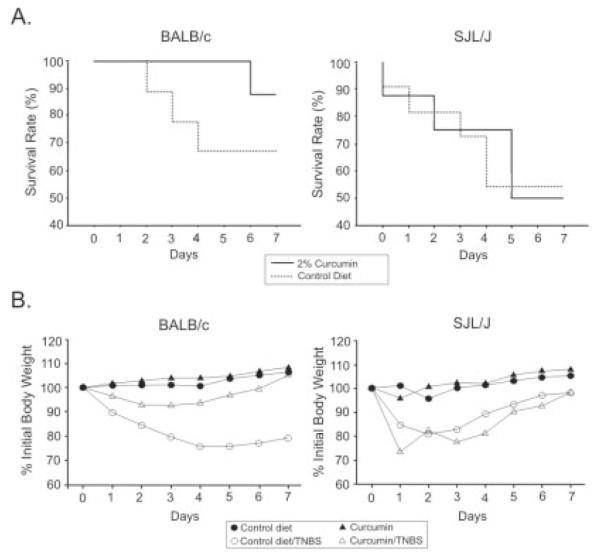
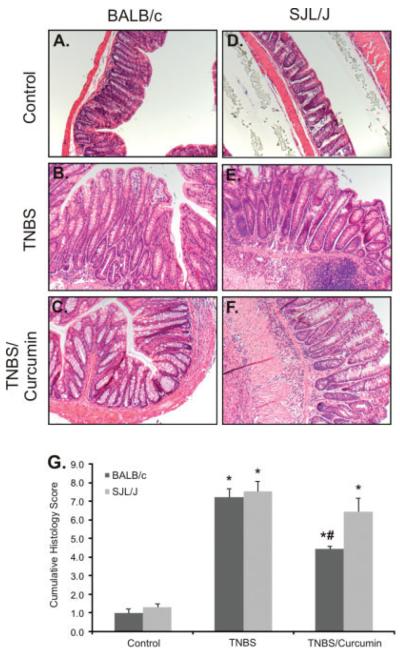
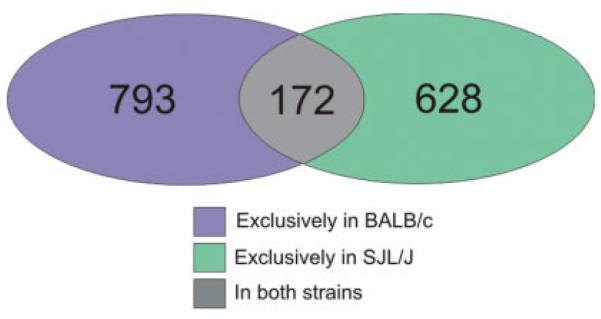
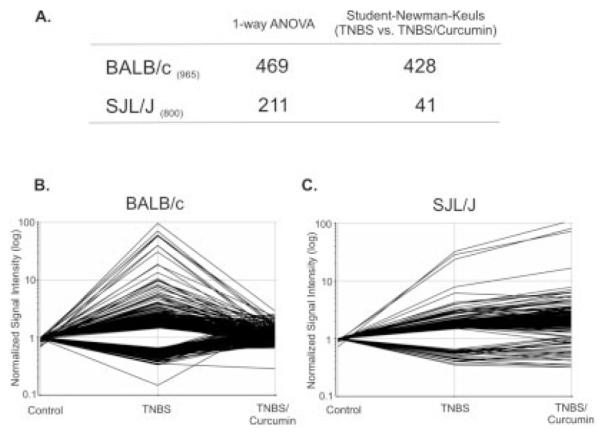
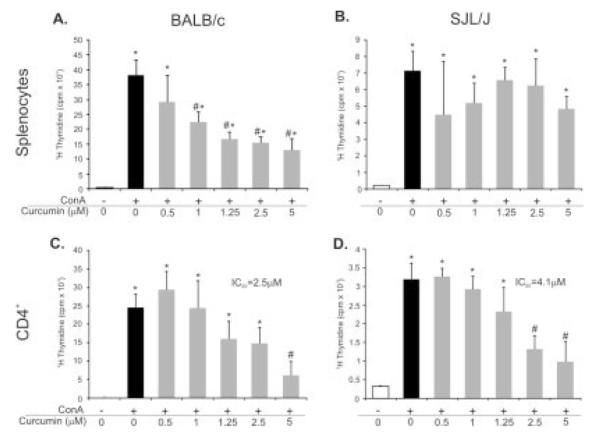
Results: In the BALB/c mice, curcumin significantly increased survival, prevented weight loss, and normalized disease activity. In the SJL/J mice, curcumin demonstrated no protective effects. Genomewide microarray analysis of colonic gene expression was employed to define the differential effect of curcumin in these 2 strains. This analysis not only confirmed the disparate responses of the 2 strains to curcumin but also indicated different responses to TNBS. Curcumin inhibited proliferation of splenocytes from naive BALB/c mice but not SJL/J mice when nonspecifically stimulated in vitro with concanavalin A (ConA). Proliferation of CD4(+) splenocytes was inhibited in both strains, albeit with about a 2-fold higher IC(50) in SJL/J mice. Secretion of IL-4 and IL-5 by CD4(+) lymphocytes of BALB/c mice but not SJL/J mice was significantly augmented by ConA and reduced to control levels by curcumin.
Conclusions: The efficacy of dietary curcumin in TNBS colitis varies in BALB/c and SJL/J mouse strains. Although the exact mechanism underlying these differences is unclear, the results suggest that the therapeutic value of dietary curcumin may differ depending on the nature of immune dysregulation in IBD.
Figures
References
-
- Sartor RB. Mechanisms of disease: pathogenesis of Crohn’s disease and ulcerative colitis. Nat Clin Pract Gastroenterol Hepatol. 2006;3:390–407. - PubMed
-
- Danese S, Sans M, Fiocchi C. Inflammatory bowel disease: the role of environmental factors. Autoimmun Rev. 2004;3:394–400. - PubMed
-
- Lawrance IC, Fiocchi C, Chakravarti S. Ulcerative colitis and Crohn’s disease: distinctive gene expression profiles and novel susceptibility candidate genes. Hum Mol Genet. 2001;10:445–456. - PubMed
-
- Fiocchi C. Inflammatory bowel disease: etiology and pathogenesis. Gastroenterology. 1998;115:182–205. - PubMed
-
- Fuss IJ, Neurath M, Boirivant M, et al. Disparate CD4+ lamina propria (LP) lymphokine secretion profiles in inflammatory bowel disease. Crohn’s disease LP cells manifest increased secretion of IFN-gamma, whereas ulcerative colitis LP cells manifest increased secretion of IL-5. J Immunol. 1996;157:1261–1270. - PubMed
Publication types
MeSH terms
Substances
Grants and funding
LinkOut - more resources
Full Text Sources
Other Literature Sources
Molecular Biology Databases
Research Materials