


Dose estimation and surveillance of mechanical loading interventions for bone loss after spinal cord injury
- PMID: 18202080
- PMCID: PMC3270311
- DOI: 10.2522/ptj.20070224
Dose estimation and surveillance of mechanical loading interventions for bone loss after spinal cord injury
Abstract
Background and purpose: The interpretation of the results of previous anti-osteoporosis interventions after spinal cord injury (SCI) is undermined by incomplete information about the intervention dose or patient adherence to dose requirements. Rehabilitation research as a whole traditionally has struggled with these same issues. The purpose of this case report is to offer proof of the concepts that careful dose selection and surveillance of patient adherence should be integral components in rehabilitation interventions.
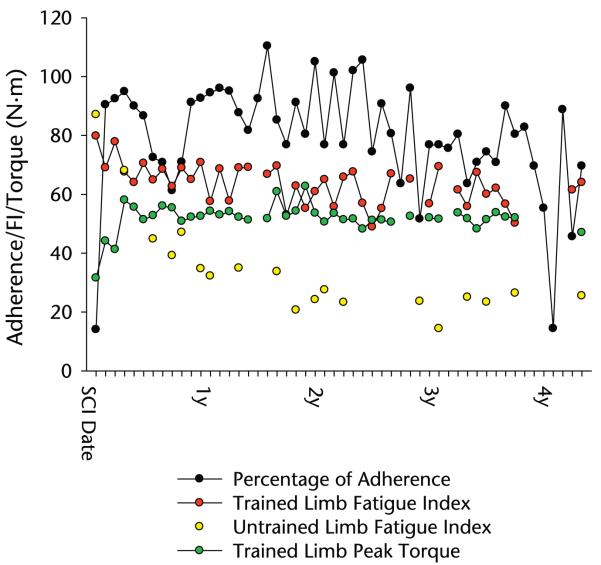
Case description: A 21-year-old man with T4 complete paraplegia (7 weeks) enrolled in a unilateral soleus muscle electrical stimulation protocol. Compressive loads applied to the tibia approximated 1.4 times body weight. Over 4.8 years of home-based training, data logging software provided surveillance of adherence. Soleus muscle torque and fatigue index adaptations to training as well as bone mineral density (BMD) adaptations in the distal tibia were measured.
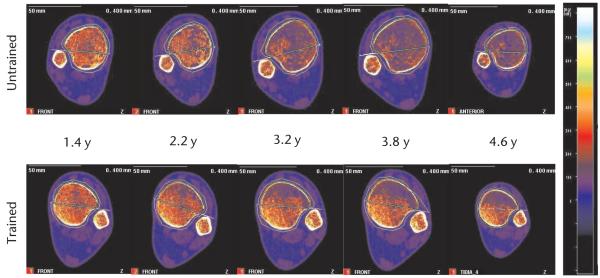
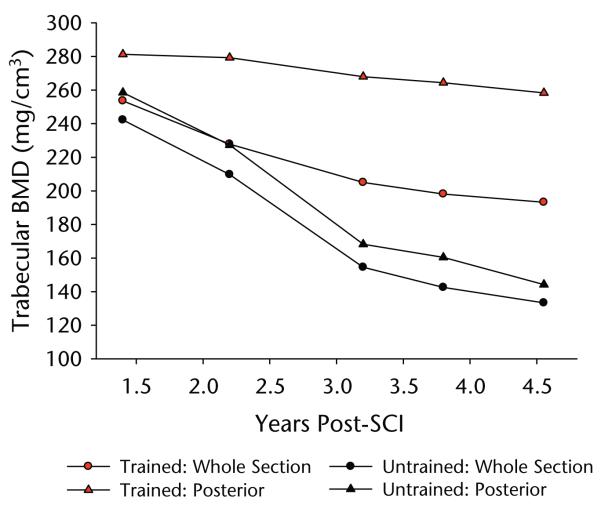
Outcomes: The patient performed nearly 8,000 soleus muscle contractions per month, with occasional fluctuations. Adherence tracking permitted intervention when adherence fell below acceptable values. The soleus muscle torque and fatigue index increased rapidly in response to training. The BMD of the untrained tibia declined approximately 14% per year. The BMD of the trained tibia declined only approximately 7% per year. The BMD was preferentially preserved in the posterior half of the tibia; this region experienced only a 2.6% annual decline.
Discussion: Early administration of a load intervention, careful estimation of the loading dose, and detailed surveillance of patient adherence aided in the interpretation of a patient's adaptations to a mechanical load protocol. These concepts possess wider applicability to rehabilitation research and should be emphasized in future physical therapy investigations.
Figures
References
-
- Maimoun L, Lumbroso S, Paris F, et al. The role of androgens or growth factors in the bone resorption process in recent spinal cord injured patients: a cross-sectional study. Spinal Cord. 2006;44:791–797. - PubMed
-
- Chantraine A, van Ouwenaller C, Hachen HJ, Schinas P. Intra-medullary pressure and intra-osseous phlebography in paraplegia. Paraplegia. 1979;17:391–399. - PubMed
-
- Hohmann EL, Elde RP, Rysavy JA, et al. Innervation of periosteum and bone by sympathetic vasoactive intestinal peptide-containing nerve fibers. Science. 1986;232:868–871. - PubMed
-
- Imai S, Matsusue Y. Neuronal regulation of bone metabolism and anabolism: calcitonin gene-related peptide-, substance P-, and tyrosine hydroxylase-containing nerves and the bone. Microsc Res Tech. 2002;58:61–69. - PubMed
Publication types
MeSH terms
Grants and funding
LinkOut - more resources
Full Text Sources
Medical
