Comparative Study
. 1991 May;1(2):117-25.

Effects of long 5' leader sequences on initiation by eukaryotic ribosomes in vitro

Affiliations
Comparative Study

Effects of long 5' leader sequences on initiation by eukaryotic ribosomes in vitro

M Kozak. Gene Expr. 1991 May.

Abstract

Lengthening the 5' noncoding sequence on SP6-derived transcripts can increase their translational efficiency by an order of magnitude under some conditions of translation in reticulocyte lysates. This effect was observed upon reiterating three different synthetic oligonucleotides, the sequences of which were designed simply to preclude secondary structure. It seems unlikely that such arbitrarily designed sequences are recognized by sequence-specific translational enhancer proteins. Rather, long 5' leader sequences appear to accumulate extra 40S ribosomal subunits, which may account for their translational advantage. The buildup of 40S subunits on long, unstructured leader sequences is predicted by the scanning model for initiation. Leader sequences such as these may be ideal for in vitro expression vectors.


Figures
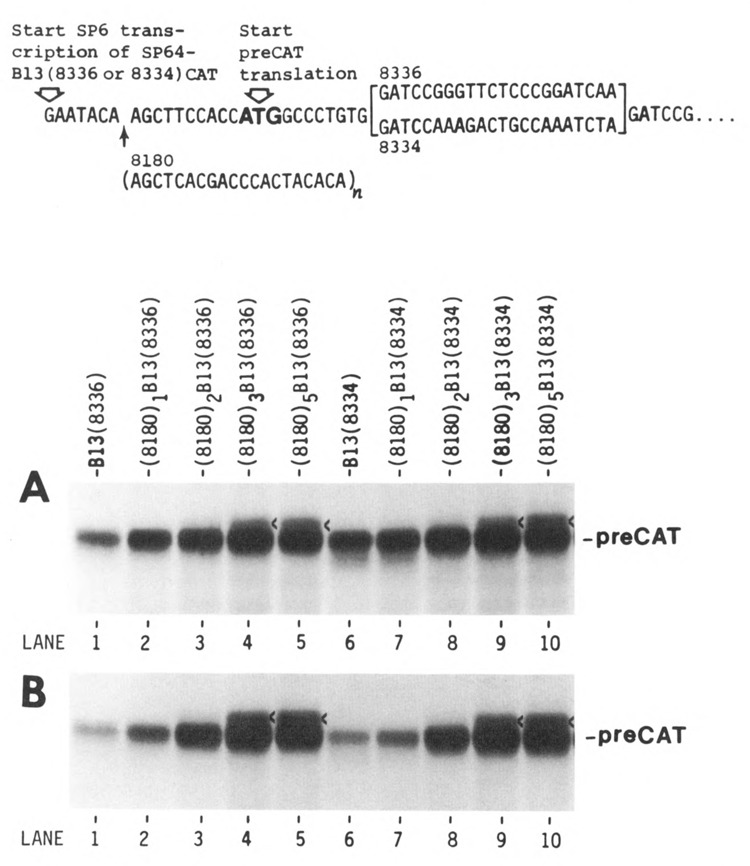
Figure 1
Figure 1
Evaluation of translational efficiency as a function of leader length. Upper. A transcript from the parental plasmid is depicted, with T’s in place of U’s. The preCAT start site is followed by either a structured (8336) or unstructured (8334) adaptor; the sequence downstream from the adaptor was published previously (Kozak, 1989a). The 5′ noncoding sequences on transcripts from the parental plasmids SP64-B13(8336)CAT and SP64-B13(8334)CAT are 17 nucleotides long. Multiples of oligonucleotide 8180, shown below the parental sequence, were inserted at the HindIII site (AAGCTT) to extend the 5′ noncoding sequence in increments of 20 nucleotides. Lower. Autoradiograms are shown of [35S]methionine-labeled proteins synthesized in a reticulocyte translation system under standard salt conditions (A) or with high KCl (B); proteins were fractionated by polyacrylamide gel electrophoresis (Kozak, 1989a). The mRNAs used for translation in panels A and B are indicated above each lane in A. A faint, slower-migrating band in lanes 4, 5, 9, and 10, marked with a caret, is attributable to an upstream ACG codon (see text and Figure 3). The band that runs faster than preCAT in lane 6 reflects a slight degree of leaky scanning (i.e., initiation from the second AUG codon) when the leader sequence is short (Kozak, 1991). Leaky scanning is suppressed by introducing secondary structure downstream (lane 1) or by lengthening the leader sequence (lanes 7–10).
Figure 2
Figure 2
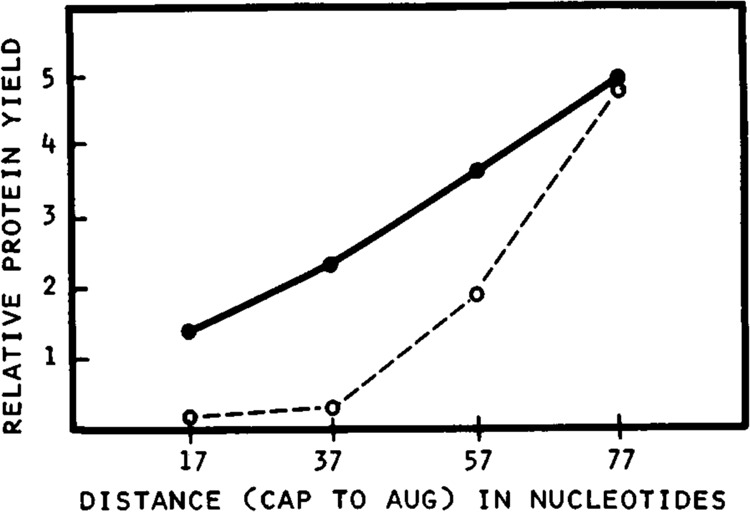
Quantitation of the relationship between leader length and translational efficiency in a reticulocyte cell-free system. The autoradiogram used for quantitation was from an experiment similar to that in Figure 1; the constructs were from series SP64(8180)nB13(8336)CAT. Relative yields of preCAT protein are expressed in optical density units. Symbols: •—• translation at 90 mM potassium acetate and 45 mM KCl (standard conditions); ○- - -○ translation at 90 mM potassium acetate and 78 mM KCl (high KCl).
Figure 3
Figure 3
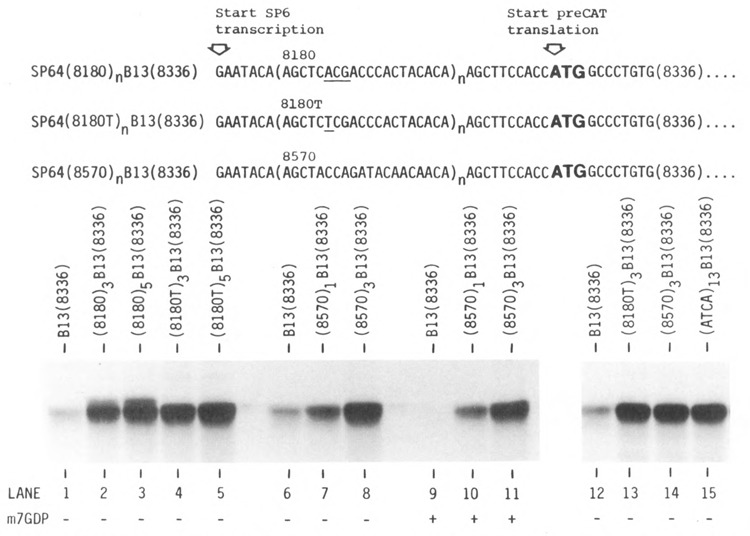
Comparison of translation with three different synthetic leader sequences. The reticulocyte translation system was used under high KCl conditions. The cap analogue m7GDP (0.8 mM) was included in the reactions represented in lanes 9–11. The 5′ sequence of the control transcript B13(8336) is given at the top of Figure 1. The upstream ACG codon in oligonucleotide 8180, which is responsible for the spurious upper band in lanes 2 and 3, is underlined in line 1. Synthesis of the extraneous upper band was abolished when the ACG codon was changed to TCG (oligonucleotide 8180T, line 2, lanes 4 and 5). Each of the transcripts tested in lanes 13–15 contained an insert of 60 nt, for a total leader length of 77 nt. The full 5′ leader sequence of the transcript designated ATCA (lane 15) is given in the text. Lanes 1–11 and lanes 12–15 represent two separate experiments.
Figure 4
Figure 4
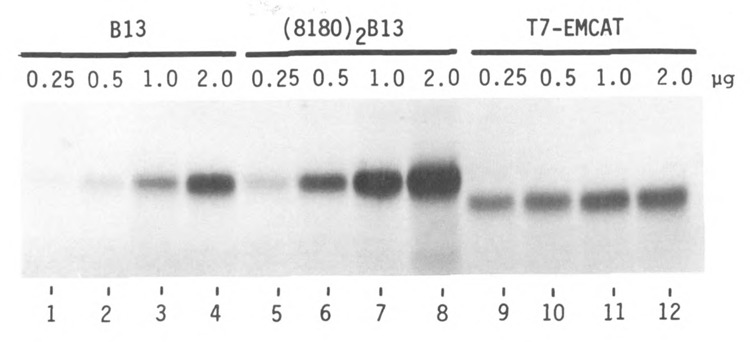
Comparison of an efficient synthetic leader sequence with an efficient natural leader sequence. Transcripts were derived from SP64-B13(8336)CAT (lanes 1–4), SP64(8180)2B13 (lanes 5–8) and pT7EMCAT (lanes 9–12; Elroy-Stein et al., 1989). Each mRNA was tested in the reticulocyte translation system under high KCl conditions; mRNA concentrations (μg per 30 μl reaction) are shown above each lane. Transcripts from the SP64-B13 series also supported translation efficiently in the wheat germ system (not shown), while T7EMCAT transcripts were nonfunctional in that system.
Figure 5
Figure 5
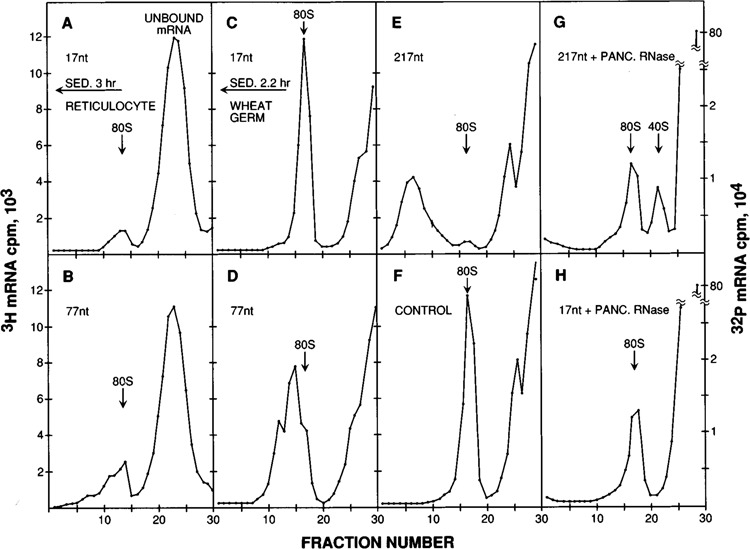
Analysis of initiation complexes by glycerol gradient centrifugation. Radiolabeled mRNAs were incubated for 8 minutes in a sparsomycin-blocked reticulocyte lysate under high KCl conditions (A–B) or in the standard wheat germ system (C–H). The mRNAs used here, from series SP64(8570)nB13(8336)CAT, had 5′ noncoding sequences of 17 (A, C, H), 77 (B, D) or 217 nt (E, G). Sedimentation (right to left) was for 3 (A, B) or 2.2 hours (C–H). The reticulocyte gradients were centrifuged slightly longer than the wheat germ gradients, because in the reticulocyte system the peaks are generally broader and thus harder to resolve. The 60 nt insert ([8570]3) that was present at the 5′ end of the mRNA used in D was relocated to a PvuII site within the CAT coding sequence in the control transcript used in F; the 5′ noncoding sequence on the control transcript was 17 nt long. For the ribosome protection experiments shown in G and H, initiation complexes formed with 32P-labeled mRNA were digested with pancreatic RNase before centrifugation. The 40S-protected peak in G is smaller than might be expected from the size of the starting complexes in E because, once the mRNA has been cleaved by RNase, there is nothing to keep the scanning 40S ribosomes from falling off. The absence of a 40S-protected peak in H validates the interpretation that the 40S peak in G derives from the binding of 40S subunits upstream from the AUG codon on long-leader mRNAs.

References

    1. Berkner K. L. and Sharp P. A. (1985), Nucl Acids Res 13, 841–857. - PMC - PubMed
    1. Brendler T., Godefroy-Colburn T., Carlill R. D., and Thach R. E. (1981), J Biol Chem 256, 11747–11754. - PubMed
    1. Carrington J. C. and Freed D. D. (1990), J Virol 64, 1590–1597. - PMC - PubMed
    1. Chinkers M., Garbers D. L., Chang M-S., Lowe D. G., Chin H., Goeddel D. V., and Schulz S. (1989), Nature 338, 78–83. - PubMed
    1. Cigan A. M., Pabich E. K., and Donahue T. F. (1988), Mol Cell Biol 8, 2964–2975. - PMC - PubMed

Publication types

LinkOut - more resources