


Artificial neural networks in the recognition of the presence of thyroid disease in patients with atrophic body gastritis
- PMID: 18203288
- PMCID: PMC2681147
- DOI: 10.3748/wjg.14.563
Artificial neural networks in the recognition of the presence of thyroid disease in patients with atrophic body gastritis
Abstract
Aim: To investigate the role of artificial neural networks in predicting the presence of thyroid disease in atrophic body gastritis patients.
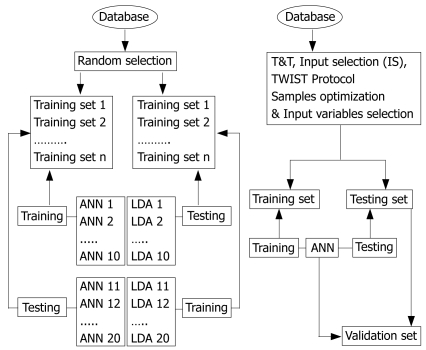
Methods: A dataset of 29 input variables of 253 atrophic body gastritis patients was applied to artificial neural networks (ANNs) using a data optimisation procedure (standard ANNs, T&T-IS protocol, TWIST protocol). The target variable was the presence of thyroid disease.
Results: Standard ANNs obtained a mean accuracy of 64.4% with a sensitivity of 69% and a specificity of 59.8% in recognizing atrophic body gastritis patients with thyroid disease. The optimization procedures (T&T-IS and TWIST protocol) improved the performance of the recognition task yielding a mean accuracy, sensitivity and specificity of 74.7% and 75.8%, 78.8% and 81.8%, and 70.5% and 69.9%, respectively. The increase of sensitivity of the TWIST protocol was statistically significant compared to T&T-IS.
Conclusion: This study suggests that artificial neural networks may be taken into consideration as a potential clinical decision-support tool for identifying ABG patients at risk for harbouring an unknown thyroid disease and thus requiring diagnostic work-up of their thyroid status.
Figures
References
-
- Dixon MF. The Components of gastritis. Histology and pathogenesis. In: Graham DY, Genta RM, Dixon MF, editors. Gastritis. Philadelphia: Lippincott Williams & Williams; 1999. pp. 51–66.
-
- Lee EL, Feldman M. Gastritis and other gastropathies. Sleisenger & Fordtran’s Gastrointestinal and Liver Disease: pathophysiology, diagnosis, management. In: Feldman M, Friedman LS, Sleisenger MH, editors. 7th editor. Philadelphia: Saunders; 2002. pp. 810–827.
-
- Toh BH, van Driel IR, Gleeson PA. Pernicious anemia. N Engl J Med. 1997;337:1441–1448. - PubMed
-
- Annibale B, Capurso G, Chistolini A, D'Ambra G, DiGiulio E, Monarca B, DelleFave G. Gastrointestinal causes of refractory iron deficiency anemia in patients without gastrointestinal symptoms. Am J Med. 2001;111:439–445. - PubMed
Publication types
MeSH terms
LinkOut - more resources
Full Text Sources
Medical
