


Pulse-chase studies of the synthesis of acetyl-CoA by carbon monoxide dehydrogenase/acetyl-CoA synthase: evidence for a random mechanism of methyl and carbonyl addition
- PMID: 18203715
- PMCID: PMC2820341
- DOI: 10.1074/jbc.M709470200
Pulse-chase studies of the synthesis of acetyl-CoA by carbon monoxide dehydrogenase/acetyl-CoA synthase: evidence for a random mechanism of methyl and carbonyl addition
Abstract
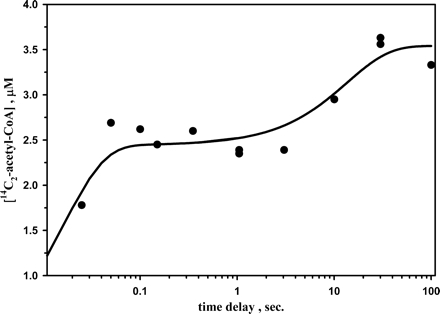
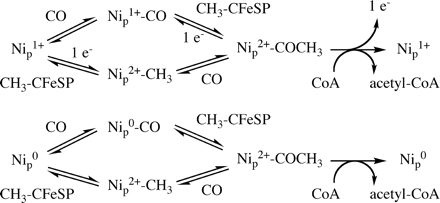
Carbon monoxide dehydrogenase/acetyl-CoA synthase catalyzes acetyl-CoA synthesis from CO, CoA, and a methylated corrinoid iron-sulfur protein, which acts as a methyl donor. This reaction is the last step in the Wood-Ljungdahl pathway of anaerobic carbon fixation. The binding sequence for the three substrates has been debated for over a decade. Different binding orders imply different mechanisms (i.e. paramagnetic versus diamagnetic mechanisms). Ambiguity arises because CO and CoA can each undergo isotopic exchange with acetyl-CoA, suggesting that either of these two substrates could be the last to bind to the acetyl-CoA synthase active site. Furthermore, carbonylation, CoA binding, and methyl transfer can all occur in the absence of the other two substrates. Here, we report pulse-chase studies, which unambiguously establish the order in which the three substrates bind. Although a CoA pulse is substantially diluted by excess CoA in the chase, isotope recovery of a pulse of labeled CO or methyl group is unaffected by the presence of excess unlabeled CO or methyl group in the chase. These results demonstrate that CoA is the last substrate to bind and that CO and the methyl group bind randomly as the first substrate in acetyl-CoA synthesis. Up to 100% of the methyl groups and CoA and up to 60-70% of the CO employed in the pulse phase can be trapped in the product acetyl-CoA.
Figures

References
MeSH terms
Substances
Grants and funding
LinkOut - more resources
Full Text Sources
Other Literature Sources
Molecular Biology Databases
