


Nondecarboxylating and decarboxylating isocitrate dehydrogenases: oxalosuccinate reductase as an ancestral form of isocitrate dehydrogenase
- PMID: 18203822
- PMCID: PMC2258884
- DOI: 10.1128/JB.01799-07
Nondecarboxylating and decarboxylating isocitrate dehydrogenases: oxalosuccinate reductase as an ancestral form of isocitrate dehydrogenase
Abstract
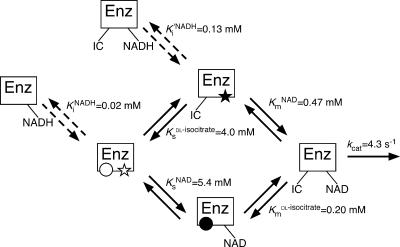
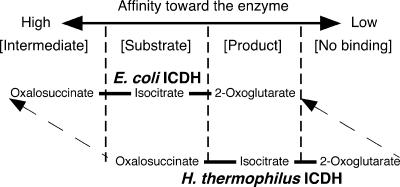
Isocitrate dehydrogenase (ICDH) from Hydrogenobacter thermophilus catalyzes the reduction of oxalosuccinate, which corresponds to the second step of the reductive carboxylation of 2-oxoglutarate in the reductive tricarboxylic acid cycle. In this study, the oxidation reaction catalyzed by H. thermophilus ICDH was kinetically analyzed. As a result, a rapid equilibrium random-order mechanism was suggested. The affinities of both substrates (isocitrate and NAD+) toward the enzyme were extremely low compared to other known ICDHs. The binding activities of isocitrate and NAD+ were not independent; rather, the binding of one substrate considerably promoted the binding of the other. A product inhibition assay demonstrated that NADH is a potent inhibitor, although 2-oxoglutarate did not exhibit an inhibitory effect. Further chromatographic analysis demonstrated that oxalosuccinate, rather than 2-oxoglutarate, is the reaction product. Thus, it was shown that H. thermophilus ICDH is a nondecarboxylating ICDH that catalyzes the conversion between isocitrate and oxalosuccinate by oxidation and reduction. This nondecarboxylating ICDH is distinct from well-known decarboxylating ICDHs and should be categorized as a new enzyme. Oxalosuccinate-reducing enzyme may be the ancestral form of ICDH, which evolved to the extant isocitrate oxidative decarboxylating enzyme by acquiring higher substrate affinities.
Figures

References
-
- Aoshima, M. 2007. Novel enzyme reactions related to the tricarboxylic acid cycle: phylogenetic/functional implications and biotechnological applications. Appl. Microbiol. Biotechnol. 75249-255. - PubMed
-
- Aoshima, M., and Y. Igarashi. 2006. A novel oxalosuccinate-forming enzyme involved in the reductive carboxylation of 2-oxoglutarate in Hydrogenobacter thermophilus TK-6. Mol. Microbiol. 62748-759. - PubMed
-
- Aoshima, M., M. Ishii, and Y. Igarashi. 2004. A novel biotin protein required for reductive carboxylation of 2-oxoglutarate by isocitrate dehydrogenase in Hydrogenobacter thermophilus TK-6. Mol. Microbiol. 51791-798. - PubMed
-
- Aoshima, M., and T. Oshima. 1997. Purification and characterization of isocitrate dehydrogenase from a hyperthermophilic archaebacterium, Caldococcus noboribetus. Biochim. Biophys. Acta 1340227-234. - PubMed
-
- Aoshima, M., A. Yamagishi, and T. Oshima. 1996. Eubacteria-type isocitrate dehydrogenase from an archaeon: cloning, sequencing, and expression of a gene encoding isocitrate dehydrogenase from a hyperthermophilic archaebacterium Caldococcus noboribetus. Arch. Biochem. Biophys. 33677-85. - PubMed
MeSH terms
Substances
LinkOut - more resources
Full Text Sources
Other Literature Sources
Molecular Biology Databases
