


doi: 10.1038/nmeth.1177.
Epub 2008 Jan 20.
A secreted luciferase for ex vivo monitoring of in vivo processes
Affiliations
- PMID: 18204457
- PMCID: PMC2699561
- DOI: 10.1038/nmeth.1177
Item in Clipboard
A secreted luciferase for ex vivo monitoring of in vivo processes
Nat Methods.
2008 Feb.
Abstract
Luciferases are widely used to monitor biological processes. Here we describe the naturally secreted Gaussia princeps luciferase (Gluc) as a highly sensitive reporter for quantitative assessment of cells in vivo by measuring its concentration in blood. The Gluc blood assay complements in vivo bioluminescence imaging, which has the ability to localize the signal and provides a multifaceted assessment of cell viability, proliferation and location in experimental disease and therapy models.
Figures
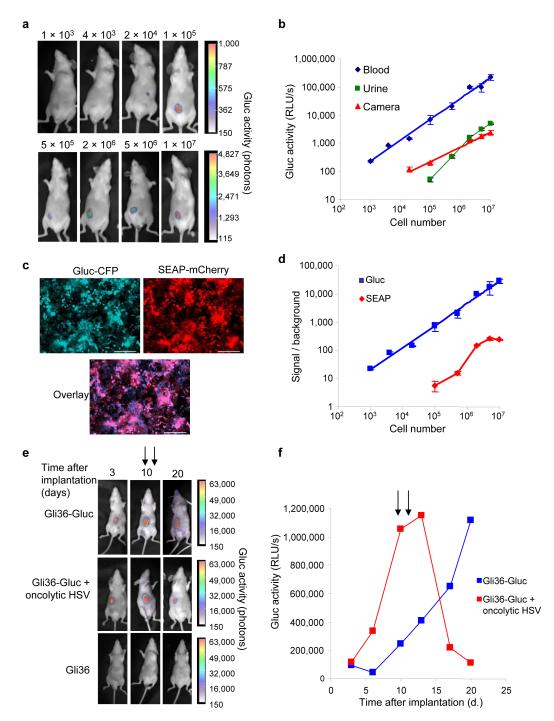
(a) Different numbers of Gli36-Gluc cells were implanted subcutaneously in mice (n = 4) and imaged with a CCD camera three days later. (b) Total relative light units (RLU) per second was calculated for tumors in (a) (red line). Gluc activity was measured in blood (blue line) or urine (green) using the luminometer. Results are presented as mean ± SD with p<0.001 as calculated by student T-test. (c and d) Different numbers of Gli36 cells expressing both Gluc-CFP and SEAP-mCherry (c) were implanted subcutaneously in mice and Gluc (in blood) or SEAP (in serum) activity was assayed 2 days later (d). Results are showing as mean ± SD with p<0.001. Bar, 100 μm. (e and f) Mice were implanted with 1×10⁶ Gli36-Gluc cells subcutaneously and tumor growth was monitored by both in vivo bioluminescence imaging (e) and the Gluc blood assay (f). At day 10 and 13 post-implantation, one set of mice was injected intra-tumorally (arrows) with an oncolytic HSV vector (108 pfu; red line) and another set with PBS (blue line) (n=3/group). The results shown are from one representative mouse from each group.
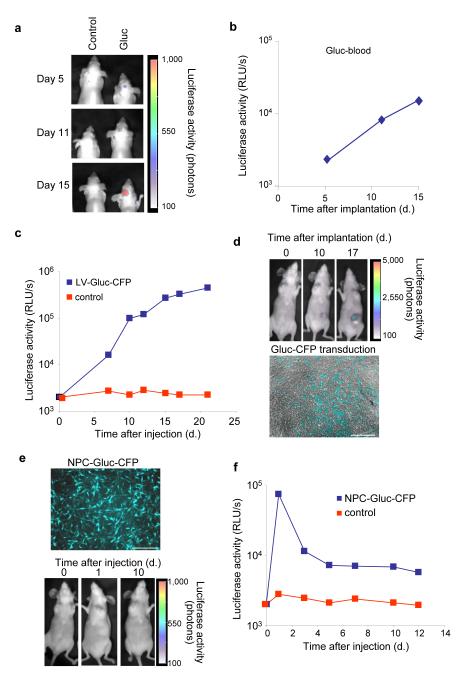
(a and b) 1×10⁵ Gli36-Gluc cells were implanted in the brains of nude mice (n=3/group) and tumor growth was monitored by in vivo bioluminescence imaging (a) or by measuring Gluc activity using the luminometer (b). (c and d) 1×10⁶ Gli36 cells were implanted subcutaneously and tumors were either injected with LV-Gluc-CFP or PBS, 3 days later. Viral delivery was monitored over time by measuring Gluc activity in blood samples (c), by in vivo bioluminescence imaging using the CCD camera (d, upper panel) and by monitoring CFP expression in tumor sections (d, lower panel). (e and f) One millions C17.2 NPCs expressing Gluc and CFP (e, upper panel) or PBS were injected i.v. in nude mice. Gluc activity was monitored over time using the CCD camera (e, lower panel) and in blood samples using the luminometer (f). Data shown are from a representative mouse from each set. Scale bar, 100 μm.
References
-
- Contag CH, Ross BD. It’s not just about anatomy: in vivo bioluminescence imaging as an eyepiece into biology. J Magn Reson Imaging. 2002;16:378–387. - PubMed
-
- Gross S, Piwnica-Worms D. Spying on cancer: molecular imaging in vivo with genetically encoded reporters. Cancer cell. 2005;7:5–15. - PubMed
-
- Negrin RS, Contag CH. In vivo imaging using bioluminescence: a tool for probing graft-versus-host disease. Nat Rev Immunol. 2006;6:484–490. - PubMed
-
- Adams JY, et al. Visualization of advanced human prostate cancer lesions in living mice by a targeted gene transfer vector and optical imaging. Nat Med. 2002;8:891–897. - PubMed
Publication types
MeSH terms
Substances
Grants and funding
LinkOut - more resources
Full Text Sources
Other Literature Sources
