. 2008 Mar;153(6):1259-71.
doi: 10.1038/sj.bjp.0707690. Epub 2008 Jan 21.

Methionine and its derivatives increase bladder excitability by inhibiting stretch-dependent K(+) channels

Affiliations

Methionine and its derivatives increase bladder excitability by inhibiting stretch-dependent K(+) channels

S A Baker et al. Br J Pharmacol. 2008 Mar.

Abstract

Background and purpose: During the bladder filling phase, the volume of the urinary bladder increases dramatically, with only minimal increases in intravesical pressure. To accomplish this, the smooth muscle of the bladder wall must remain relaxed during bladder filling. However, the mechanisms responsible for the stabilization of bladder excitability during stretch are unclear. We hypothesized that stretch-dependent K(+) (TREK) channels in bladder smooth muscle cells may inhibit contraction in response to stretch.

Experimental approaches: Bladder tissues from mouse, guinea pig and monkey were used for molecular, patch clamp, mechanical, electrical, Ca(2+) imaging and cystometric responses to methionine and its derivatives, which are putative blockers of stretch-dependent K(+) (SDK) channels.

Key results: SDK channels are functionally expressed in bladder myocytes. The single channel conductance of SDK channels is 89pS in symmetrical K(+) conditions and is blocked by L-methionine. Expressed TREK-1 currents are also inhibited by L-methioninol. All three types of bladder smooth muscle cells from mouse, guinea pig and monkey expressed TREK-1 genes. L-methionine, methioninol and methionine methyl ester but not D-methionine increased contractility in concentration-dependent manner. Methioninol further increased contractility and depolarized the membrane in the presence of blockers of Ca(2+)-activated K(+) conductance. L-methionine induced Ca(2+) waves that spread long distances through the tissue under stretched conditions and were associated with strong contractions. In cystometric assays, methioninol injection increased bladder excitability mimicking overactive bladder activity.

Conclusions and implications: Methioninol-sensitive K(+) (SDK, TREK-1) channels appear to be important to prevent spread of excitation through the syncitium during bladder filling.


Figures
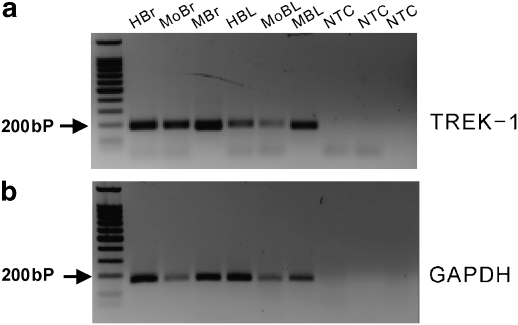
Figure 1
Figure 1
mRNA expression of TREK-1 in BSMs cells from mouse, monkey and human bladder. (a) Two per cent agarose/TAE gel showing results of PCR amplifications using probes specific for TREK-1. Lane 1 shows the molecular weight marker used to indicate the size of the PCR fragments. RT-PCR demonstrated the presence of TREK-1 in human brain (HBr, 191 bp), mouse brain (MoBr, 180 bp) and monkey brain (MBr, 191 bp) tissues. TREK-1 was also detected in smooth muscle cells in human bladder (HBL), mouse bladder (MoBL) and monkey bladder (MBL) using the same primers. Human primers were used for monkey tissues. Reverse transcription control on each RNA sample used a cDNA reaction as template for which the reverse transcriptase was not added (NTC), controlling for genomic DNA contamination in the source RNA. (b) GAPDH (170 bp) was used as an internal control to test for DNA contamination in the RNA preparations. BSM, bladder smooth muscle; GAPDH, glyceraldehyde-3-phosphate dehydrogenase; RT-PCR, reverse transcription-PCR; TREK, TWIK-related K+.
Figure 2
Figure 2
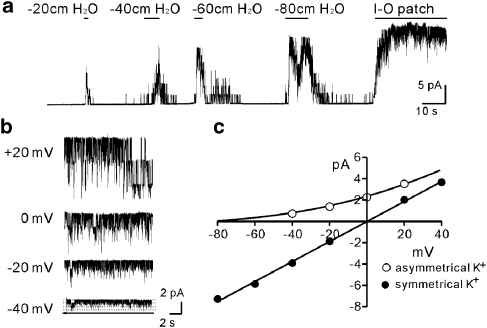
Negative pressure activated SDK channel in bladder myocytes. (a) Freshly dispersed bladder myocytes were exposed to pressures ranging from −20 to −80 cmH2O at holding potential of 0 mV in asymmetrical K+ gradient (5/140 mM). I-O patch denotes inside-out patch. (b) Representative traces in asymmetrical K+ gradient (5/140 mM) at various holding potentials from excised patches. Solid line denotes channel close and dotted line channel open. (c) The unitary current amplitude–voltage (I–V) plot of the single-channel conductance was well fitted by the Goldman–Hodgkin–Katz equation in asymmetrical K+ solutions and with linear regression in symmetrical K+ solutions. SDK, stretch-dependent K+ channel.
Figure 3
Figure 3
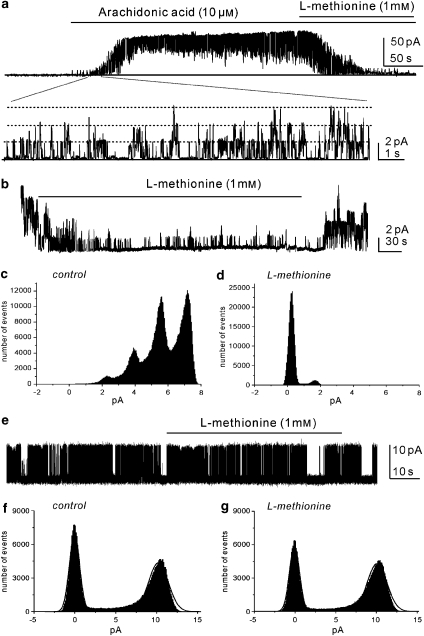
The effect of L-methionine on SDK and BK channels in excised patches. (a) Arachidonic acid increased the open probability of SDK channels and L-methionine decreased the open probability of SDK channels at 0 mV in asymmetrical K+ gradients. The lower panel in (a) shows responses on an extended time scale. Solid line denotes channel closed and dotted line denotes channel openings. (b) Excised patches revealed a high open probability of SDK channels and L-methionine (1 mM) decreased the open probability of SDK channels at 0 mV in asymmetrical K+ gradients. (c and d) The amplitude histogram was obtained from 1 min of channel recording before and after L-methionine. (e) Inside-out patches demonstrated the opening of BK channels at +20 mV in asymmetrical K+ gradients. (f and g) The representative amplitude histogram before and after L-methionine. BK, large-conductance Ca2+-activated K+ channel; SDK, stretch-dependent K+ channel.
Figure 4
Figure 4
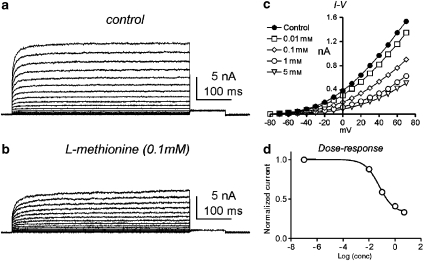
Concentration-dependent response of TREK-1 currents to L-methionine. (a) Representative TREK-1 currents were recorded from COS-7 cells. (b) L-methionine decreased TREK-1 currents. (c) I–V relationship of L-methionine on TREK-1 currents in various concentrations of L-methionine. (d) Dose–response relationship analysed from maximum currents at +70 mV of test potentials and fitted to a sigmoidal concentration–response function. TREK, TWIK-related K+.
Figure 5
Figure 5
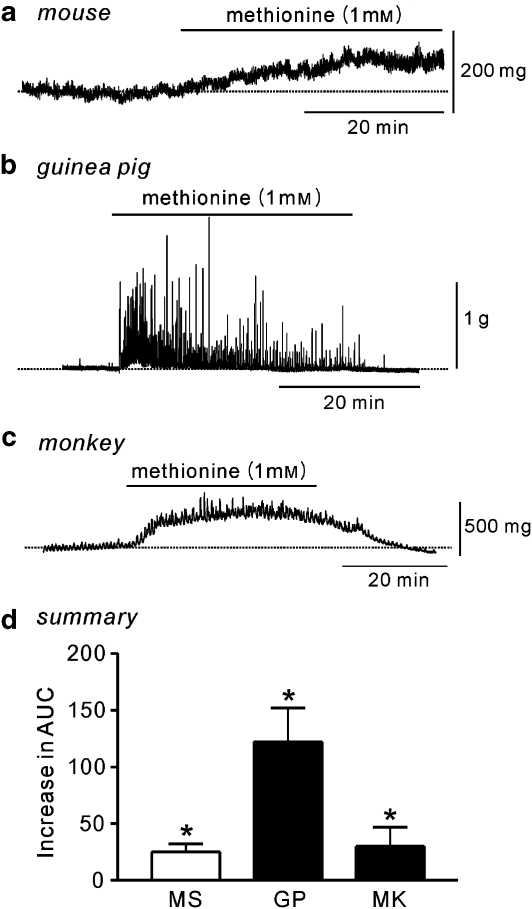
Effect of L-methionine on contractility of bladder strips. (a) Strips of murine bladder did not display spontaneous contractile activity. Addition of L-methionine (indicated by horizontal black bars) increased the tone. (b) Bladder strips from guinea pig showed spontaneous contractile activity that was greatly enhanced by L-methionine. (c) Bladder strips in monkey rarely showed spontaneous contractile activity. The application of L-methionine increased the tone, amplitude and frequency of contractions. (d) Summarized data show the mean increase in the AUC (mg·s) after L-methionine, compared to control, in mouse (MS), guinea pig (GP) and monkey (MK). All experiments were performed in the presence of tetrodotoxin (1 μM). *Significantly increased over control AUC (P<0.05, Student's t-test). AUC, area under the curve.
Figure 6
Figure 6
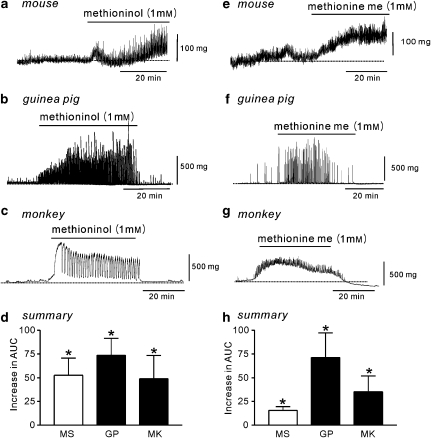
Effects of methioninol and methionine methyl ester on the mechanical activities of bladder strips. (ac) Methioninol increased contractility in strips of bladder in mouse, guinea pig and monkey (indicated by black bars). (d) Summarized data show the mean increase in the AUC (mg·s) after methioninol compared with control in mouse (MS), guinea pig (GP) and monkey (MK). (eg) Methionine methyl ester (methionine me) increased contractility in bladder strips from mouse, guinea pig and monkey. (h) Summarized data show mean increase in the AUC (mg·s) after methionine methyl ester compared with control in mouse (MS), guinea pig (GP) and monkey (MK). All experiments were performed in the presence of tetrodotoxin (1 μM). *Significantly increased over control AUC (P<0.05, Student's t-test). AUC, area under the curve.
Figure 7
Figure 7
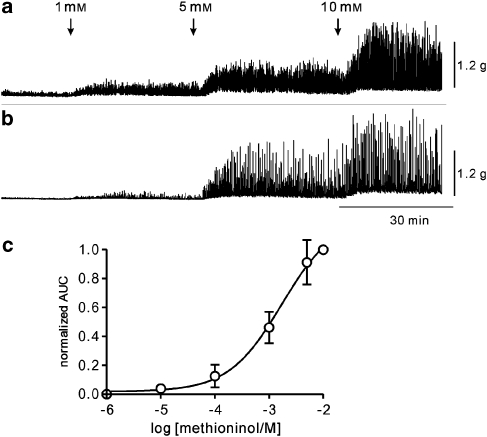
Effect of methioninol on murine bladder contractility. (a and b) Representative traces showing the effect of methioninol on bladder contractility in a concentration-dependent manner. (c) The AUC was normalized for the effects of methioninol (10 mM) and a concentration–response curve was fitted (Hill equation; n=6). AUC, area under the curve.
Figure 8
Figure 8
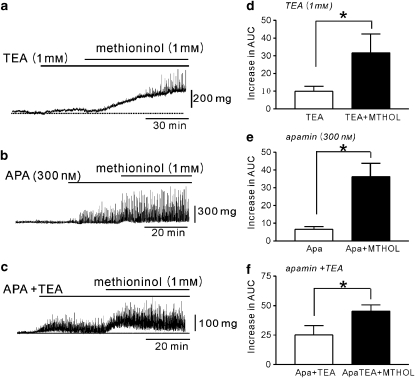
The effect of methioninol on bladder contractility in the presence of K+ channel blockers. (a) Tetraethyl ammonium (TEA) increased contractility in strips of murine bladder. The application of methioninol further increased contractility in the presence of TEA. (b) Apamin (APA) increased contractility in murine bladder strips. The application of methioninol further increased contractility in the presence of apamin. (c) The application of both TEA (10 mM) and apamin (APA, 300 nM) increased contractility in murine bladder strip. The application of methioninol further increased contractility in the presence of both blockers. (df) Summarized data show the mean increase in the AUC (mg·s) after methioninol (MTHOL) in the presence of TEA (d), apamin (Apa) (e) and both blockers (f). All experiments were performed in the presence of tetrodotoxin (1 μM). *Significant difference between means shown; P<0.05, Students' t-test. AUC, area under the curve.
Figure 9
Figure 9
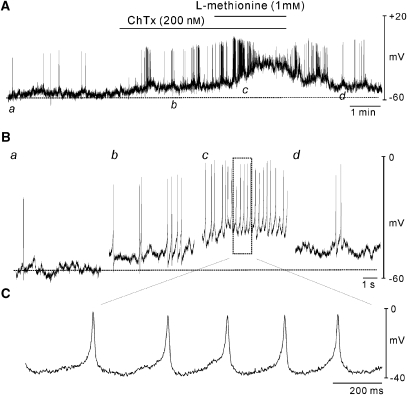
Effects of L-methionine on the membrane potential of murine BSM cells. (A) Intracellular microelectrode recordings were made from intact bladder muscle strips. Charybdotoxin (ChTx) induced depolarization. L-methionine caused further depolarization in the presence of ChTx. (B) Panels a–d: the lower traces (b and c) are expanded from (A). (C) L-methionine induced continuous firing of action potentials. Dashed lines in each panel denote membrane potentials under control conditions. BSM, bladder smooth muscle.
Figure 10
Figure 10
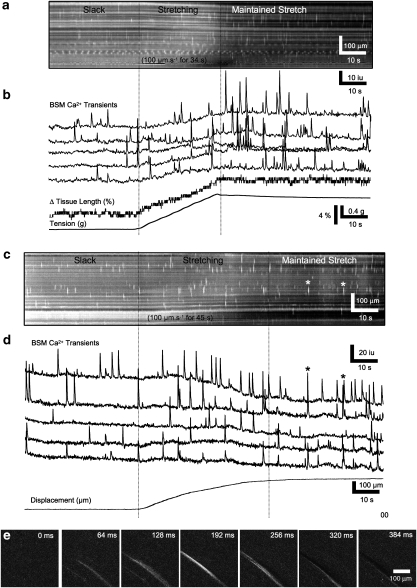
Effects of stretch on Ca2+ transients of murine BSM. (a) Shown a spatio-temporal map of Ca2+ transients in a flat-sheet preparation of bladder detrusor muscle during a stretch sequence. At a slack length, isolated individual firing of BSM cells prevailed (see individual Ca2+ transients from five cells in b). During active stretch, the pattern of firing did not change appreciably; however, when the active stretch was stopped and the length maintained, there appeared to be a brief period in which BSM firing was enhanced. (c) The response to stretch in the presence of TEA (1 mM) during which some Ca2+ transients appeared to propagate short distances (see asterisks). (d) Traces of individual BSM cells in TEA (1 mM). (e) Individual frames during a short propagating event (first asterisk in c). BSM, bladder smooth muscle; TEA, tetraethylammonium.
Figure 11
Figure 11
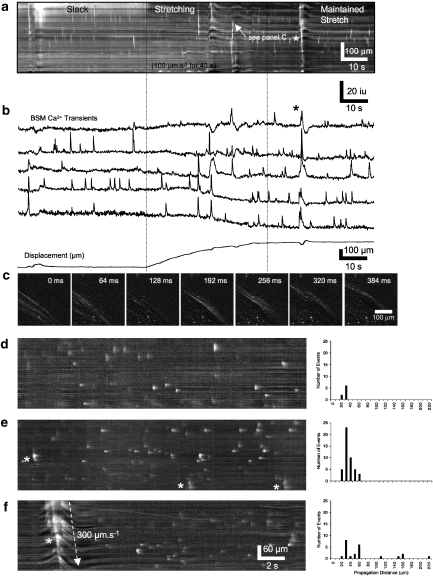
Effects of stretch on Ca2+ transients in the presence of L-methioninol. (a) A spatio-temporal map of Ca2+ activity in a flat-sheet preparation of bladder detrusor muscle during a stretch sequence in the presence of TEA (1 mM) and L-methioninol (1 mM). In addition to Ca2+ transients in individual BSM cells, during stretch, the frequency and distance of propagation of Ca2+ waves increased dramatically, often spreading across the entire field of view and were associated with large contractions of the tissue (see asterisk in panels a and b). An example of a propagating Ca2+ wave is shown in (c). (d) An example of Ca2+ transients during maintained stretch in control conditions. It was rare to see Ca2+ transients that appeared to propagate. In the presence of TEA during maintained stretch (e), occasional Ca2+ waves appear to propagate short distances (<4 cells; see asterisks in panel e); however, these events did not cause contraction of the tissue. (f) In the presence of TEA and L-methioninol, Ca2+ waves propagated large distances and were associated with considerable movements of the tissue (see asterisk in panel f). The number of events and the distance each Ca2+ propagated in each conditions are shown to the right of each spatio-temporal maps (de, n=4). BSM, bladder smooth muscle; TEA, tetraethylammonium.
Figure 12
Figure 12
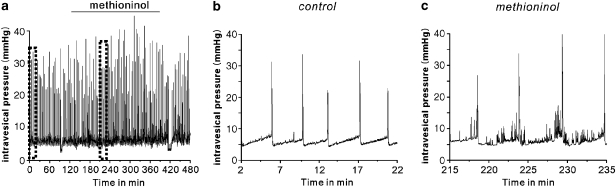
The effect of methioninol on cystometrograms in mice. (a) Long recordings of cystometrogram before and after methioninol (i.p., 2 mg g−1). (b and c) Cystometrogram displayed on an expanded time scale before and after methioninol, respectively. Representative trace from five experiments.

References

    1. Bayguinov O, Hagen B, Bonev AD, Nelson MT, Sanders KM. Intracellular calcium events activated by ATP in murine colonic myocytes. Am J Physiol Cell Physiol. 2000;279:C126–C135. - PubMed
    1. Brading AF. Ion channels and control of contractile activity in urinary bladder smooth muscle. Jpn J Pharmacol. 1992;58:120P–127P. - PubMed
    1. Brading AF. The pathophysiological changes in the bladder obstructed by benign prostatic hyperplasia. Br J Urol. 1994;74:133. - PubMed
    1. Dick GM, Bradley KK, Horowitz B, Hume JR, Sanders KM. Functional and molecular identification of a novel chloride conductance in canine colonic smooth muscle. Am J Physiol. 1998;275:C940–C950. - PubMed
    1. Farrugia G, Holm AN, Rich A, Sarr MG, Szurszewski JH, Rae JL. A mechanosensitive calcium channel in human intestinal smooth muscle cells. Gastroenterology. 1999;117:900–905. - PubMed

Publication types

MeSH terms