


Prospective, randomized evaluation of a personal digital assistant-based research tool in the emergency department
- PMID: 18205902
- PMCID: PMC2245927
- DOI: 10.1186/1472-6947-8-3
Prospective, randomized evaluation of a personal digital assistant-based research tool in the emergency department
Abstract
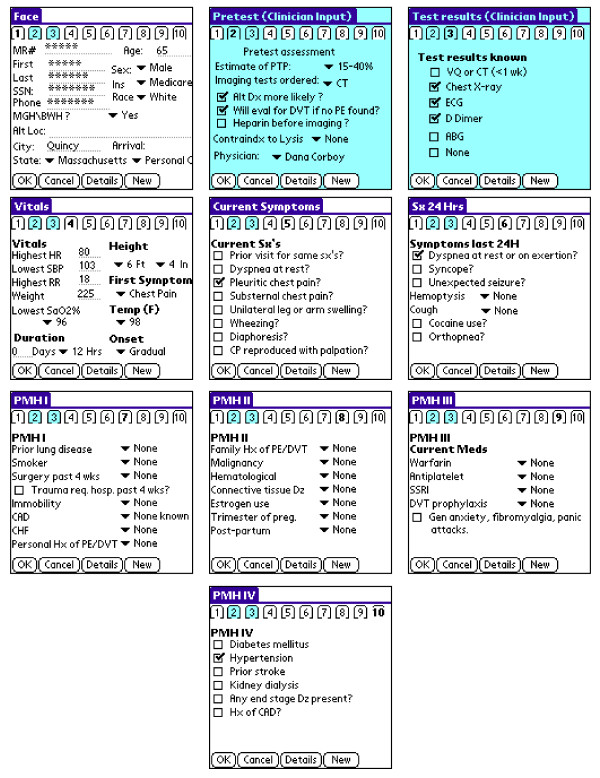
Background: Personal digital assistants (PDA) offer putative advantages over paper for collecting research data. However, there are no data prospectively comparing PDA and paper in the emergency department. The aim of this study was to prospectively compare the performance of PDA and paper enrollment instruments with respect to time required and errors generated.
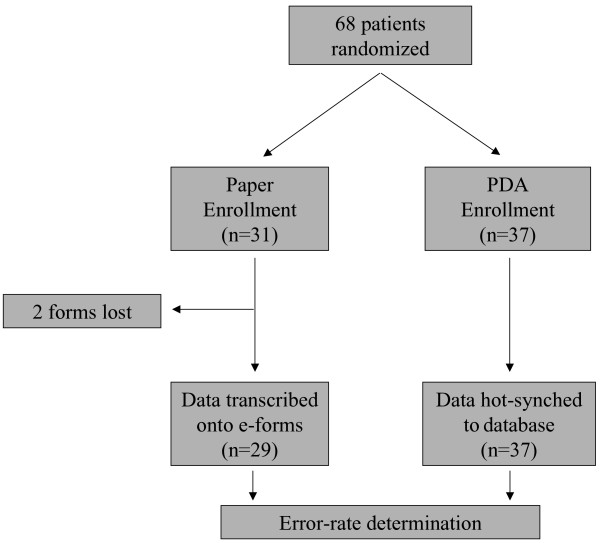
Methods: We randomized consecutive patients enrolled in an ongoing prospective study to having their data recorded either on a PDA or a paper data collection instrument. For each method, we recorded the total time required for enrollment, and the time required for manual transcription (paper) onto a computer database. We compared data error rates by examining missing data, nonsensical data, and errors made during the transcription of paper forms. Statistical comparisons were performed by Kruskal-Wallis and Poisson regression analyses for time and errors, respectively.
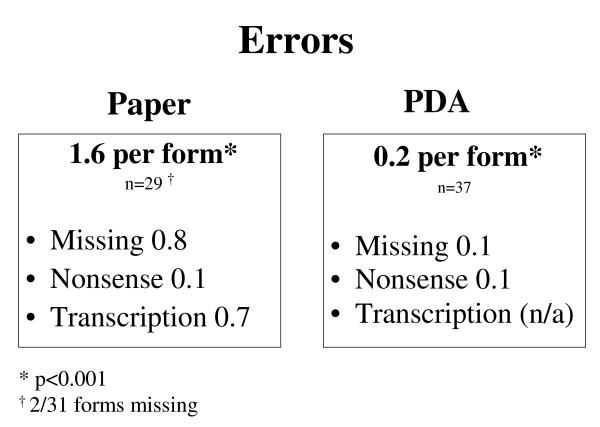
Results: We enrolled 68 patients (37 PDA, 31 paper). Two of 31 paper forms were not available for analysis. Total data gathering times, inclusive of transcription, were significantly less for PDA (6:13 min per patient) compared to paper (9:12 min per patient; p < 0.001). There were a total of 0.9 missing and nonsense errors per paper form compared to 0.2 errors per PDA form (p < 0.001). An additional 0.7 errors per paper form were generated during transcription. In total, there were 1.6 errors per paper form and 0.2 errors per PDA form (p < 0.001).
Conclusion: Using a PDA-based data collection instrument for clinical research reduces the time required for data gathering and significantly improves data integrity.
Figures
References
-
- Wilcox RA, La Tella RR. The personal digital assistant: a new medical instrument for the exchange of clinical information at the point of care. Med J Aust. 2001;175:659–662. - PubMed
-
- VanDenKerkhof EG, Goldstein DH, Lane J, Rimmer MJ, Van Dijk JP. Using a personal digital assistant enhances gathering of patient data on an acute pain management service: a pilot study. Can J Anesth. 2003;50:368–75. - PubMed
Publication types
MeSH terms
LinkOut - more resources
Full Text Sources
