


Immune evasion of natural killer cells by viruses
- PMID: 18206359
- PMCID: PMC2700287
- DOI: 10.1016/j.coi.2007.11.002
Immune evasion of natural killer cells by viruses
Abstract
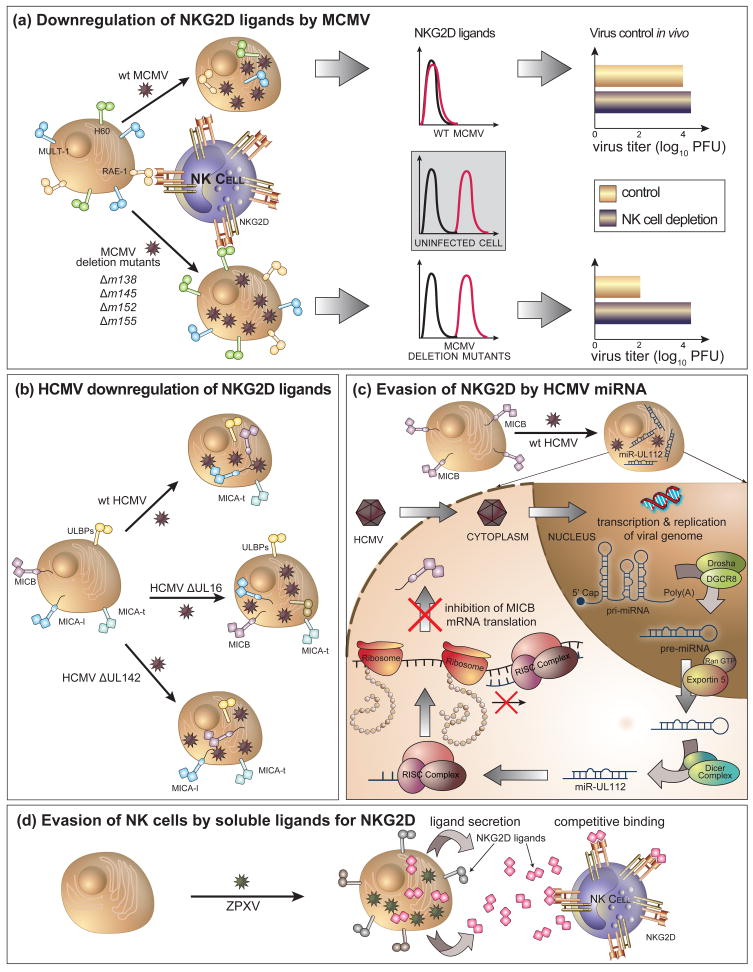
Natural killer (NK) cells are important in the host resistance to viral infections. They are among the first cells to sense the release of proinflammatory cytokines, as well as the downregulation of surface MHC class I molecules and molecules induced by viral invasion of cells. Various viral functions have evolved to counter NK cell responses illustrating the evolutionary struggles between viruses and NK cells. Ligands for NK cell receptors are primary targets for viral immunoevasion. In order to counteract NK cell activation via the 'missing self'-axis, viruses encode proteins which serve as ligands for inhibitory NK cell receptors. Viruses also downmodulate the ligands for the activating NK cell receptors and encode soluble ligands which block these receptors. In addition to viral immunoregulatory proteins, regulatory RNAs can also inhibit the expression of ligands for NK cell receptors. Improving our understanding of viral regulation of NK cell function could be essential for designing more efficient measures in the prophylaxis and treatment of virus-induced pathology.
Figures
References
-
- Degli-Esposti MA, Smyth MJ. Close encounters of different kinds. dendritic cells and NK cells take centre stage. Nat Rev Immunol. 2005;5:112–124. - PubMed
-
- Raulet DH. Natural Killer Cells. In: Paul WE, editor. Fundamental Immunology. 5. Lippincott Williams & Wilkins; 2003. pp. 365–391.
-
- Kirwan SE, Burshtyn DN. Regulation of natural killer cell activity. Curr Opin Immunol. 2007;19:46–54. - PubMed
-
- Yokoyama WM, Kim S. How do natural killer cells find self to achieve tolerance? Immunity. 2006;24:249–257. - PubMed
Publication types
MeSH terms
Substances
Grants and funding
LinkOut - more resources
Full Text Sources
Other Literature Sources
Medical
Research Materials
