


Regulatory roles of junctin in sarcoplasmic reticulum calcium cycling and myocardial function
- PMID: 18206802
- PMCID: PMC2593792
- DOI: 10.1016/j.tcm.2007.10.002
Regulatory roles of junctin in sarcoplasmic reticulum calcium cycling and myocardial function
Abstract
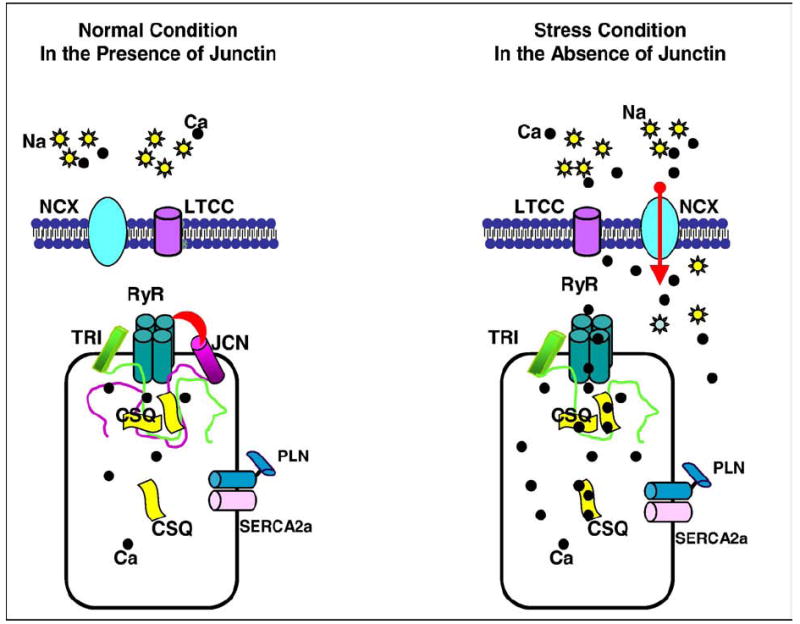
Junctin (JCN), a 26-kd sarcoplasmic reticulum (SR) transmembrane protein, forms a quaternary protein complex with the ryanodine receptor, calsequestrin, and triadin in the SR lumen of cardiac muscle. Within this complex, calsequestrin, triadin, and JCN appear to be critical for normal regulation of ryanodine receptor-mediated calcium (Ca) release. Junctin and triadin exhibit 60% to 70% amino acid homology in their transmembrane domains, including repeated KEKE motifs important for macromolecular protein-protein interactions within their SR luminal tails. Recent studies have uncovered functional roles of both JCN and triadin in the mouse heart, using transgenic overexpression strategies, which exhibit varying phenotypes including mild SR structural alterations, prolongation of Ca transient decay, impaired relaxation, and cardiac hypertrophy and/or heart failure. More specifically, both in vitro adenoviral gene transfer and in vivo gene-targeting techniques to manipulate JCN expression levels have shown that JCN is an essential factor in maintaining normal cardiac Ca handling and cardiac function. This article reviews the new findings on the regulatory roles of JCN in cardiac SR Ca cycling and contractility, with special emphasis on the effects of JCN ablation on delayed after depolarization-induced arrhythmias and premature mortality in mouse models.
Figures
References
-
- Bers DM, Pogwizd SM, Schlotthauer K. Upregulated Na/Ca exchange is involved in both contractile dysfunction and arrhythmogenesis in heart failure. Basic Res Cardiol. 2002;97:I36–I42. - PubMed
-
- Cheng H, Lederer MR, Lederer WJ, et al. Calcium sparks and [Ca2+]i waves in cardiac myocytes. Am J Physiol. 1996;270(1 Pt 1):C148–C159. - PubMed
-
- Dinchuk JE, Henderson NL, Burn TC, et al. Aspartyl beta-hydroxylase (Asph) and an evolutionarily conserved isoform of Asph missing the catalytic domain share exons with junctin. J Biol Chem. 2000;275:39543–39554. - PubMed
-
- Dinchuk JE, Focht RJ, Kelley JA, et al. Absence of post-translational aspartyl beta-hydroxylation of epidermal growth factor domains in mice leads to developmental defects and an increased incidence of intestinal neoplasia. J Biol Chem. 2002;277:12970–12977. - PubMed
-
- Di Barletta MR, Viatchenko-Karpinski S, Nori A, et al. Clinical phenotype and functional characterization of CASQ2 mutations associated with catecholaminergic polymorphic ventricular tachycardia. Circulation. 2006;114:1012–1019. - PubMed
Publication types
MeSH terms
Substances
Grants and funding
LinkOut - more resources
Full Text Sources
Research Materials
