Asymmetric centrosome behavior and the mechanisms of stem cell division
- PMID: 18209101
- PMCID: PMC2213579
- DOI: 10.1083/jcb.200707083
Asymmetric centrosome behavior and the mechanisms of stem cell division
Abstract
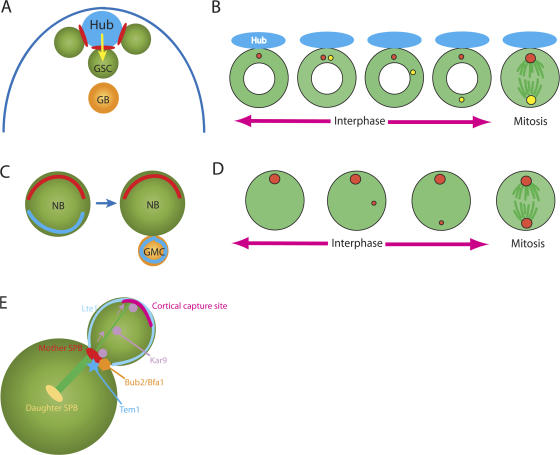
The ability of dividing cells to produce daughters with different fates is an important developmental mechanism conserved from bacteria to fungi, plants, and metazoan animals. Asymmetric outcomes of a cell division can be specified by two general mechanisms: asymmetric segregation of intrinsic fate determinants or asymmetric placement of daughter cells into microenvironments that provide extrinsic signals that direct cells to different states. For both, spindle orientation must be coordinated with the localization of intrinsic determinants or source of extrinsic signals to achieve the proper asymmetric outcome. Recent work on spindle orientation in Drosophila melanogaster male germline stem cells and neuroblasts has brought into sharp focus the key role of differential centrosome behavior in developmentally programmed asymmetric division (for reviews see Cabernard, C., and C.Q. Doe. 2007. Curr. Biol. 17:R465-R467; Gonzalez, C. 2007. Nat. Rev. Genet. 8:462-472). These findings provide new insights and suggest intriguing new models for how cells coordinate spindle orientation with their cellular microenvironment to regulate and direct cell fate decisions within tissues.
Figures
Comment in
-
Cell biology of stem cells: an enigma of asymmetry and self-renewal.J Cell Biol. 2008 Jan 28;180(2):257-60. doi: 10.1083/jcb.200712159. J Cell Biol. 2008. PMID: 18227277 Free PMC article.
References
-
- Bienz, M. 2001. Spindles cotton on to junctions, APC and EB1. Nat. Cell Biol. 3:E67–E68. - PubMed
-
- Cabernard, C., and C.Q. Doe. 2007. Stem cell self-renewal: centrosomes on the move. Curr. Biol. 17:R465–R467. - PubMed
-
- Chen, D., and D. McKearin. 2003. a. Dpp signaling silences bam transcription directly to establish asymmetric divisions of germline stem cells. Curr. Biol. 13:1786–1791. - PubMed
-
- Chen, D., and D.M. McKearin. 2003. b. A discrete transcriptional silencer in the bam gene determines asymmetric division of the Drosophila germline stem cell. Development. 130:1159–1170. - PubMed
-
- Delattre, M., and P. Gonczy. 2004. The arithmetic of centrosome biogenesis. J. Cell Sci. 117:1619–1630. - PubMed
Publication types
MeSH terms
Grants and funding
LinkOut - more resources
Full Text Sources
Medical
Molecular Biology Databases