


Associations of endogenous sex hormones with the vasculature in menopausal women: the Study of Women's Health Across the Nation (SWAN)
- PMID: 18209686
- PMCID: PMC2874195
- DOI: 10.1097/gme.0b013e318154b6f5
Associations of endogenous sex hormones with the vasculature in menopausal women: the Study of Women's Health Across the Nation (SWAN)
Abstract
Objective: As associations between endogenous sex hormones and the vasculature are not well characterized, the objective was to examine the cross-sectional associations of menopausal status and endogenous sex hormones with vascular characteristics.
Design: Common carotid artery adventitial diameter and intima-media thickness were determined using B-mode ultrasonography among 483 middle-aged women enrolled in the Pittsburgh and Chicago sites of the Study of Women's Health Across the Nation.
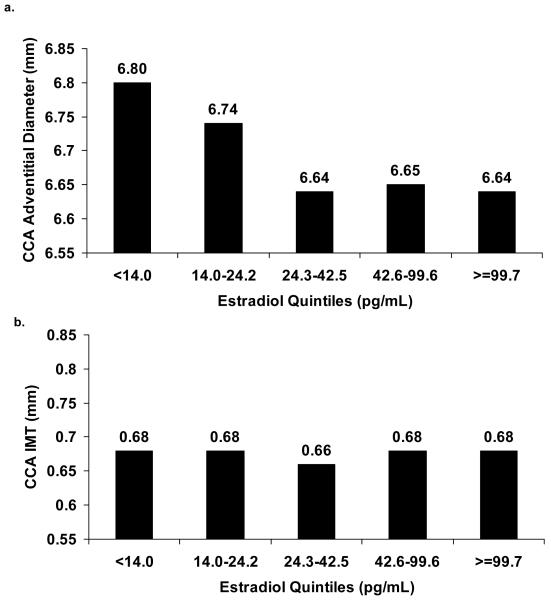
Results: Sixty-two percent of women were pre- or early perimenopausal (<3 mo amenorrhea), 12% were late perimenopausal (3-12 mo amenorrhea), and 27% were postmenopausal (>or=12 mo amenorrhea). After adjustment for age, compared with pre-/early perimenopause, late perimenopause was associated with a 0.28-mm larger adventitial diameter (P=0.001), whereas postmenopause was associated with a 0.15-mm larger adventitial diameter (P=0.040). Adjustment for traditional cardiovascular risk factors slightly attenuated these associations, but the association with late perimenopause remained statistically significant (P=0.001). Each SD lower log estradiol value was associated with a 0.07-mm larger adventitial diameter after adjustment for traditional cardiovascular risk factors (P=0.023), whereas other endogenous hormones showed no associations. Intima-media thickness values were not significantly associated with menopausal status or endogenous sex hormones after adjustment for age.
Conclusions: The menopausal transition and declining estrogen levels are associated with alterations of the peripheral vasculature, which may help to explain the increased risk of cardiovascular disease with postmenopause.
Figures
Comment in
-
Endogenous sex hormones and subclinical atherosclerosis.Menopause. 2008 May-Jun;15(3):405-6. doi: 10.1097/gme.0b013e31816be9b0. Menopause. 2008. PMID: 18340279 No abstract available.
References
-
- Kannel WB, Hjortland MC, McNamara PM, Gordon T. Menopause and risk of cardiovascular disease: the Framingham study. Ann Intern Med. 1976;85:447–452. - PubMed
-
- Colditz GA, Willett WC, Stampfer MJ, Rosner B, Speizer FE, Hennekens CH. Menopause and the risk of coronary heart disease in women. N Engl J Med. 1987;316:1105–1110. - PubMed
-
- Hulley S, Grady D, Bush T, et al. Heart and Estrogen/progestin Replacement Study (HERS) Research Group Randomized trial of estrogen plus progestin for secondary prevention of coronary heart disease in postmenopausal women. JAMA. 1998;280:605–613. - PubMed
-
- Rossouw JE, Anderson GL, Prentice RL, et al. Risks and benefits of estrogen plus progestin in healthy postmenopausal women: principal results From the Women’s Health Initiative randomized controlled trial. JAMA. 2002;288:321–333. - PubMed
-
- Harman SM, Brinton EA, Clarkson T, et al. Is the WHI relevant to HRT started in the perimenopause? Endocrine. 2004;24:195–202. - PubMed
Publication types
MeSH terms
Substances
Grants and funding
- AG012553/AG/NIA NIH HHS/United States
- R01 HL065591/HL/NHLBI NIH HHS/United States
- R01 HL065581/HL/NHLBI NIH HHS/United States
- AG012554/AG/NIA NIH HHS/United States
- K12 HD043451/HD/NICHD NIH HHS/United States
- AG012539/AG/NIA NIH HHS/United States
- AG012531/AG/NIA NIH HHS/United States
- U01 AG012495/AG/NIA NIH HHS/United States
- HL065591/HL/NHLBI NIH HHS/United States
- AG012546/AG/NIA NIH HHS/United States
- NR004061/NR/NINR NIH HHS/United States
- U01 AG012554/AG/NIA NIH HHS/United States
- U01 AG012535/AG/NIA NIH HHS/United States
- U01 AG012553/AG/NIA NIH HHS/United States
- U01 NR004061/NR/NINR NIH HHS/United States
- U01 AG012539/AG/NIA NIH HHS/United States
- AG012495/AG/NIA NIH HHS/United States
- U01 AG012546/AG/NIA NIH HHS/United States
- U01 AG012505/AG/NIA NIH HHS/United States
- HL065581/HL/NHLBI NIH HHS/United States
- U01 AG012531/AG/NIA NIH HHS/United States
- AG012505/AG/NIA NIH HHS/United States
- AG012535/AG/NIA NIH HHS/United States
- K12 HD43451/HD/NICHD NIH HHS/United States
LinkOut - more resources
Full Text Sources
Medical
Research Materials
