. 2008 Jan 22:6:3.
doi: 10.1186/1477-7827-6-3.

Calcitriol affects hCG gene transcription in cultured human syncytiotrophoblasts

Affiliations

Calcitriol affects hCG gene transcription in cultured human syncytiotrophoblasts

David Barrera et al. Reprod Biol Endocrinol. .

Abstract

Background: In pregnancy, maternal serum concentrations of calcitriol significantly rise as a result of increased renal and placental contribution in order to assure calcium supply for the developing fetus. Considering that placenta is a site for vitamin D activation, and the versatility and potency of calcitriol, it is feasible that this hormone participates in fetal/placental development and physiology. In the present work we studied calcitriol actions upon human chorionic gonadotropin (hCG) secretion and expression in cultured trophoblasts, as well as vitamin D receptor (VDR) and CYP27B1 immunolocalization in placental villi.

Methods: Quantification of hCG in culture media was performed by immunoassay. Expression studies were carried out by real time PCR. Analysis of CYP27B1 and VDR localization in placental slides were performed by immunohistochemistry. Statistical significance was established by one way ANOVA using Tukey test for comparisons.

Results: Calcitriol regulated hCG in a time-dependent manner: at 6 h the secosteroid stimulated hCG, whereas longer incubations (24 h) showed opposite effects. Interestingly, calcitriol stimulatory effects on hCG were accompanied by an increase in intracellular cAMP content and were abolished by pre-incubation of the cells with a selective protein kinase A inhibitor. Immunohistochemical techniques showed differential VDR localization in the syncytiotrophoblast layer or in the vascular smooth muscle cells depending on the epitope to which the antibodies were raised (specific for the carboxy- or amino-terminal regions, respectively). CYP27B1 was immunolocalized in the syncytiotrophoblast layer of placental villi.

Conclusion: The presence and location of the vitamin D activating enzyme CYP27B1 as well as the specific receptor for vitamin D were shown in placental sections. The latter, together with findings demonstrating specific effects of calcitriol acting through the VDR and the cAMP/PKA signaling pathway upon hCG expression and secretion, indicate that there is a functional vitamin D endocrine system in the placenta, and recognize calcitriol as an autocrine regulator of hCG.


Figures
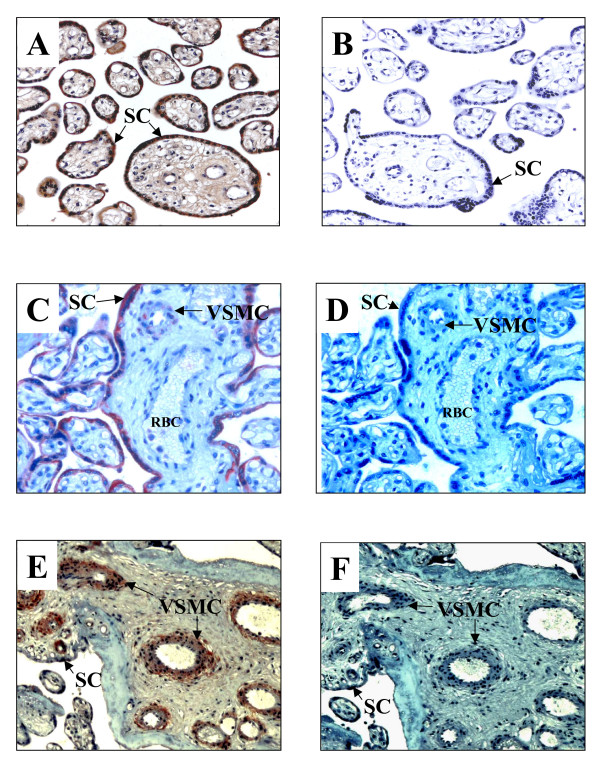
Figure 1
Figure 1
Immunolocalization of CYP27B1 and VDR in placental chorionic villi. Placental sections were incubated with specific antibodies in order to localize important components of the vitamin D endocrine system. CYP27B1 protein was located in the syncytiotrophoblast layer (A). The use of anti N-terminus VDR specific antibody disclosed intense immunostaining in the VSMC (E), whereas a VDR-C-terminus antibody preferentially stained the syncytiotrophoblast layer (C). Figure shows representative pictures of 5 different placentas. Negative controls in the absence of first antibodies are shown in B, D and F. SC = syncytiotrophoblast layer, VSMC = vascular smooth muscle cells, RBC = red blood cells. (200×).
Figure 2
Figure 2
Temporal pattern of hCG secretion (A) and expression (B) in cultured human trophoblasts. Cytotrophoblasts were plated in the absence (●) or presence (▲) of 8-Br-cAMP (1.5 mM). Two scale bars were used in order to show all data [stimulated (▲) vs. non stimulated (●)] in the same graphic. Media was changed every day. A) Secretion of hCG in culture media was measured daily and results were expressed as mIU/mg protein. B) Real time PCR analysis of hCGβ expression in different culture days. Results were normalized against GAPDH mRNA. Vehicle data were arbitrarily given a value of 1. Basal hCG secretion and expression increased significantly compared with day 1. Note that hCGβ mRNA increased considerably on day 2 in the presence of 8-Br-cAMP (B), which was reflected on hCG secretion on day 3 (A), showing an important protein synthesis activity between day 2 and 3 of the cell culture. Data are presented as the mean ± S.D. of three different cell cultures. *P < 0.05 vs. day 1; **P < 0.05 vs. control.
Figure 3
Figure 3
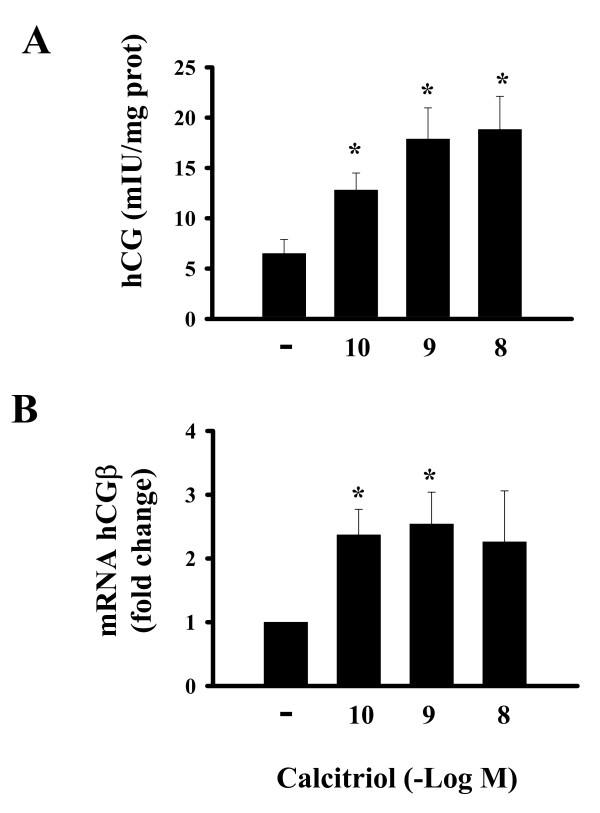
Stimulatory effects of calcitriol on hCG secretion and gene expression in cultured syncytiotrophoblasts. A) Hormone secretion was determined by EIA after 6 hours incubation in the presence of increasing concentrations of calcitriol or its vehicle (-). B) Real time PCR analysis of hCGβ gene expression of calcitriol-treated cells. Results were normalized against GAPDH mRNA. Vehicle data were arbitrarily given a value of 1. Each bar represents the mean ± S.D. of triplicate cultures. *P < 0.05 vs. control.
Figure 4
Figure 4
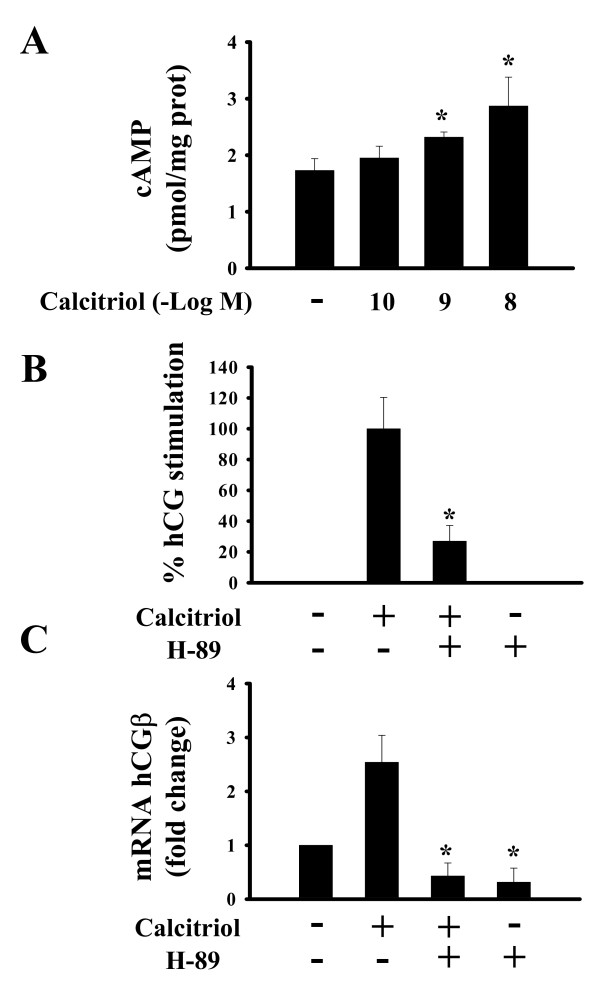
Calcitriol stimulatory effects on hCG involve cAMP. A) Dose-dependent effects of calcitriol upon intracellular cAMP. Quantification of intracellular cAMP was determined by RIA after 10 minutes incubation in the presence of increasing concentrations of calcitriol or the vehicle (-). Effects of H-89 (a selective PKA inhibitor) upon calcitriol-dependent stimulation of hCG secretion and gene expression are shown in B and C, respectively. B and C) Cells were incubated with calcitriol (1 × 10⁻⁹ M) in the presence or absence of H-89 (5 μM) during 6 hours. In panel B, calcitriol incubations in the absence of H-89 represent 100% stimulation. In panel C results were normalized against GAPDH mRNA, giving vehicle data an arbitrarily value of 1. Each bar represents the mean ± S.D. of triplicate experiments. *P < 0.05 vs. control.
Figure 5
Figure 5
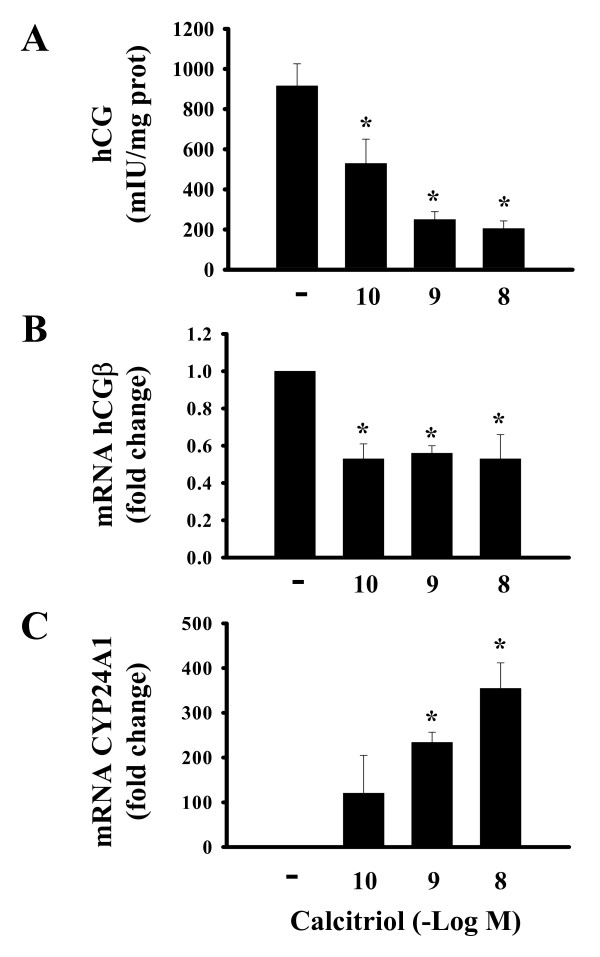
Long-term inhibitory effects of calcitriol on placental hCG. A) hCG concentration in culture medium was determined after 2 days incubation in the presence of increasing concentrations of calcitriol or the vehicle alone (-). B) Real time PCR analysis of hCGβ gene expression in calcitriol-treated cells after 24 h. Results were normalized against GAPDH mRNA, vehicle data were arbitrarily given a value of 1. C) CYP24A1 mRNA induction by calcitriol after 24 h. Results were normalized against GAPDH mRNA. Vehicle data were arbitrarily given a value of 1. The inhibitory effects of calcitriol upon hCG gene expression detected after 24 h (B) were reflected in a reduction of secreted hCG after 48 h (A). These effects were not due to a toxic effect of calcitriol since cells showed increased CYP24A1 gene expression, as expected (C). Each bar represents the mean ± S.D. of triplicate experiments. *P < 0.05 vs. control.

References

    1. Dusso AS, Brown AJ, Slatopolsky E. Vitamin D. Am J Physiol Renal Physiol. 2005;289:F8–28. doi: 10.1152/ajprenal.00336.2004. - DOI - PubMed
    1. Avila E, Diaz L, Halhali A, Larrea F. Regulation of 25-hydroxyvitamin D3 1alpha-hydroxylase, 1,25-dihydroxyvitamin D3 24-hydroxylase and vitamin D receptor gene expression by 8-bromo cyclic AMP in cultured human syncytiotrophoblast cells. J Steroid Biochem Mol Biol. 2004;89–90:115–119. doi: 10.1016/j.jsbmb.2004.03.090. - DOI - PubMed
    1. Diaz L, Sanchez I, Avila E, Halhali A, Vilchis F, Larrea F. Identification of a 25-hydroxyvitamin D3 1alpha-hydroxylase gene transcription product in cultures of human syncytiotrophoblast cells. J Clin Endocrinol Metab. 2000;85:2543–2549. doi: 10.1210/jc.85.7.2543. - DOI - PubMed
    1. Halhali A, Acker GM, Garabedian M. 1,25-Dihydroxyvitamin D3 induces in vivo the decidualization of rat endometrial cells. J Reprod Fertil. 1991;91:59–64. - PubMed
    1. Du H, Daftary GS, Lalwani SI, Taylor HS. Direct regulation of HOXA10 by 1,25-(OH)2D3 in human myelomonocytic cells and human endometrial stromal cells. Mol Endocrinol. 2005;19:2222–2233. doi: 10.1210/me.2004-0336. - DOI - PubMed

Publication types

MeSH terms

LinkOut - more resources