


Inhibition of human immunodeficiency virus type 1 replication in human cells by Debio-025, a novel cyclophilin binding agent
- PMID: 18212100
- PMCID: PMC2292519
- DOI: 10.1128/AAC.01324-07
Inhibition of human immunodeficiency virus type 1 replication in human cells by Debio-025, a novel cyclophilin binding agent
Abstract
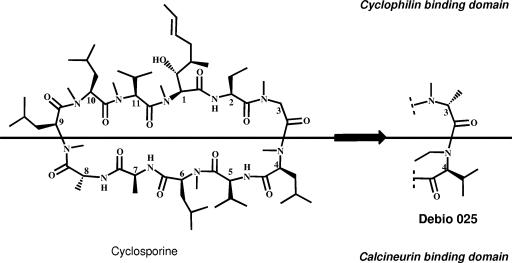
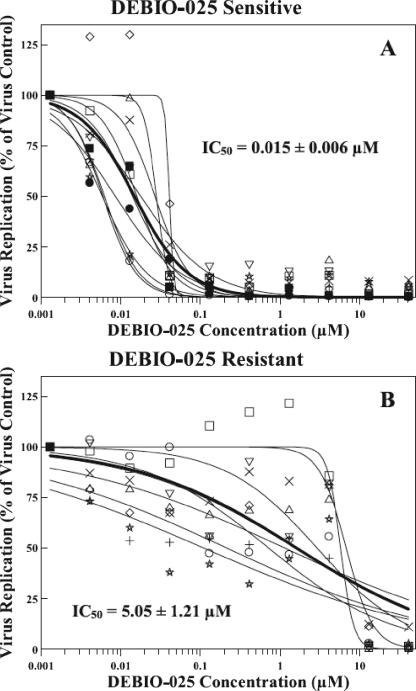
Debio-025 is a synthetic cyclosporine with no immunosuppressive capacity but a high inhibitory potency against cyclophilin A (CypA)-associated cis-trans prolyl isomerase (PPIase) activity. A lack of immunosuppressive effects compared to that of cyclosporine was demonstrated both in vitro and in vivo. For three cyclosporines, the inhibitory potential against PPIase activity was quantitatively correlated with that against human immunodeficiency virus type 1 (HIV-1) replication. Debio-025 selectively inhibited the replication of HIV-1 in a CD4+ cell line and in peripheral blood mononuclear cells: potent activity was demonstrated against clinical isolates of various HIV-1 subtypes, including isolates with multidrug resistance to reverse transcriptase and protease inhibitors. Simian immunodeficiency virus and HIV-2 strains were generally resistant to inhibition by Debio-025; however, some notable exceptions of sensitive HIV-2 clinical isolates were detected. In two-drug combination studies, additive inhibitory effects were found between Debio-025 and 19 clinically used drugs of different classes. Clinical HIV-1 isolates that are naturally resistant to Debio-025 and that do not depend on CypA for infection were identified. Comparison of the amino acid sequences of the CypA binding domain of the capsid (CA) protein from Debio-025-sensitive and -resistant HIV-1 isolates indicated that resistance was mostly associated with an H87Q/P exchange. Mechanistically, cyclosporines competitively inhibit the binding of CypA to the HIV-1 CA protein, which is an essential interaction required for early steps in HIV-1 replication. By real-time PCR we demonstrated that early reverse transcription is reduced in the presence of Debio-025 and that late reverse transcription is almost completely blocked. Thus, Debio-025 seems to interfere with the function of CypA during the progression/completion of HIV-1 reverse transcription.
Figures

References
-
- Andrei, G., R. Snoeck, J. Piette, P. Delvenne, and E. De Clercq. 1998. Antiproliferative effects of acyclic nucleoside phosphonates on human papillomavirus (HPV)-harboring cell lines compared with HPV-negative cell lines. Oncol. Res. 10:523-531. - PubMed
-
- Andrieu, J. M., P. Even, and A. Venet. 1986. AIDS and related syndromes as a viral-induced autoimmune disease of the immune system: an anti-MHC II disorder. Therapeutic implications. AIDS Res. 2:163-174. - PubMed
-
- Balzarini, J., E. Keyaerts, L. Vijgen, H. Egberink, E. De Clercq, M. Van Ranst, S. S. Printsevskaya, E. N. Olsufyeva, S. E. Solovieva, and M. N. Preobrazhenskaya. 2006. Inhibition of feline (FIPV) and human (SARS) coronavirus by semisynthetic derivatives of glycopeptide antibiotics. Antivir. Res. 72:20-33. - PMC - PubMed
Publication types
MeSH terms
Substances
Grants and funding
LinkOut - more resources
Full Text Sources
Other Literature Sources
Chemical Information
Research Materials
