


Full genome-based classification of rotaviruses reveals a common origin between human Wa-Like and porcine rotavirus strains and human DS-1-like and bovine rotavirus strains
- PMID: 18216098
- PMCID: PMC2268446
- DOI: 10.1128/JVI.02257-07
Full genome-based classification of rotaviruses reveals a common origin between human Wa-Like and porcine rotavirus strains and human DS-1-like and bovine rotavirus strains
Abstract
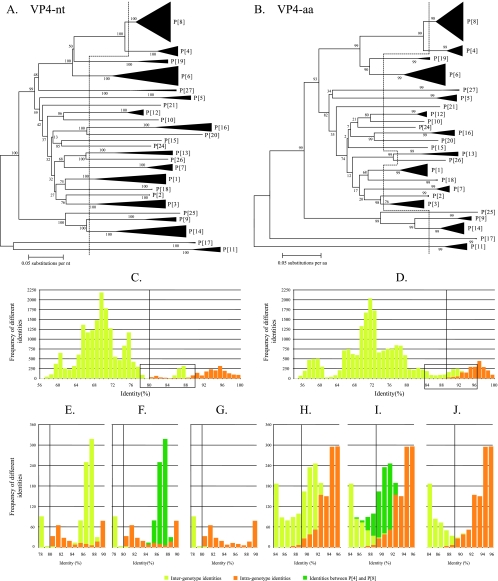
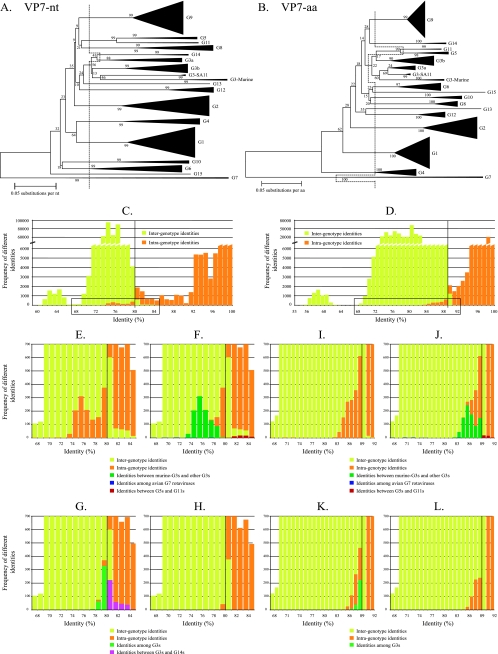
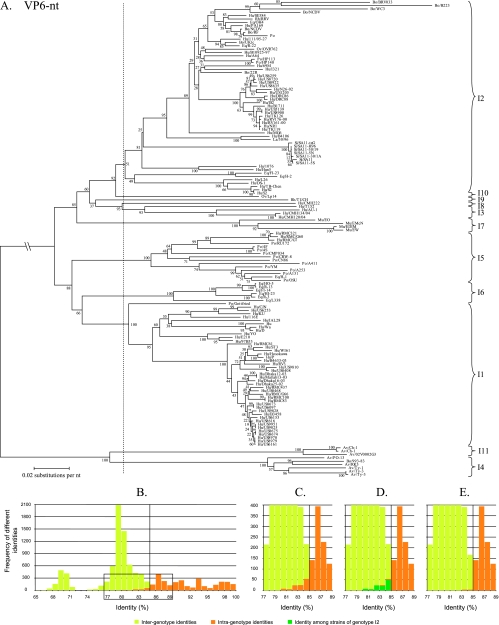
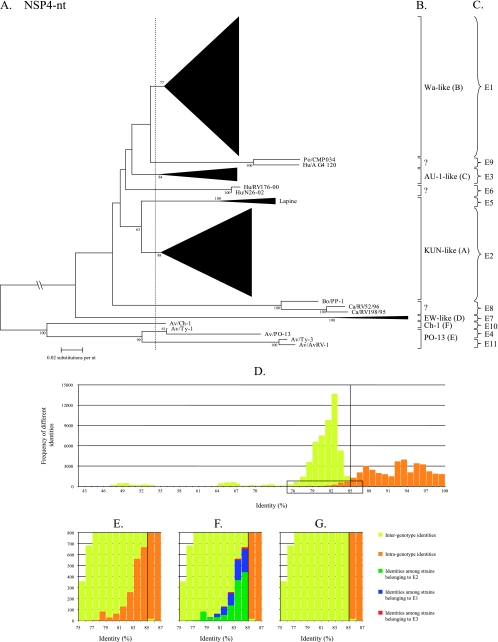
Group A rotavirus classification is currently based on the molecular properties of the two outer layer proteins, VP7 and VP4, and the middle layer protein, VP6. As reassortment of all the 11 rotavirus gene segments plays a key role in generating rotavirus diversity in nature, a classification system that is based on all the rotavirus gene segments is desirable for determining which genes influence rotavirus host range restriction, replication, and virulence, as well as for studying rotavirus epidemiology and evolution. Toward establishing such a classification system, gene sequences encoding VP1 to VP3, VP6, and NSP1 to NSP5 were determined for human and animal rotavirus strains belonging to different G and P genotypes in addition to those available in databases, and they were used to define phylogenetic relationships among all rotavirus genes. Based on these phylogenetic analyses, appropriate identity cutoff values were determined for each gene. For the VP4 gene, a nucleotide identity cutoff value of 80% completely correlated with the 27 established P genotypes. For the VP7 gene, a nucleotide identity cutoff value of 80% largely coincided with the established G genotypes but identified four additional distinct genotypes comprised of murine or avian rotavirus strains. Phylogenetic analyses of the VP1 to VP3, VP6, and NSP1 to NSP5 genes showed the existence of 4, 5, 6, 11, 14, 5, 7, 11, and 6 genotypes, respectively, based on nucleotide identity cutoff values of 83%, 84%, 81%, 85%, 79%, 85%, 85%, 85%, and 91%, respectively. In accordance with these data, a revised nomenclature of rotavirus strains is proposed. The novel classification system allows the identification of (i) distinct genotypes, which probably followed separate evolutionary paths; (ii) interspecies transmissions and a plethora of reassortment events; and (iii) certain gene constellations that revealed (a) a common origin between human Wa-like rotavirus strains and porcine rotavirus strains and (b) a common origin between human DS-1-like rotavirus strains and bovine rotaviruses. These close evolutionary links between human and animal rotaviruses emphasize the need for close simultaneous monitoring of rotaviruses in animals and humans.
Figures
References
-
- Altschul, S. F., W. Gish, W. Miller, E. W. Myers, and D. J. Lipman. 1990. Basic local alignment search tool. J. Mol. Biol. 215403-410. - PubMed
-
- Ball, L. A. 2005. The universal taxonomy of viruses in theory and practice, p. 3-8. In C. M. Fauquet, M. A. Mayo, J. Maniloff, U. Desselberger, and L. A. Ball (ed.), Virus taxonomy. Eighth report of the International Committee on Taxonomy of Viruses. Elsevier, Amsterdam, The Netherlands.
-
- Both, G. W., A. R. Bellamy, and D. B. Mitchell. 1994. Rotavirus protein structure and function. Curr. Top. Microbiol. Immunol. 18567-105. - PubMed
-
- Ciarlet, M., M. E. Conner, and M. K. Estes. 2003. The rat model of rotavirus infection, p. 291-306. In J. Gray and U. Desselberger (ed.), Perspectives in medical virology: viral gastroenteritis. Elsevier Science BV, Amsterdam, The Netherlands.
-
- Ciarlet, M., and M. K. Estes. 2002. Rotaviruses: basic biology, epidemiology and methodologies, p. 2573-2773. In G. Britton (ed.), Encyclopedia of environmental microbiology. John Wiley and Sons, New York, NY.
Publication types
MeSH terms
Substances
Grants and funding
LinkOut - more resources
Full Text Sources
Other Literature Sources
Research Materials
