


The evolution of gene collectives: How natural selection drives chemical innovation
- PMID: 18216259
- PMCID: PMC2290807
- DOI: 10.1073/pnas.0709132105
The evolution of gene collectives: How natural selection drives chemical innovation
Erratum in
- Proc Natl Acad Sci U S A. 2009 Feb 3;106(5):1679
Abstract
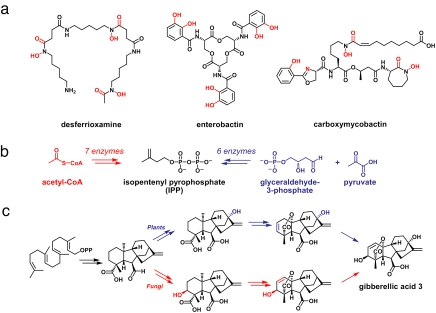
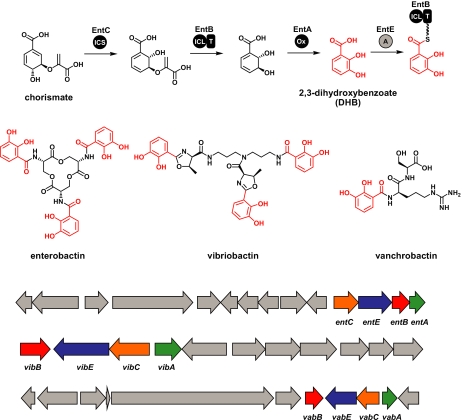
DNA sequencing has become central to the study of evolution. Comparing the sequences of individual genes from a variety of organisms has revolutionized our understanding of how single genes evolve, but the challenge of analyzing polygenic phenotypes has complicated efforts to study how genes evolve when they are part of a group that functions collectively. We suggest that biosynthetic gene clusters from microbes are ideal candidates for the evolutionary study of gene collectives; these selfish genetic elements evolve rapidly, they usually comprise a complete pathway, and they have a phenotype-a small molecule-that is easy to identify and assay. Because these elements are transferred horizontally as well as vertically, they also provide an opportunity to study the effects of horizontal transmission on gene evolution. We discuss known examples to begin addressing two fundamental questions about the evolution of biosynthetic gene clusters: How do they propagate by horizontal transfer? How do they change to create new molecules?
Conflict of interest statement
The authors declare no conflict of interest.
Figures
References
-
- Hanson JR. Natural Products: The Secondary Metabolites. Cambridge, UK: R Soc of Chem; 2003.
Publication types
MeSH terms
Grants and funding
LinkOut - more resources
Full Text Sources
Other Literature Sources
