


Review
doi: 10.3201/eid1311.061093.
Conflict and emerging infectious diseases
Affiliations
- PMID: 18217543
- PMCID: PMC3375795
- DOI: 10.3201/eid1311.061093
Item in Clipboard
Review
Conflict and emerging infectious diseases
Emerg Infect Dis.
2007 Nov.
Abstract
Detection and control of emerging infectious diseases in conflict situations are major challenges due to multiple risk factors known to enhance emergence and transmission of infectious diseases. These include inadequate surveillance and response systems, destroyed infrastructure, collapsed health systems and disruption of disease control programs, and infection control practices even more inadequate than those in resource-poor settings, as well as ongoing insecurity and poor coordination among humanitarian agencies. This article outlines factors that potentiate emergence and transmission of infectious diseases in conflict situations and highlights several priority actions for their containment and control.
Figures
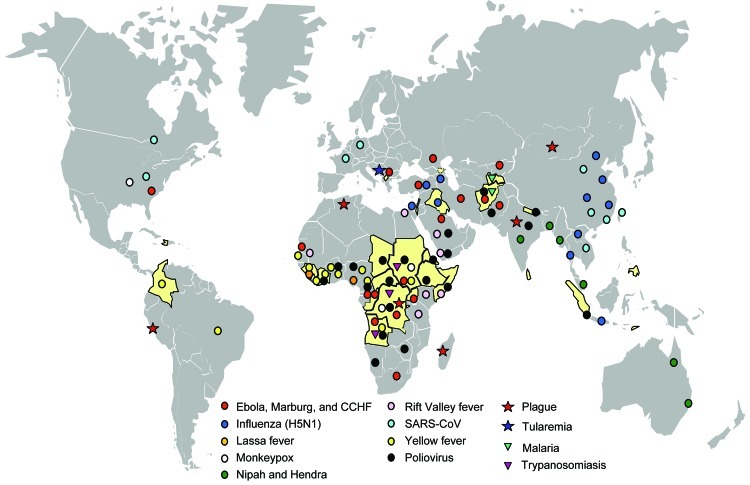
Geographic distribution of recent emerging or reemerging infectious disease outbreaks and countries affected by conflict, 1990–2006. Countries in yellow were affected by conflict during this period (source: Office for the Coordination of Humanitarian Affairs, World Health Organization, www.reliefweb.int/ocha_ol/onlinehp.html ). Symbols indicate outbreaks of emerging or reemerging infectious diseases during this period (source: Epidemic and Pandemic Alert and Response, World Health Organization, www.who.int/csr/en ). Circles indicate diseases of viral origin, stars indicate diseases of bacterial origin, and triangles indicate diseases of parasitic origin. CCHF, Crimean-Congo hemorrhagic fever; SARS-CoV, severe acute respiratory syndrome coronavirus.
Comment in
-
Conflict and emerging infectious diseases.Emerg Infect Dis. 2008 Jun;14(6):1004-5; author reply 1005. doi: 10.3201/eid1406.080027. Emerg Infect Dis. 2008. PMID: 18507934 Free PMC article. No abstract available.
References
-
- Morse SS. Factors and determinants of disease emergence. Rev Sci Tech. 2004;23:443–51. - PubMed
-
- Aliev SP. Malaria in the Republic of Tajikistan [in Russian]. Med Parazitol (Mosk). 2000;2:27–9. - PubMed
-
- World Health Organization. World malaria situation in 1994. Wkly Epidemiol Rec. 1997;72:285–92.
-
- Aliev S, Saparova N. Current malaria situation and its control in Tadjikistan [in Russian]. Med Parazitol (Mosk). 2001;1:35–7. - PubMed
Publication types
MeSH terms
LinkOut - more resources
Full Text Sources