. 2008 Jan 24:5:15.
doi: 10.1186/1743-422X-5-15.

Avian influenza: genetic evolution under vaccination pressure

Affiliations

Avian influenza: genetic evolution under vaccination pressure

Magdalena Escorcia et al. Virol J. .

Abstract

Antigenic drift of avian influenza viruses (AIVs) has been observed in chickens after extended vaccination program, similar to those observed with human influenza viruses. To evaluate the evolutionary properties of endemic AIV under high vaccination pressure (around 2 billion doses used in the last 12 years), we performed a pilot phylogenic analysis of the hemagglutinin (HA) gene of AIVs isolated from 1994 to 2006. This study demonstrates that Mexican low pathogenicity (LP) H5N2-AIVs are constantly undergoing genetic drifts. Recent AIV isolates (2002-2006) show significant molecular drifts when compared with the H5N2 vaccine-strain or other field isolates (1994-2000). This study also demonstrates that molecular drifts in the HA gene lineages follow a yearly trend, suggesting gradually cumulative sequence mutations. These findings might explain the increasing incidence of LP H5N2 AIV isolated from commercial avian farms. These findings support recent concerns about the challenge of AIV antigenic drift and influenza epidemics.


Figures
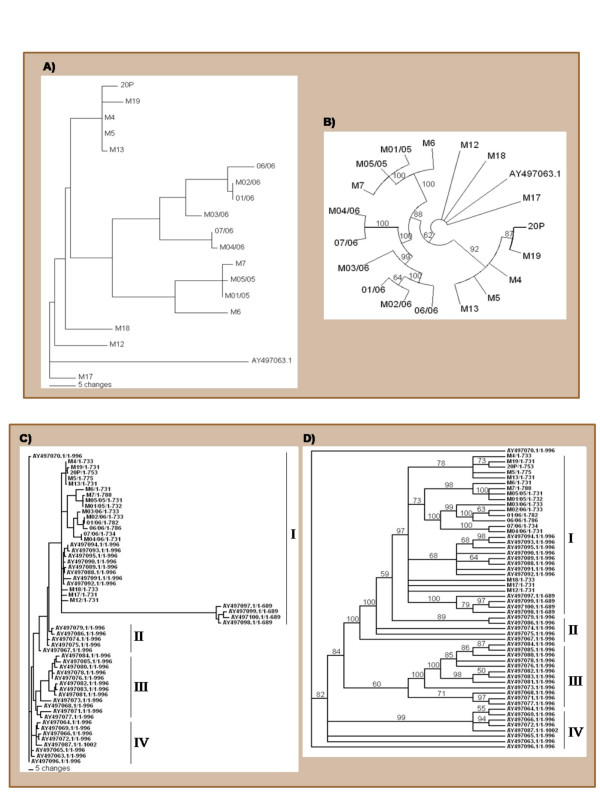
Figure 1
Figure 1
Current Mexican avian influenza virus lineages. Phylogenetic rooted trees based on the nucleotide sequence of the hemagglutining (HA) gene (cleavage site sequence) from avian influenza virus (AIV) strains. Trees were constructed using maximum parsimony and best heuristic tree search analysis. The analysis shows the relationships of nucleotide sequences of the HA gene. The [GenBank:AY497063.1] nucleotide sequence was used for rooting. A) Phylogram tree and B) Circular tree showing bootstrap values (numbers on braches) after 1,000 replicates. Parts A and B include recent AIV isolates from years 2002 to 2006. Sequence labels are contractions of the official identifications: sequence label (official code) M4 (A/Chicken/Querétaro/M4/02), M5 (A/Chicken/Hidalgo/M5/02), M12 (A/Chicken/Nuevo León/M12/02), M13 (A/Chicken/San Luis Potosí/M13/02), M17 (A/Chicken/Puebla/M17//02), M18 9 (A/Chicken/San Luis Potosí/M18//02), M19 (no official ID), 20P (no official ID), M6 (A/Chicken/Colima/M6/05), M7 (A/Chicken/Jalisco/M7/05), M01/05 (A/Chicken/Aguascalientes/01-05/05), M05/05 (A/Chicken/Puebla/05-05/05), 01/06-A/Chicken/Puebla/01-06/06, M02/06 (A/Chicken/Estado de México/02-06/06), M03/06 (A/Chicken/Estado de México/03-06/06), M04/06 (A/Chicken/Puebla/04-06/06), 06/06 (A/Chicken/Puebla/06-06/06), 07/06 (A/Chicken/Puebla/07-06/06). For each official code: serotype/host/location/reference/year of isolation.C) Phylogram tree and D) Rectangular tree showing bootstrap values (numbers on braches) after 1000 replicates. Parts C and D include AIV isolated from 1994 to 2006. Current Mexican AIV lineages are indicated by I to IV. Sequence labels correspond to GenBank accession numbers/nucleotide fragment size (HA gene cleavage site) used for phylogenetic analysis.

References

    1. Ito T, Goto H, Yamamoto E, Tanaka H, Takeuchi M, Kuwayama M, Kawaoka Y, Otsuki K. Generation of a highly pathogenic avian influenza A virus from an avirulent field isolate by passaging in chickens. J Virol. 2001;75:4439–4443. doi: 10.1128/JVI.75.9.4439-4443.2001. - DOI - PMC - PubMed
    1. Swayne DE, Halvorson DA. Influenza. In: Saif YM, Barnes HJ, Glisson JR, Fadly AM, McDougald LR, Swayne DE, editor. Diseases of poultry. Ames Iowa, IA: Iowa State University Press; 2003. pp. 135–160.
    1. Lee CW, Senne DA, Suarez DL. Effect of vaccine use in the evolution of Mexican lineage H5N2 avian influenza virus. J Virol. 2004;78:8372–8381. doi: 10.1128/JVI.78.15.8372-8381.2004. - DOI - PMC - PubMed
    1. Villarreal-Chavez C, Rivera-Cruz E. An update on avian influenza in Mexico. Avian Dis. 2003;47:1002–1005. - PubMed
    1. Smith DJ, Forrest S, Ackley DH, Perelson AS. Variable efficacy of repeated annual influenza vaccination. Proc Natl Acad Sci USA. 1999;96:14001–14006. doi: 10.1073/pnas.96.24.14001. - DOI - PMC - PubMed

MeSH terms

Substances
