


Alpha-adrenergic inhibition increases collateral circuit conductance in rats following acute occlusion of the femoral artery
- PMID: 18218679
- PMCID: PMC2375691
- DOI: 10.1113/jphysiol.2007.149567
Alpha-adrenergic inhibition increases collateral circuit conductance in rats following acute occlusion of the femoral artery
Abstract
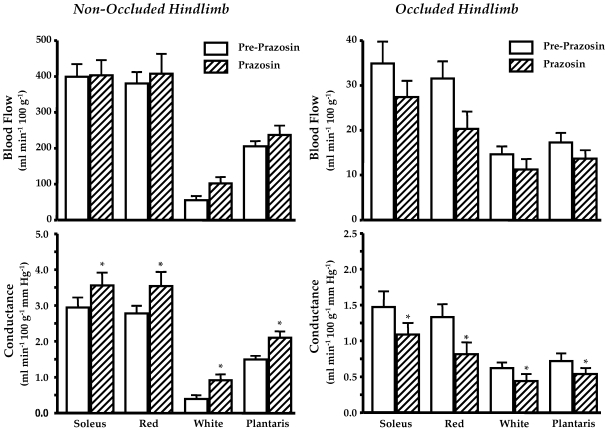
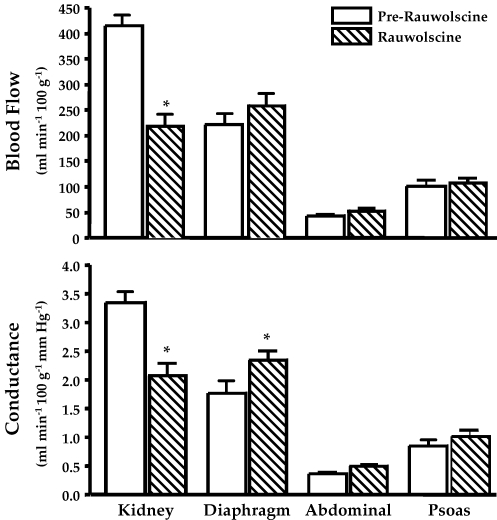
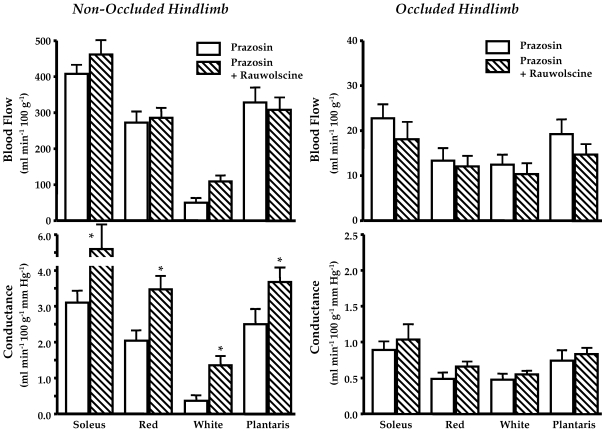
This study evaluated whether alpha-adrenergic activation contributes to collateral circuit vascular resistance in the hindlimb following acute unilateral occlusion of the femoral artery in rats. Blood pressures (BPs) were measured above (caudal artery) and below (distal femoral artery) the collateral circuit. Arterial BPs were reduced (15-35 mmHg) with individual (prazosin, rauwolscine) or combined (phentolamine) alpha-receptor inhibition. Blood flows (BFs) were measured using microspheres before and after alpha inhibition during the same treadmill speed. alpha(1) inhibition increased blood flow by approximately 40% to active muscles that were not affected by femoral occlusion, whereas collateral-dependent BFs to the calf muscles were reduced by 29 +/- 8.4% (P < 0.05), due to a decrease in muscle conductance with no change in collateral circuit conductance. alpha(2) inhibition decreased both collateral circuit (39 +/- 6.0%; P < 0.05) and calf muscle conductance (36 +/- 7.3%; P < 0.05), probably due to residual alpha(1) activation, since renal BF was markedly reduced with rauwolscine. Most importantly, inhibiting alpha(2) receptors in the presence of alpha(1) inhibition increased (43 +/- 12%; P < 0.05) collateral circuit conductance. Similarly, non-selective alpha inhibition with phentolamine increased collateral conductance (242 +/- 59%; P < 0.05). We interpret these findings to indicate that both alpha(1)- and alpha(2)-receptor activation can influence collateral circuit resistance in vivo during the high flow demands caused by exercise. Furthermore, we observed a reduced maximal conductances of active muscles that were ischaemic. Our findings imply that in the presence of excessive sympathetic activation, which can occur in the condition of intermittent claudication during exertion, an exaggerated vasoconstriction of the existing collateral circuit and active muscle will occur.
Figures






References
-
- Bakke EF, Hisdal J, Jorgensen JJ, Kroese A, Stranden E. Blood pressure in patients with intermittent claudication increases continuously during walking. Eur J Vasc Endovasc Surg. 2007;33:2–25. - PubMed
-
- Buckwalter JB, Hamann JJ, Clifford PS. Neuropeptide Y1 receptor vasoconstriction in exercising canine skeletal muscles. J Appl Physiol. 2005;99:2115–2120. - PubMed
-
- Buckwalter JB, Mueller PJ, Clifford PS. Sympathetic vasoconstriction in active skeletal muscles during dynamic exercise. J Appl Physiol. 1997;83:1575–1580. - PubMed
-
- Buschmann I, Schaper W. Arteriogenesis versus angiogenesis: two mechanisms of vessel growth. News Physiol Sci. 1999;14:121–125. - PubMed
-
- Buschmann I, Schaper W. The pathophysiology of the collateral circulation (arteriogenesis) J Pathol. 2000;190:338–342. - PubMed
Publication types
MeSH terms
Substances
Grants and funding
LinkOut - more resources
Full Text Sources
Miscellaneous
