Comparative Study
. 2008 Mar;146(3):1242-54.
doi: 10.1104/pp.107.108779. Epub 2008 Jan 24.

Comparative genomic sequence and expression analyses of Medicago truncatula and alfalfa subspecies falcata COLD-ACCLIMATION-SPECIFIC genes

Affiliations
Comparative Study

Comparative genomic sequence and expression analyses of Medicago truncatula and alfalfa subspecies falcata COLD-ACCLIMATION-SPECIFIC genes

Joyce C Pennycooke et al. Plant Physiol. 2008 Mar.

Abstract

In Arabidopsis (Arabidopsis thaliana) the low-temperature induction of genes encoding the C-REPEAT BINDING FACTOR (CBF) transcriptional activators is a key step in cold acclimation. CBFs in turn activate a battery of downstream genes known as the CBF regulon, which collectively act to increase tolerance to low temperatures. Fundamental questions are: What determines the size and scope of the CBF regulon, and is this is a major determinant of the low-temperature tolerance capacity of individual plant species? Here we have begun to address these questions through comparative analyses of Medicago truncatula and Medicago sativa subsp. falcata. M. truncatula survived to -4 degrees C but did not cold acclimate, whereas Medicago falcata cold acclimated and survived -14 degrees C. Both species possessed low-temperature-induced CBFs but differed in the expression of the COLD-ACCLIMATION-SPECIFIC (CAS) genes, which are candidate CBF targets. M. falcata CAS30 was robustly cold-responsive whereas the MtCAS31 homolog was not. M. falcata also possessed additional CAS30 homologs in comparison to the single CAS31 gene in M. truncatula. MfCAS30 possessed multiple pairs of closely spaced C-REPEAT/DEHYDRATION RESPONSIVE ELEMENT (CRT/DRE) motifs, the cognate CBF binding site in its upstream region whereas MtCAS31 lacked one CRT/DRE partner of the two proximal partner pairs. CAS genes also shared a promoter structure comprising modules proximal and distal to the coding sequence. CAS15, highly cold-responsive in both species, harbored numerous CRT/DRE motifs, but only in the distal module. However, fusion of the MtCAS15 promoter, including the distal module, to a reporter gene did not result in low-temperature responsiveness in stably transformed Arabidopsis. In contrast, both MtCAS31 and MfCAS30 promoter fusions were low-temperature responsive, although the MfCAS31 fusion was less robust than the MfCAS30 fusion. From these studies we conclude that CAS genes harbor CRT/DRE motifs, their proximity to one another is likely key to regulatory output in Medicago, and they may be located kilobases distal to the transcriptional start site. We hypothesize that these differences in CRT/DRE copy numbers in CAS30/CAS31 upstream regions combined with differences in gene copy numbers may be a factor in determining differences in low-temperature tolerance between M. truncatula and M. falcata.


Figures
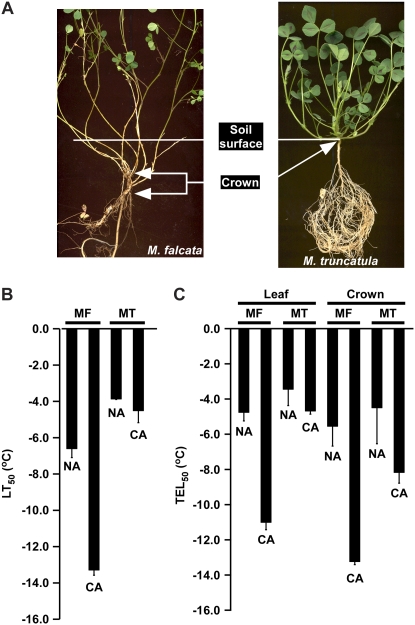
Figure 1.
Figure 1.
Freezing tolerance of M. falcata (MF) and M. truncatula (MT) plants after 4 weeks growth at 20°C/18°C day/night (NA), or after an additional 4 weeks at +2°C (CA). A, Crown regions used for electrolyte leakage and whole-plant freezing assays. B, Temperature at which 50% of the plants failed to regrow (LT50) after freezing to the indicated temperatures. C, Temperature at which 50% electrolyte leakage (TEL50) occurred after freezing.
Figure 2.
Figure 2.
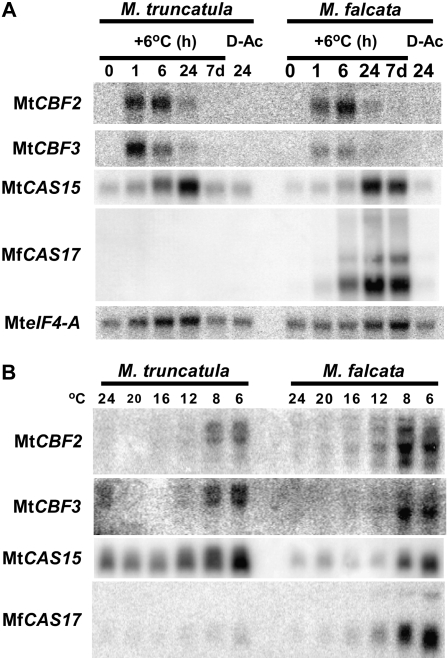
M. truncatula and M. falcata CBF and CAS cold-responsive gene expression. A, Time course. Leaf material from plants harvested at 0, 1, 6, and 24 h, and 7 d after the growth chamber temperature equilibrated to 6°C, or 24 h after the chamber was returned to 25°C (D-Ac). Each lane contains 5 μg of total RNA. The same filter was hybridized with each of the indicated probes. B, Temperature step-down series. Leaf material from plants harvested 6 h after decreasing the growth chamber temperature to the indicated temperatures. Each lane contains 15 μg of total RNA.
Figure 3.
Figure 3.
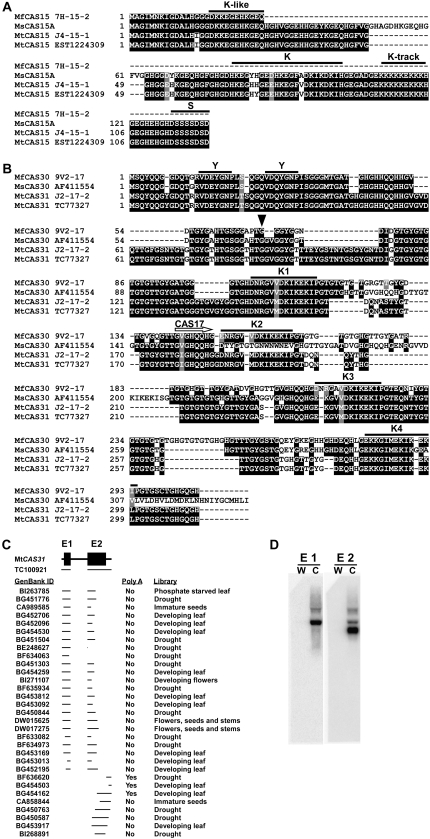
Alignments of polypeptide sequences encoded by M. truncatula and M. falcata CAS15, CAS30, and CAS31. A, Alignment of predicted CAS15 polypeptides encoded by M. falcata λ7H-15-2 (partial length), and M. truncatula λJ4-15-1 genomic clones with those encoded by the expressed sequences from alfalfa CAS15 (GenBank accession L12461; Monroy et al., 1993), and M. truncatula EST1224309 (GenBank accession DW015348). B, Alignment of CAS30 and CAS31 polypeptides encoded by M. falcata λV2-17 and M. truncatula λJ2-17-2 genomic clones with those encoded by alfalfa expressed sequence AF411554 (Ivashuta et al., 2002) and M. truncatula TC77327. The downward pointing arrow identifies Gln residues 69 and 89 in M. falcata and M. truncatula CAS30/31 polypeptides, respectively, whose codon is split between Exons 1 and 2. Sequences were aligned using ClustalX and highlighted using BoxShade. The rightward horizontal arrow indicates where similarity to CAS17 begins. Dehydrin K-, S-, and Y-segments (Close, 1996) are overlined and denoted as such above the sequences. C, Ab initio predicted structure of M. truncatula CAS31 and relative positions of sequence assembly TC100921, and EST hits; and the tissue sources for those ESTs. D, RNA blot hybridization under noninducing conditions (W) or after 6 h at 4°C (C) using probes specific to either MfCAS30 Exon 1 (E1) or Exon 2/CAS17 (E2).
Figure 4.
Figure 4.
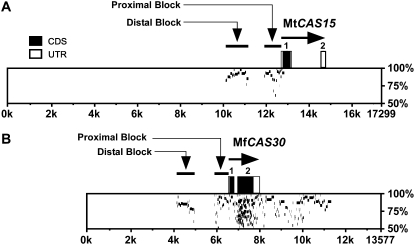
PIPs between the M. truncatula and M. falcata CAS15 and CAS30/31 genomic regions. A, PIPs between 17,299 bp of the M. truncatula CAS15 genomic region (horizontal axis) and the 7,779 bp M. falcata genomic clone λ7H-15-2 (vertical axis). (The MfCAS15 genomic clone λ7H-15-2 terminates at amino acid residue Q27.) B, PIPs between the 13,577 bp of M. falcata CAS30 genomic clone λV2-17 (horizontal axis) and the 14,288 bp M. truncatula λJ2-17-2 genomic clone (vertical axis). The MtCAS31 genomic clone λJ2-17-2 terminates at −1,728 within the distal upstream identity block. Exons 1 and 2 are shown as boxes; black boxes are protein CDSs, gray boxes are untranslated regions (UTR). The percent identity between the genomic regions from 50% and 100% is presented on the vertical axis. The multiple horizontal bars at the same position along the x axis under Exon 2 in CAS30 are a result of the low complexity and multiple repeating unit structural composition of dehydrins.
Figure 5.
Figure 5.
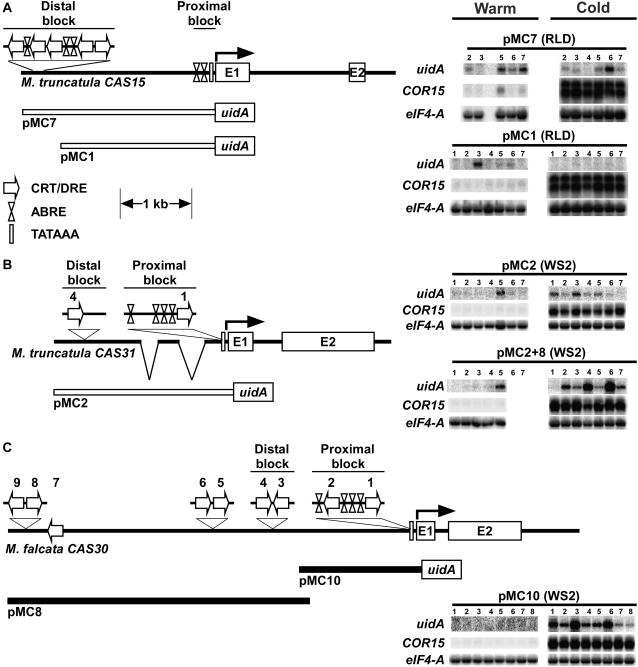
RNA blot analysis of Medicago CAS promoter uidA fusions in Arabidopsis. A, MtCAS15 and the MtCAS15 promoter-uidA reporter gene fusion constructs that either included (pMC7), or excluded (pMC1) the distal upstream CRT/DRE and ABRE motifs (B) MtCAS31 and the MtCAS31 promoter-uidA reporter gene fusion constructs pMC2 and pMC2+8. C, MfCAS30 and the MfCAS30 promoter-uidA reporter gene fusion construct pMC10. Line drawings are drawn to scale, except for the clustered CRT/DRE and ABRE sequences, which are shown above the scaled horizontal genomic regions. CRT/DRE motifs in the MfCAS30 upstream region are numbered beginning with number 1 adjacent to the CDS. The numbering of CRT/DRE motifs in MtCAS31 is based on homology with MfCAS30 and follows that of the MfCAS30 scheme. The two breaks in MtCAS31 represent deletions relative to MfCAS30. Expression analysis conducted using T2 plants from multiple independent lines of each construct transformed into Arabidopsis laboratory strain RLD (pMC7 and pMC1) or WS-2 (pMC2, pMC10, and pMC2+8) and assayed for uidA, COR15, and eIF4-A transcript accumulation under noninducing conditions (warm) or after 6 h of low-temperature exposure (cold). Each lane contains 7 μg total RNA.
Figure 6.
Figure 6.
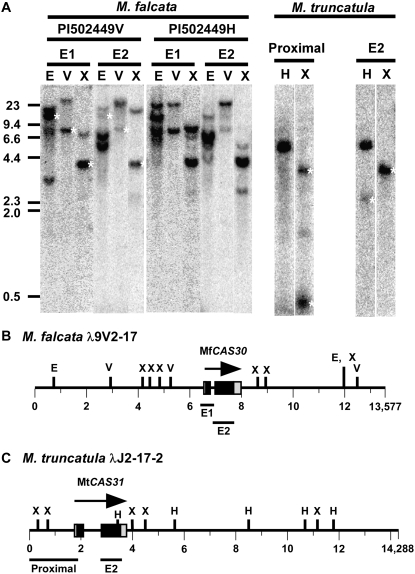
CAS30 and CAS31 complexity in M. falcata and M. truncatula. A, DNA blot analyses of diploid M. falcata genotypes PI502449V (9V) and PI502449H (9H), and M. truncatula ‘Jemalong’. White asterisks identify the fragments predicted from the genomic sequence. B, Structure of the M. falcata CAS30 genomic region. C, Structure of the M. truncatula CAS31 genomic region. E1, Exon 1; E2, Exon 2; E, EcoRI; V, EcoRV; H, HindIII; X, XbaI. Distances in kilobase are indicated below. Fragments used as probes are drawn below the genomic regions.

References

    1. Adams MD (2005) Conserved sequences and the evolution of gene regulatory signals. Curr Opin Genet Dev 15 628–633 - PubMed
    1. Ausubel FM, Brent R, Kingston RE, Moore DD, Seidmen JG, Smith JA, Struhl K (1993) Current Protocols in Molecular Biology. Greene Publishing Associates/John Wiley and Sons, New York
    1. Baker SS, Wilhelm KS, Thomashow MF (1994) The 5′-region of Arabidopsis thaliana cor15a has cis-acting elements that confer cold-, drought- and ABA-regulated gene expression. Plant Mol Biol 24 701–713 - PubMed
    1. Barker DG, Bianchi S, Blondon F, Dattée Y, Duc G, Essad S, Flament P, Gallusci P, Génier G, Guy P, et al (1990) Medicago truncatula, a model plant for studying the molecular genetics of the Rhizobium-legume symbiosis. Plant Mol Biol Rep 8 40–49
    1. Bell CJ, Dixon RA, Farmer AD, Flores R, Inman J, Gonzales RA, Harrison MJ, Paiva NL, Scott AD, Weller JW, et al (2001) The Medicago Genome Initiative: a model legume database. Nucleic Acids Res 29 114–117 - PMC - PubMed

Publication types

Substances

Associated data