


Review
doi: 10.1186/1745-6150-3-2.
The prokaryotic V4R domain is the likely ancestor of a key component of the eukaryotic vesicle transport system
Affiliations
- PMID: 18221539
- PMCID: PMC2253512
- DOI: 10.1186/1745-6150-3-2
Item in Clipboard
Review
The prokaryotic V4R domain is the likely ancestor of a key component of the eukaryotic vesicle transport system
Biol Direct.
.
Abstract
Intracellular vesicle traffic that enables delivery of proteins between the endoplasmic reticulum, Golgi and various endosomal subcompartments is one of the hallmarks of the eukaryotic cell. Its evolutionary history is not well understood but the process itself and the core vesicle traffic machinery are believed to be ancient. We show here that the 4-vinyl reductase (V4R) protein domain present in bacteria and archaea is homologous to the Bet3 subunit of the TRAPP1 vesicle-tethering complex that is conserved in all eukaryotes. This suggests, for the first time, a prokaryotic origin for one of the key eukaryotic trafficking proteins.
Figures
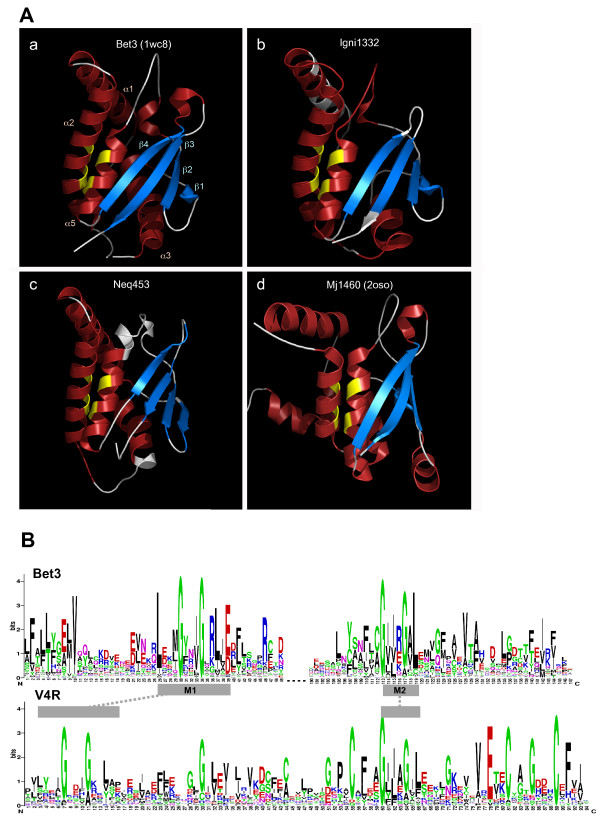
(A) Structure of mouse BET3 (PDB:1wc8)(a) and homology models of archaeal V4R domains (Ignicoccus hospitalis p1332 and Nanoarchaeum equitans p453)(b, c). Secondary structure inference for the archaeal proteins is overlaid on the models, coloring of the alpha helix (red) and beta strand (blue) elements corresponding to the type of prediction using PSIPRED v2.5. The location of the conserved pairs of glycines in helices 2 and 5 is indicated in yellow. The crystal structure of the Methanocaldococcus jannaschii p1460 (PDB, 2oso) is shown in panel d. The models were visualized using Pymol [17]. (B) Sequence conservation logos for eukaryotic TRAPP-Bet3 and archaeal V4R domain proteins. M1 and M2 represent previously identified motifs characteristic to the TRAPP-Bet3 family and are linked to the corresponding structure and sequence regions in V4R. The sequence logos were generated using WebLogo3 [18](the sequence alignments used as input are available upon request).
References
Publication types
MeSH terms
Substances
Grants and funding
LinkOut - more resources
Full Text Sources
