


Cyclic AMP-dependent catabolite repression is the dominant control mechanism of metabolic fluxes under glucose limitation in Escherichia coli
- PMID: 18223071
- PMCID: PMC2293195
- DOI: 10.1128/JB.01353-07
Cyclic AMP-dependent catabolite repression is the dominant control mechanism of metabolic fluxes under glucose limitation in Escherichia coli
Abstract
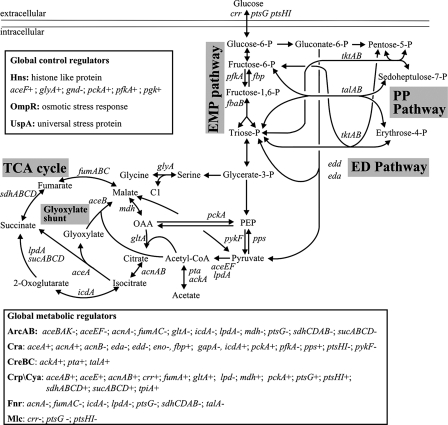
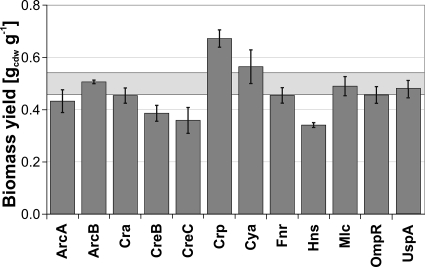
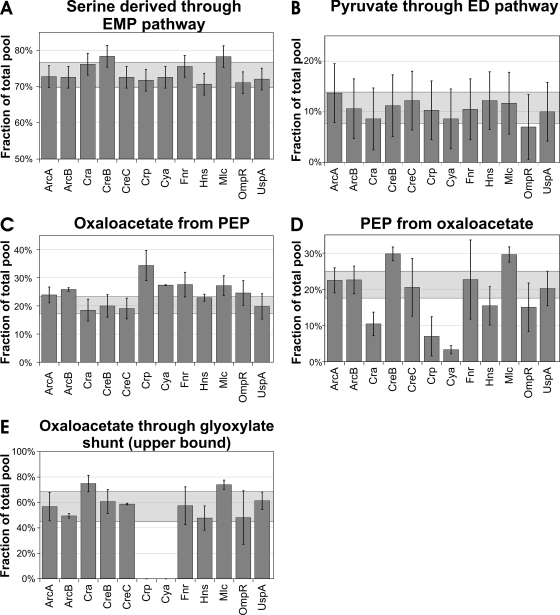
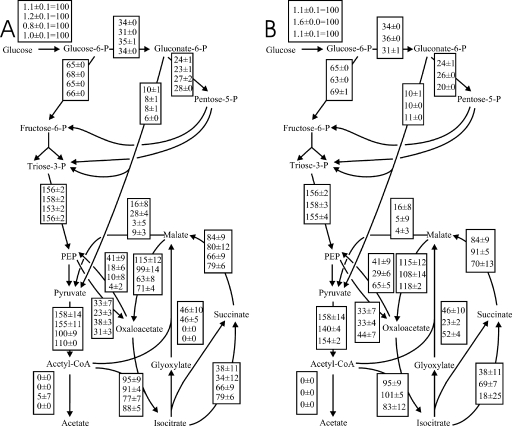
Although a whole arsenal of mechanisms are potentially involved in metabolic regulation, it is largely uncertain when, under which conditions, and to which extent a particular mechanism actually controls network fluxes and thus cellular physiology. Based on (13)C flux analysis of Escherichia coli mutants, we elucidated the relevance of global transcriptional regulation by ArcA, ArcB, Cra, CreB, CreC, Crp, Cya, Fnr, Hns, Mlc, OmpR, and UspA on aerobic glucose catabolism in glucose-limited chemostat cultures at a growth rate of 0.1 h(-1). The by far most relevant control mechanism was cyclic AMP (cAMP)-dependent catabolite repression as the inducer of the phosphoenolpyruvate (PEP)-glyoxylate cycle and thus low tricarboxylic acid cycle fluxes. While all other mutants and the reference E. coli strain exhibited high glyoxylate shunt and PEP carboxykinase fluxes, and thus high PEP-glyoxylate cycle flux, this cycle was essentially abolished in both the Crp and Cya mutants, which lack the cAMP-cAMP receptor protein complex. Most other mutations were phenotypically silent, and only the Cra and Hns mutants exhibited slightly altered flux distributions through PEP carboxykinase and the tricarboxylic acid cycle, respectively. The Cra effect on PEP carboxykinase was probably the consequence of a specific control mechanism, while the Hns effect appears to be unspecific. For central metabolism, the available data thus suggest that a single transcriptional regulation process exerts the dominant control under a given condition and this control is highly specific for a single pathway or cycle within the network.
Figures
References
-
- Al Zaid Siddiquee, K., M. J. Arauzo-Bravo, and K. Shimizu. 2004. Metabolic flux analysis of pykF gene knockout Escherichia coli based on 13C-labeling experiments together with measurements of enzyme activities and intracellular metabolite concentrations. Appl. Microbiol. Biotechnol. 63407-417. - PubMed
-
- Atlung, T., and H. Ingmer. 1997. H-NS: a modulator of environmentally regulated gene expression. Mol. Microbiol. 247-17. - PubMed
-
- Avison, M. B., R. E. Horton, T. R. Walsh, and P. M. Bennett. 2001. Escherichia coli CreBC is a global regulator of gene expression that responds to growth in minimal media. J. Biol. Chem. 27626955-26961. - PubMed
-
- Brückner, R., and F. Titgemeyer. 2002. Carbon catabolite repression in bacteria: choice of the carbon source and autoregulatory limitation of sugar utilization. FEMS Microbiol. Lett. 209141-148. - PubMed
Publication types
MeSH terms
Substances
LinkOut - more resources
Full Text Sources
Other Literature Sources
Research Materials
Miscellaneous
