Comment
doi: 10.1371/journal.pcbi.0040015.
Coping with viral diversity in HIV vaccine design: a response to Nickle et al
- PMID: 18225944
- PMCID: PMC2217576
- DOI: 10.1371/journal.pcbi.0040015
Item in Clipboard
Comment
Coping with viral diversity in HIV vaccine design: a response to Nickle et al
PLoS Comput Biol.
2008 Jan.
No abstract available
Conflict of interest statement
Figures
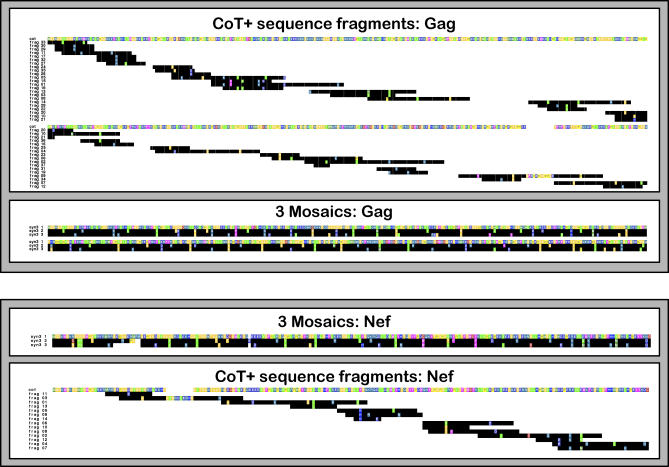
The COT+ candidate vaccine sets represent one full-length COT protein plus numerous discrete sequence fragments located in various positions relative to the intact Gag protein; mosaics are full-length “native-like” proteins. For the COT+ sequence sets, the sequence on the top line is the COT sequence; additional peptide fragments are numbered by addition order, and plotted by location from N-terminus to C-terminus. Gag sequences are presented in two parts. For the mosaic sets, the sequence in the top line was arbitrarily chosen from the set, as the mosaics are designed as a combination of strains. For all sequence sets, amino acid residues identical to those in the top line sequence are shown with a black background; differences from the first sequence are shown in color, with different colors representing different amino acid classes; white space is used to represent gaps. The COT+ antigen sequences [1] were generously provided by J. I. Mullins.
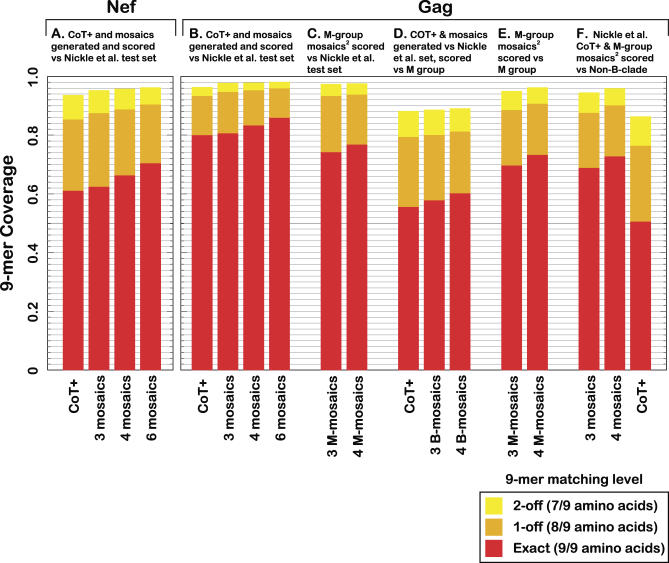
To allow direct methodological comparison, mosaic antigen sets were generated as in Fischer et al. [2], but based on the test set of 169 sequences used in Nickle et al. [1] for Nef (A) and Gag (B,D). Potential epitope coverage provided by the combination of proteins is indicated by the percentage of perfectly matched 9-mers in the protein alignment (red), the addition of those that match in 8/9 amino acids (orange), and the further addition of those that match in 7/9 amino acids (yellow). Three full-length mosaic proteins provide slightly better coverage than three gene lengths of COT+ protein fragments. For this class of methods, coverage may generally be improved by increasing the number of antigens, but with diminishing returns and at the cost of increased vaccine complexity and expense; the best strategy must realistically balance these factors. Previously published mosaic sequences (based on 551 Los Alamos sequences spanning the entire M group [2]) were scored against the 169-sequence Gag set (C), and the M group (E). To directly compare the coverage of each antigen set to subtypes other than B, the COT+ antigen set and the M-group mosaics were also scored against an M-group dataset from which all B-clade sequences had been removed (F). The M-group mosaic coverage of non-B clade proteins is 4%–5% less than the M-group coverage of B clade (C,F). Predictably, interclade coverage of the B-clade–optimized antigens drops dramatically (81% → 51% for COT+, F; B-clade mosaics slightly less reduced ([2], unpublished data). For the M-group global mosaics, in contrast, coverage is roughly equal for all clades; coverage of B-clade sequences by M-group mosaics is only 6%–7% below that of specific B-clade–optimized mosaics (B,C), and coverage of non-B sequences remains relatively high (F). All computer code for creating mosaics and assessing coverage, our previously designed mosaic antigens, and the datasets used were made publicly accessible upon the original publication [2].
Comment on
-
Coping with viral diversity in HIV vaccine design.PLoS Comput Biol. 2007 Apr 27;3(4):e75. doi: 10.1371/journal.pcbi.0030075. PLoS Comput Biol. 2007. PMID: 17465674 Free PMC article.
References
-
- Fischer W, Perkins S, Theiler J, Bhattacharya T, Yusim K, et al. Polyvalent vaccines for optimal coverage of potential T-cell epitopes in global HIV-1 variants. Nat Med. 2007;13:100–106. - PubMed
-
- Li F, Malhotra U, Gilbert PB, Hawkins NR, Duerr AC, et al. Peptide selection for human immunodeficiency virus type 1 CTL-based vaccine evaluation. Vaccine. 2006;24:6893–6904. - PubMed
-
- Nickle DC, Jensen MA, Gottlieb GS, Shriner D, Learn GH, et al. Consensus and ancestral state HIV vaccines. Letter in response to Gaschen et al. [5] Science. 2003;299:1515–1518. - PubMed
-
- Gaschen B, Taylor J, Yusim K, Foley B, Gao F, et al. Diversity considerations in HIV-1 vaccine selection. Science. 2002;296:2354–2360. - PubMed
Publication types
MeSH terms
Substances
Grants and funding
LinkOut - more resources
Full Text Sources
Other Literature Sources