


High frequency of microsatellites in S. cerevisiae meiotic recombination hotspots
- PMID: 18226240
- PMCID: PMC2267716
- DOI: 10.1186/1471-2164-9-49
High frequency of microsatellites in S. cerevisiae meiotic recombination hotspots
Abstract
Background: Microsatellites are highly abundant in eukaryotic genomes but their function and evolution are not yet well understood. Their elevated mutation rate makes them ideal markers of genetic difference, but high levels of unexplained heterogeneity in mutation rates among microsatellites at different genomic locations need to be elucidated in order to improve the power and accuracy of the many types of study that use them as genetic markers. Recombination could contribute to this heterogeneity, since while replication errors are thought to be the predominant mechanism for microsatellite mutation, meiotic recombination is involved in some mutation events. There is also evidence suggesting that microsatellites could function as recombination signals. The yeast S. cerevisiae is a useful model organism with which to further explore the link between microsatellites and recombination, since it is very amenable to genetic study, and meiotic recombination hotspots have been mapped throughout its entire genome.
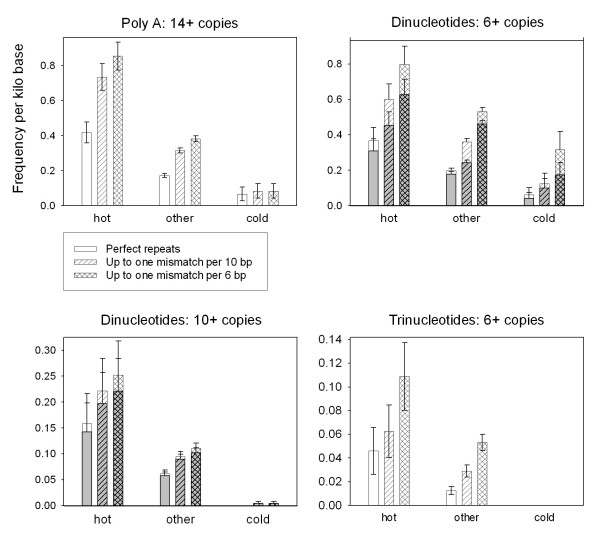
Results: We examined in detail the relationship between microsatellites and hotspots of meiotic double-strand breaks, the precursors of meiotic recombination, throughout the S. cerevisiae genome. We included all tandem repeats with motif length (repeat period) between one and six base pairs. Long, short and two-copy arrays were considered separately. We found that long, mono-, di- and trinucleotide microsatellites are around twice as frequent in hot than non-hot intergenic regions. The associations are weak or absent for repeats with less than six copies, and also for microsatellites with 4-6 base pair motifs, but high-copy arrays with motif length greater than three are relatively very rare throughout the genome. We present evidence that the association between high-copy, short-motif microsatellites and recombination hotspots is not driven by effects on microsatellite distribution of other factors previously linked to both recombination and microsatellites, including transcription, GC-content and transposable elements.
Conclusion: Our findings suggest that a mutation bias relating to recombination hotspots causing repeats to form and grow, and/or regulation of a subset of hotspots by simple sequences, may be significant processes in yeast. Some previous evidence has cast doubt on both of these possibilities, and as a result they have not been explored on a large scale, but the strength of the association we report suggests that they deserve further experimental testing.
Figures
References
-
- Uhlemann AC, Szlezak NA, Vonthein R, Tomiuk J, Emmer SA, Lell B, Kremsner PG, Kun JF. DNA phasing by TA dinucleotide microsatellite length determines in vitro and in vivo expression of the gp91phox subunit of NADPH oxidase and mediates protection against severe malaria. J Infect Dis. 2004;189:2227–2234. doi: 10.1086/421242. - DOI - PubMed
Publication types
MeSH terms
Substances
LinkOut - more resources
Full Text Sources
Molecular Biology Databases
Miscellaneous
