


Altered body composition in type 2 diabetes mellitus
- PMID: 18227843
- PMCID: PMC2921819
- DOI: 10.1038/sj.ijo.0803802
Altered body composition in type 2 diabetes mellitus
Abstract
Objective: To identify differences in amount and distribution of fat and lean soft tissue in a cross-sectional study of subjects with and without type 2 diabetes and to determine whether any differences are affected by race/ethnicity or sex.
Design and methods: Overweight and obese (body mass index, BMI > or = 25 kg m(-2)) Black, White and Hispanic men (490) and women (825) with type 2 diabetes ((mean+/-s.d.) age 58.5+/-6.6; BMI 35.3+/-5.3) who had a baseline dual energy X-ray absorptiometry whole-body scan at the time of enrollment in the Look AHEAD clinical trial, and 242 healthy controls, 91 males and 151 females (age 55.3+/-8.6 years, BMI 30.7+/-4.2 kg m(-2)) who were participating in unrelated research and were scanned on the same densitometers.
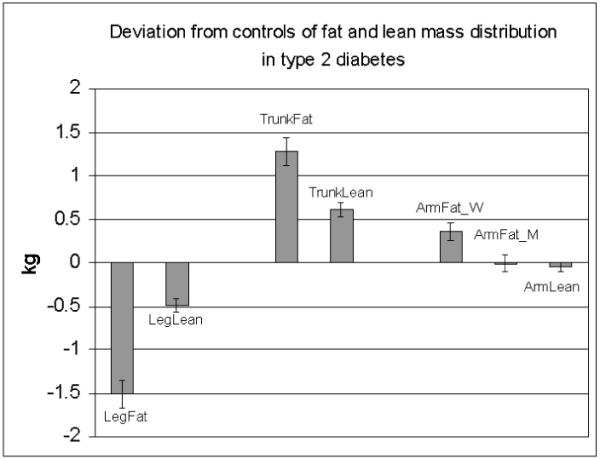
Results: Adjusted for gender, age, race, clinical site and body size, total fat mass was smaller in persons with type 2 diabetes than in controls (-1.4+/-0.3 (s.e.); 34.5 vs 35.8 kg, P<0.001) while trunk fat was larger (1.3+/-0.2 (s.e.); 19.9 vs 18.6 kg, P<0.001) and leg fat was smaller (-1.5+/-0.2 (s.e.); 10.7 vs 12.3 kg, P<0.001). The arms of subjects with type 2 diabetes did not have significantly less fat compared to controls. Adjusted trunk lean mass was larger in type 2 diabetes by 0.6 kg (28.4 vs 27.8 kg, P<0.001) while leg lean was smaller by 0.5 kg (18.1 vs 18.6 kg, P<0.001).
Conclusions: Type 2 diabetes is associated with less total fat, leg fat and leg lean mass and more truncal fat and lean mass than controls. The physiological processes producing these deviations in tissue distribution and their metabolic significance warrant further investigation.
Figures

References
-
- Cnop M, Landchild MJ, Vidal J, Havel PJ, Knowles NG, Carr DR, Wang F, Hull RL, Boyko EJ, Retzlaff BM, Walden CE, Knopp RH, Kahn SE. The concurrent accumulation of intra-abdominal and subcutaneous fat explains the association between insulin resistance and plasma leptin concentrations : distinct metabolic effects of two fat compartments. Diabetes. 2002;51:1005–15. - PubMed
-
- Wagenknecht LE, Langefeld CD, Scherzinger AL, Norris JM, Haffner SM, Saad MF, Bergman RN. Insulin sensitivity, insulin secretion, and abdominal fat: the Insulin Resistance Atherosclerosis Study (IRAS) Family Study. Diabetes. 2003;52:2490–6. - PubMed
-
- Utzschneider KM, Carr DB, Hull RL, Kodama K, Shofer JB, Retzlaff BM, Knopp RH, Kahn SE. Impact of intra-abdominal fat and age on insulin sensitivity and beta-cell function. Diabetes. 2004;53:2867–72. - PubMed
-
- Kuk JL, Katzmarzyk PT, Nichaman MZ, Church TS, Blair SN, Ross R. Visceral fat is an independent predictor of all-cause mortality in men. Obesity. 2006;14:336–41. - PubMed
-
- Svendsen OL, Hassager C. Body composition and fat distribution measured by dual-energy x-ray absorptiometry in premenopausal and postmenopausal insulin-dependent and non-insulin-dependent diabetes mellitus patients. Metabolism. 1998;47:212–216. - PubMed
Publication types
MeSH terms
Grants and funding
- U01 DK057151/DK/NIDDK NIH HHS/United States
- U01 DK057154/DK/NIDDK NIH HHS/United States
- U01 DK056992/DK/NIDDK NIH HHS/United States
- U01 DK057171/DK/NIDDK NIH HHS/United States
- U01 DK057182/DK/NIDDK NIH HHS/United States
- U01 DK057136/DK/NIDDK NIH HHS/United States
- U01 DK057002/DK/NIDDK NIH HHS/United States
- M01 RR000211/RR/NCRR NIH HHS/United States
- U01 DK057177/DK/NIDDK NIH HHS/United States
- M01 RR001066/RR/NCRR NIH HHS/United States
- U01 DK057078/DK/NIDDK NIH HHS/United States
- U01 DK057008/DK/NIDDK NIH HHS/United States
- U01 DK057149/DK/NIDDK NIH HHS/United States
- P30 DK048520/DK/NIDDK NIH HHS/United States
- U01 DK057135/DK/NIDDK NIH HHS/United States
- P30 DK046204/DK/NIDDK NIH HHS/United States
- M01 RR002719/RR/NCRR NIH HHS/United States
- M01 RR000056/RR/NCRR NIH HHS/United States
- U01 DK057219/DK/NIDDK NIH HHS/United States
- U01 DK057131/DK/NIDDK NIH HHS/United States
- M01 RR000051/RR/NCRR NIH HHS/United States
- U01 DK056990/DK/NIDDK NIH HHS/United States
- U01 DK057178/DK/NIDDK NIH HHS/United States
LinkOut - more resources
Full Text Sources
Medical
