. 2008 Apr 22;275(1637):915-21.
doi: 10.1098/rspb.2007.1647.

Place memory in crickets

Affiliations

Place memory in crickets

Jan Wessnitzer et al. Proc Biol Sci. .

Abstract

Certain insect species are known to relocate nest or food sites using landmarks, but the generality of this capability among insects, and whether insect place memory can be used in novel task settings, is not known. We tested the ability of crickets to use surrounding visual cues to relocate an invisible target in an analogue of the Morris water maze, a standard paradigm for spatial memory tests on rodents. Adult female Gryllus bimaculatus were released into an arena with a floor heated to an aversive temperature, with one hidden cool spot. Over 10 trials, the time taken to find the cool spot decreased significantly. The best performance was obtained when a natural scene was provided on the arena walls. Animals can relocate the position from novel starting points. When the scene is rotated, they preferentially approach the fictive target position corresponding to the rotation. We note that this navigational capability does not necessarily imply the animal has an internal spatial representation.


Figures
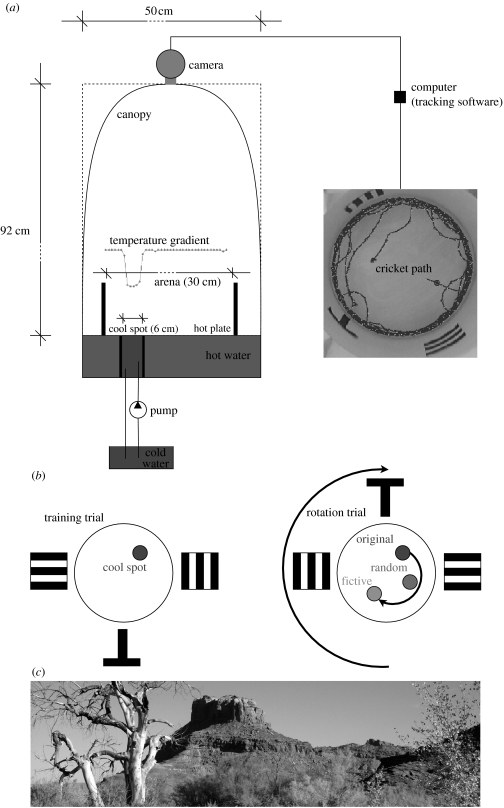
Figure 1
Figure 1
Experimental set-up. (a) The arena was illuminated by two desk lamps. The temperature gradient was measured at the surface (min∼25° and max∼50°). (b) For the rotation trials, the wall of the arena is rotated by 180°, changing the position of the visual cues, and creating a fictive target location relative to those cues. (c) This natural scene wallpaper is wrapped around the inside of the arena wall.
Figure 2
Figure 2
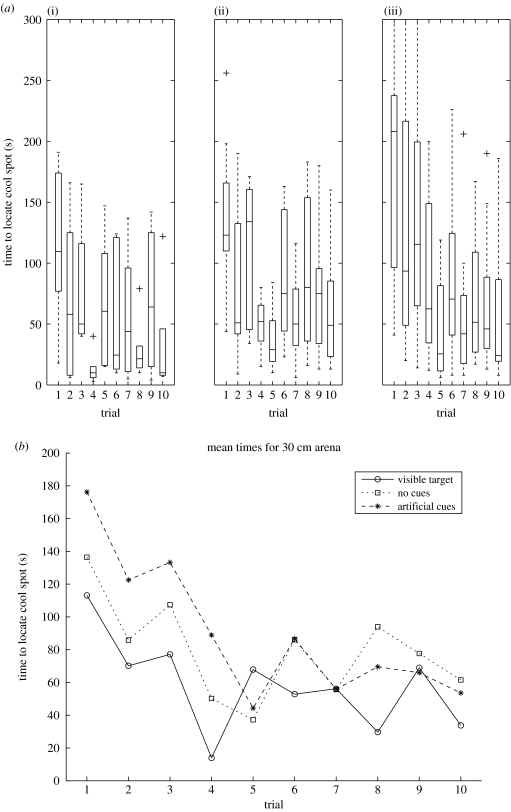
Experiment 1 results. Time taken to find the cool spot over 10 trials in 30 cm arena (a) with (i) a visible target (n=6), (ii) no cues (n=9) or (iii) visual cues on the arena wall (n=12); (b) a comparison of mean times for the three conditions. Learning occurs in all three conditions.
Figure 3
Figure 3
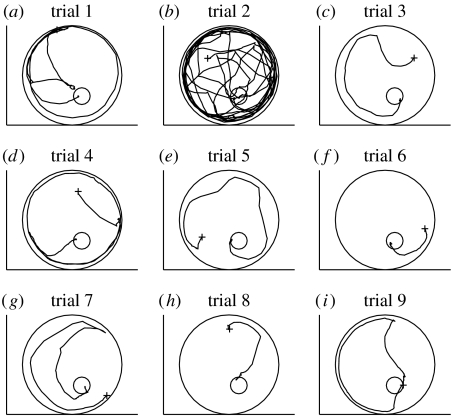
Cricket paths. Paths from (ai) nine trials (trials 1–9) for one cricket with artificial visual cues. Cross, start of the path; small circle, the hidden target location.
Figure 4
Figure 4
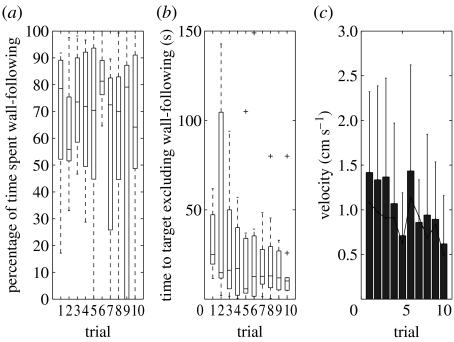
Wall-following. For the visual cues condition, (a) the percentage of time spent wall-following and (b) the time to locate target excluding time spent wall-following. (c) Mean and standard deviation of the crickets' velocity against trial numbers (the black line represents the median).
Figure 5
Figure 5
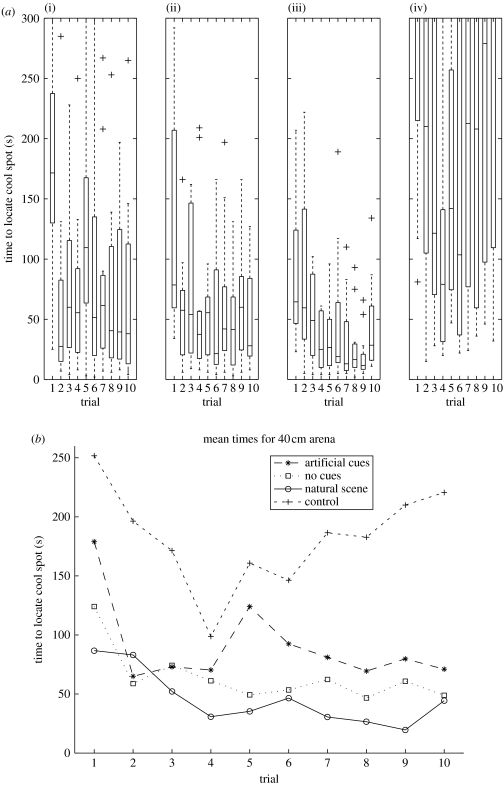
Experiment 2 results. Time taken to find the hidden cool spot over 10 trials in an 40 cm arena (a) with (i) artificial cues on the arena wall (n=12), (ii) no cues (n=12), (iii) a natural scene on the arena wall (n=12) and (iv) control experiment in the dark (n=12); (b) a comparison of mean times for all conditions.
Figure 6
Figure 6
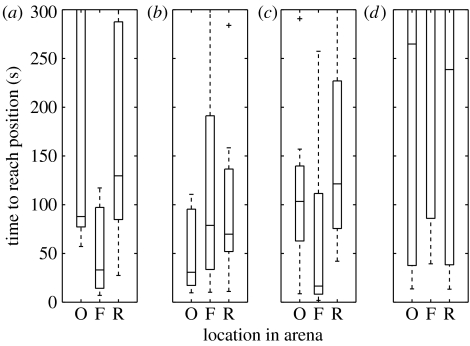
Results on rotation trials. For (a) artificial cues and (c) the natural scene, the fictive position of the cool spot indicated by the rotated cues or panorama is approached more quickly than the original location, or a random position. (b) For ‘no cues on arena wall’, the original position is approached more quickly than the fictive or random locations. (d) In the control experiment, no spot, original, fictive or random, is approached significantly faster. O, original cool spot; F, fictive; R, random.

References

    1. Beugnon G. Learned orientation in landward swimming in the cricket Pteronemobius lineolatus. Behav. Process. 1986;12:215–226. doi:10.1016/0376-6357(86)90037-9 - DOI - PubMed
    1. Beugnon G, Campan R. Homing in the field cricket, Gryllus campestris. J. Insect Behav. 1989;2:187–198. doi:10.1007/BF01053291 - DOI
    1. Brunner D, Labhart T. Behavioural evidence for polarization vision in crickets. Physiol. Entomol. 1987;12:1–10.
    1. Cartwright B, Collett T. Landmark learning in bees: experiments and models. J. Comp. Physiol. A. 1983;151:521–543. doi:10.1007/BF00605469 - DOI
    1. Franz M, Mallot H. Biomimetic robot navigation. Robot. Auton. Syst. 2000;30:133–153. doi:10.1016/S0921-8890(99)00069-X - DOI

Publication types