. 2008 Feb 5;105(5):1698-703.
doi: 10.1073/pnas.0711767105. Epub 2008 Jan 29.

A direct link between carbohydrate utilization and virulence in the major human pathogen group A Streptococcus

Affiliations

A direct link between carbohydrate utilization and virulence in the major human pathogen group A Streptococcus

Samuel A Shelburne 3rd et al. Proc Natl Acad Sci U S A. .

Erratum in

  • Proc Natl Acad Sci U S A. 2009 May 26;106(21):8790

Abstract

Although central to pathogenesis, the molecular mechanisms used by microbes to regulate virulence factor production in specific environments during host-pathogen interaction are poorly defined. Several recent ex vivo and in vivo studies have found that the level of group A Streptococcus (GAS) virulence factor gene transcripts is temporally related to altered expression of genes encoding carbohydrate utilization proteins. These findings stimulated us to analyze the role in pathogenesis of catabolite control protein A (CcpA), a GAS ortholog of a key global regulator of carbohydrate metabolism in Bacillus subtilis. Inasmuch as the genomewide effects of CcpA in a human pathogen are unknown, we analyzed the transcriptome of a DeltaccpA isogenic mutant strain grown in nutrient-rich medium. CcpA influences the transcript levels of many carbohydrate utilization genes and several well characterized GAS virulence factors, including the potent cytolysin streptolysin S. Compared with the wild-type parental strain, the DeltaccpA isogenic mutant strain was significantly less virulent in a mouse model of invasive infection. Moreover, the isogenic mutant strain was significantly impaired in ability to colonize the mouse oropharynx. When grown in human saliva, a nutrient-limited environment, CcpA influenced production of several key virulence factors not influenced during growth in nutrient-rich medium. Purified recombinant CcpA bound to the promoter region of the gene encoding streptolysin S. Our discovery that GAS virulence and complex carbohydrate utilization are directly linked through CcpA provides enhanced understanding of a mechanism used by a Gram-positive pathogen to modulate virulence factor production in specific environments.


Conflict of interest statement

The authors declare no conflict of interest.

Figures
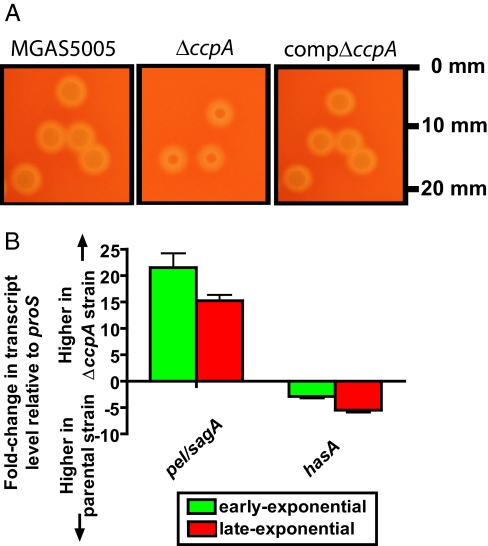
Fig. 1.
Fig. 1.
CcpA influences streptolysins and hyalouronic acid capsule expression. (A) Colony phenotype of strain MGAS5005, its ΔccpA mutant derivative strain, and compΔccpA strain on sheep blood agar plates. The ΔccpA strain has significantly increased hemolysis and decreased colony size compared with strain MGAS5005 and strain compΔccpA. All three images are of same magnification with size indications at right. (B) Changes in colony hemolysis and size were associated with altered pel/sagA and hasA gene transcript levels. Strain MGAS5005 and ΔccpA were grown in THY to early- and late-logarithmic growth phase, and pel/sagA and hasA transcript levels were measured by real-time TaqMan QRT-PCR with the ΔΔCT method. Values above the x axis indicate higher gene transcript levels in the ΔccpA strain, whereas values below the x axis indicate higher gene transcript levels in strain MGAS5005. Error bars indicate standard deviation among quadruplicate samples done on two separate occasions.
Fig. 2.
Fig. 2.
Analysis of the CcpA transcriptome. Strain MGAS5005 and ΔccpA were grown to early- and late-logarithmic growth phase in THY, and expression microarray analysis was performed as described in Materials and Methods. Values above the x axis indicate higher gene transcript levels in the ΔccpA strain and values below the x axis indicate higher gene transcript levels in wild-type strain MGAS5005. (A) Summary of genes with altered transcript levels grouped by functional category. Percentage numbers refer to genes affected by CcpA inactivation/total number of genes in that particular category in the entire GAS genome. (B) Genes encoding carbohydrate utilization proteins. Shown are the mean fold changes in transcript levels of genes in an operon known or putatively involved in the transport and/or metabolism of the indicated carbohydrate. The transcript levels of all genes in the indicated operons were similarly affected. (C) Mean transcript levels of genes encoding select virulence factors. For B and C, error bars show standard deviation among four samples.
Fig. 3.
Fig. 3.
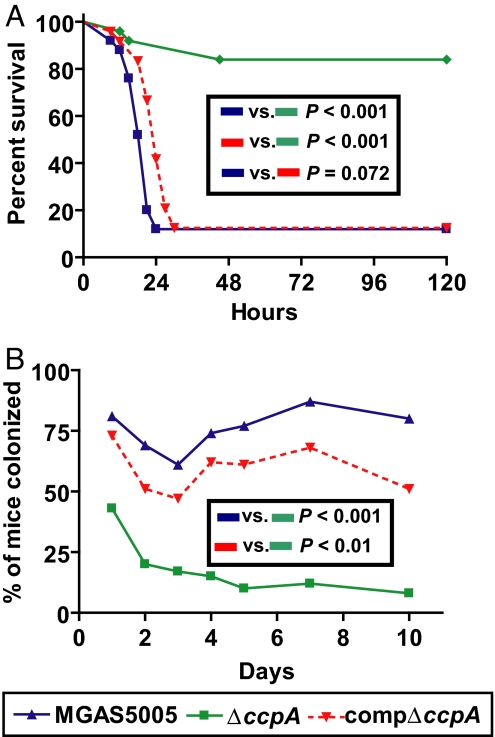
Inactivation of CcpA significantly decreases GAS virulence. (A) Invasive disease model. Twenty-five adult outbred CD-1 mice per group were inoculated i.p. with ≈1 × 10⁷ CFU of the indicated strains. Percent survival is graphed with P values for Kaplan–Meier survival analysis. (B) Oropharyngeal colonization model. Adult outbred CD-1 mice (35 per group) were inoculated intranasally with ≈1.0 × 10⁷ CFU of the indicated strains. Mice oropharynxes were swabbed daily. Percentage of mice with GAS isolated by day with P values shown for repeated measures analysis.
Fig. 4.
Fig. 4.
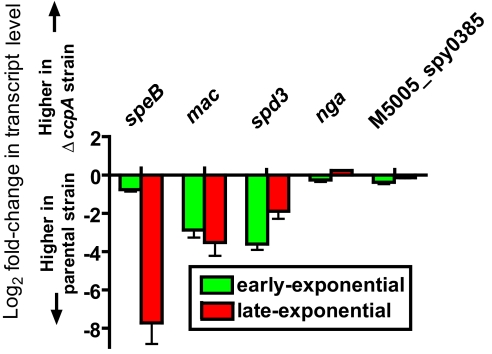
CcpA affects GAS virulence factor production in glucose-limited medium. Gene transcript levels were measured by TaqMan real-time QRT-PCR in strains MGAS5005 and ΔccpA grown to early- and late-logarithmic growth phase in human saliva. Bars indicate log2 differences in gene transcript levels between the two strains with error bars showing standard deviation for quadruplicate samples done on two separate occasions. Values above the x axis indicate higher gene transcript levels in the ΔccpA strain and values below the x axis indicate higher gene transcript levels in strain MGAS5005.
Fig. 5.
Fig. 5.
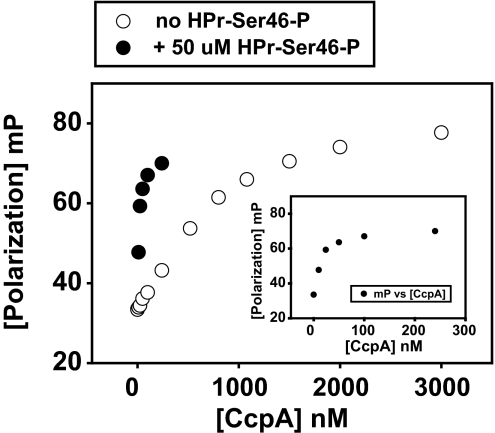
The CcpA–(HPr-Ser-46-P) complex interacts specifically with the promoter region of pel/sagA. Purified GAS CcpA was titrated to 1 nM pel/sagA cre in the absence (open circles) and presence (closed circles) of 50 μM HPr-Ser-46-P. Millipolarization units (mP) are plotted against the CcpA concentration. The shift to the left in the binding curve demonstrates stimulation of DNA–CcpA complex formation by HPr-Ser-46P (KDs for DNA interaction are 948 ± 89 nM and 14.5 ± 2.2 nM with and without HPr-Ser-46P, respectively). (Inset) Shown is relationship between CcpA concentration and mP units in the presence of HPr-Ser-46-P to clarify that saturation is already reached at a CcpA concentration of 240 nM.
Fig. 6.
Fig. 6.
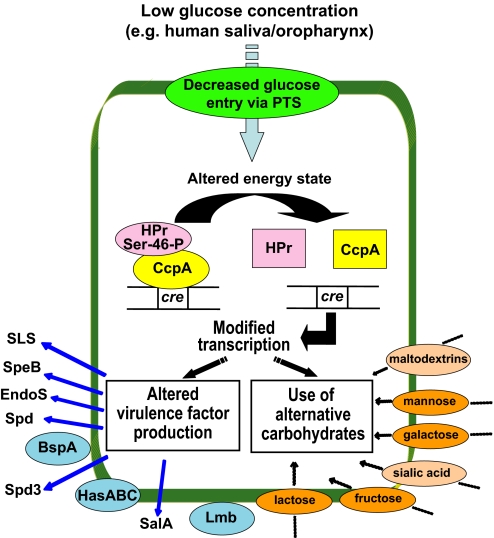
Hypothesis explaining how CcpA affects GAS carbohydrate utilization and virulence factor production. Decreased extracellular glucose levels result in dephosphorylation of HPr-Ser-46-P leading to dissociation of HPr and CcpA. CcpA/HPr dissociation results in changes in CcpA binding to DNA catabolite response element sites (cre) and altered transcription. Systems involved in the uptake and utilization of specific carbohydrates are shown on the right side of the figure. Phosphotransferase systems are shown in orange and ATP-binding cassette transport systems are in tan. On the left side of the figure, in blue, are virulence factors with the relationship of the protein names to the cell surface corresponding to their inferred location (e.g., actively secreted, anchored to the cell wall, or embedded in the cell membrane). Putative or known functions of affected virulence factors: SLS, cytolysin; SpeB, cysteine protease; EndoS, Ig cleavage; Spd and Spd3, DNases; BspA, epithelial cell-binding protein; HasABC, hyaluronic acid capsule production; SalA, salivaricin production; Lmb, laminin binding protein.

References

    1. Loughman JA, Caparon MG. A novel adaptation of aldolase regulates virulence in Streptococcus pyogenes. EMBO J. 2006;25:5414–5422. - PMC - PubMed
    1. Moyrand F, Fontaine T, Janbon G. Systematic capsule gene disruption reveals the central role of galactose metabolism on Cryptococcus neoformans virulence. Mol Microbiol. 2007;64:771–781. - PubMed
    1. Larocque RC, et al. Transcriptional profiling of Vibrio cholerae recovered directly from patient specimens during early and late stages of human infection. Infect Immun. 2005;73:4488–4493. - PMC - PubMed
    1. Faucher SP, Porwollik S, Dozois CM, McClelland M, Daigle F. Transcriptome of Salmonella enterica serovar Typhi within macrophages revealed through the selective capture of transcribed sequences. Proc Natl Acad Sci USA. 2006;103:1906–1911. - PMC - PubMed
    1. Moreno MS, Schneider BL, Maile RR, Weyler W, Saier MH., Jr Catabolite repression mediated by the CcpA protein in Bacillus subtilis: novel modes of regulation revealed by whole-genome analyses. Mol Microbiol. 2001;39:1366–1381. - PubMed

Publication types

MeSH terms

Associated data