


Performance of generalist and specialist herbivores and their endoparasitoids differs on cultivated and wild Brassica populations
- PMID: 18231835
- PMCID: PMC2239250
- DOI: 10.1007/s10886-008-9429-z
Performance of generalist and specialist herbivores and their endoparasitoids differs on cultivated and wild Brassica populations
Abstract
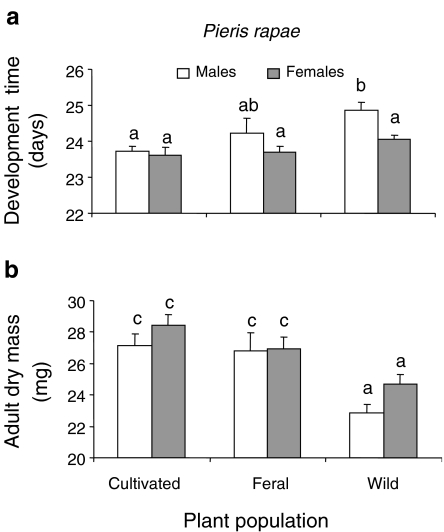
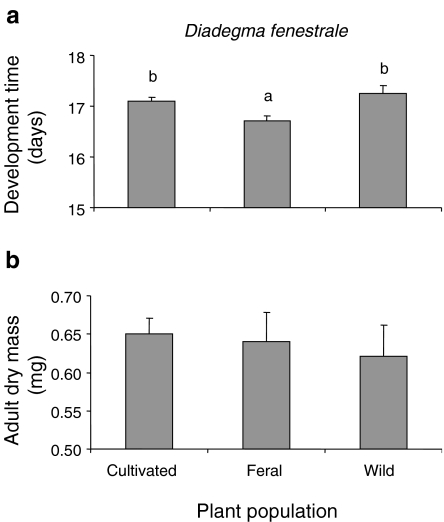
Through artificial selection, domesticated plants often contain modified levels of primary and secondary metabolites compared to their wild progenitors. It is hypothesized that the changed chemistry of cultivated plants will affect the performance of insects associated with these plants. In this paper, the development of several specialist and generalist herbivores and their endoparasitoids were compared when reared on a wild and cultivated population of cabbage, Brassica oleracea, and a recently established feral Brassica species. Irrespective of insect species or the degree of dietary specialization, herbivores and parasitoids developed most poorly on the wild population. For the specialists, plant population influenced only development time and adult body mass, whereas for the generalists, plant populations also affected egg-to-adult survival. Two parasitoid species, a generalist (Diadegma fenestrale) and a specialist (D. semiclausum), were reared from the same host (Plutella xylostella). Performance of D. semiclausum was closely linked to that of its host, whereas the correlation between survival of D. fenestrale and host performance was less clear. Plants in the Brassicaceae characteristically produce defense-related glucosinolates (GS). Levels of GS in leaves of undamaged plants were significantly higher in plants from the wild population than from the domesticated populations. Moreover, total GS concentrations increased significantly in wild plants after herbivory, but not in domesticated or feral plants. The results of this study reveal that a cabbage cultivar and plants from a wild cabbage population exhibit significant differences in quality in terms of their effects on the growth and development of insect herbivores and their natural enemies. Although cultivated plants have proved to be model systems in agroecology, we argue that some caution should be applied to evolutionary explanations derived from studies on domesticated plants, unless some knowledge exists on the history of the system under investigation.
Figures




References
-
- None
- Agrawal, A. A. 1999a. Induced plant defense: Evolution of induction and adaptive phenotypic plasticity, pp. 251–268, in A. A. Agrawal, S. Tuzun, and E. Bent (eds.). Induced Plant Defenses Against Pathogens and Herbivores. Biochemistry, Ecology and AgricultureAPS Press, St. Paul, Minnesota.
-
- None
- Agrawal, A. A. 1999b. Induced responses to herbivory in wild radish: Effects on several herbivores and plant fitness. Ecology 80:1713–1723.
-
- {'text': '', 'ref_index': 1, 'ids': [{'type': 'DOI', 'value': '10.1023/A:1024265420375', 'is_inner': False, 'url': 'https://doi.org/10.1023/a:1024265420375'}, {'type': 'PubMed', 'value': '12918924', 'is_inner': True, 'url': 'https://pubmed.ncbi.nlm.nih.gov/12918924/'}]}
- Agrawal, A. A., and Kurashige, N. S. 2003. A role for isothiocyanates in plant resistance against the specialist herbivore Pieris rapae. J. Chem. Ecol. 29:1403–1415. - PubMed
-
- {'text': '', 'ref_index': 1, 'ids': [{'type': 'DOI', 'value': '10.2307/2640814', 'is_inner': False, 'url': 'https://doi.org/10.2307/2640814'}, {'type': 'PubMed', 'value': '28565524', 'is_inner': True, 'url': 'https://pubmed.ncbi.nlm.nih.gov/28565524/'}]}
- Agrawal, A. A., Strauss, S. Y., and Stout, M. J. 1999. Costs of induced responses and tolerance to herbivory in male and female fitness components of wild radish. Evolution 53:1093–1104. - PubMed
-
- {'text': '', 'ref_index': 1, 'ids': [{'type': 'DOI', 'value': '10.1017/S0007485300000511', 'is_inner': False, 'url': 'https://doi.org/10.1017/s0007485300000511'}, {'type': 'PubMed', 'value': '11082555', 'is_inner': True, 'url': 'https://pubmed.ncbi.nlm.nih.gov/11082555/'}]}
- Azidah, A. A., Fitton, M. G., and Quicke, D. L. J. 2000. Identification of the Diadegma species (Hymenoptera: Ichneumonidae, Campopleginae) attacking the diamondback moth, Plutella xylostella (Lepidoptera: Plutellidae) . Bull. Entomol. Res. 90:375–389. - PubMed
Publication types
MeSH terms
Substances
LinkOut - more resources
Full Text Sources
