


Twelve-year depressive symptom trajectories and their predictors in a community sample of older adults
- PMID: 18234145
- PMCID: PMC2743537
- DOI: 10.1017/S1041610207006667
Twelve-year depressive symptom trajectories and their predictors in a community sample of older adults
Abstract
Introduction: The aim of this study is to understand the long-term course and outcomes of depressive symptoms among older adults in the community by examining trajectories of depressive symptoms over time and identifying profiles of depressive symptoms predicting different trajectories.
Method: We measured depressive symptoms biennially for up to 12 years, using the modified Center for Epidemiological Studies-Depression (mCES-D) scale, in 1260 community-based adults aged 65+ years. We determined latent trajectories of total mCES-D scores over time. We identified symptom profiles based on subgroups of baseline depressive symptoms derived from factor analysis, and examined their associations with the different trajectories.
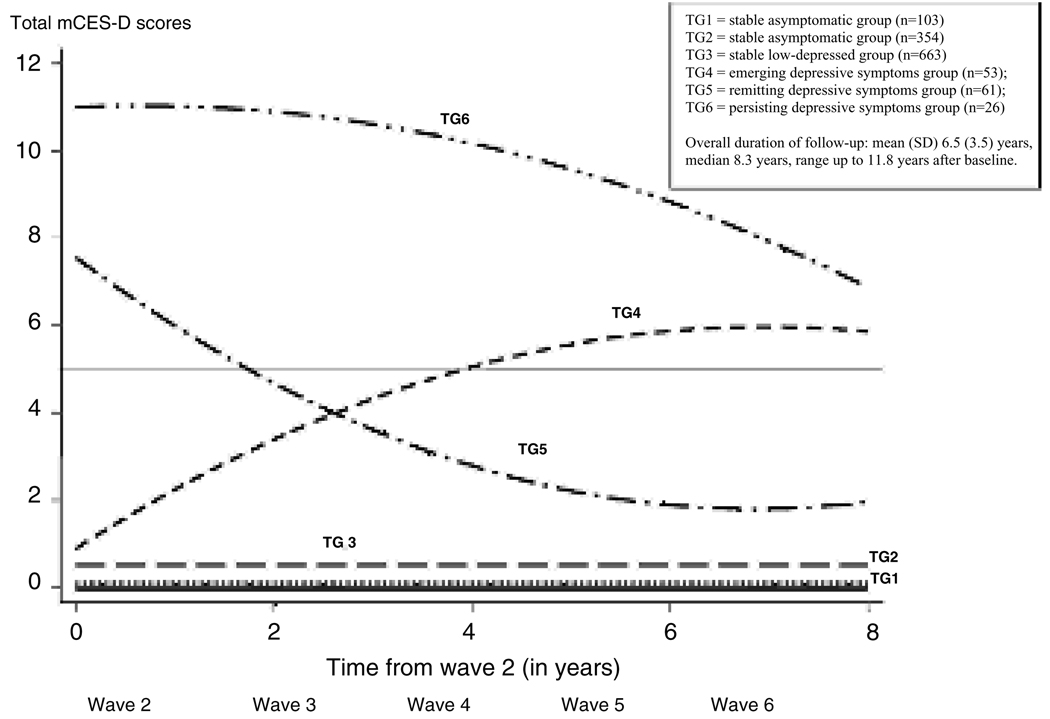
Results: Six trajectories were identified. Two had one or no depressive symptoms at baseline and flat trajectories during follow-up. Two began with low baseline symptom scores and then diverged; female sex and functional disability were associated with future increases in depressive symptoms. Two trajectories began with high baseline scores but had different slopes: the higher trajectory was associated with medical burden, higher overall baseline score, and higher baseline scores on symptom profiles including low self-esteem, interpersonal difficulties, neurovegetative symptoms, and anhedonia. Mortality was higher among those in the higher trajectories.
Conclusions: In the community at large, those with minimal depressive symptoms are more likely to experience future increases in symptoms if they are women and have functional disability. Among those with higher current symptom levels, depression is more likely to persist over time in individuals who have greater medical burden and specific depressive symptoms.
Conflict of interest statement
Benoit H. Mulsant has received research funds or honoraria from AstraZeneca, Bristol-Myers Squibb Company, Corcept Therapeutics, Eli Lilly and Co., Eisai, Fox Learning System, GlaxoSmithKline, Janssen-Ortho Inc., Lundbeck Inc., Janssen and and Pfizer Inc.; he directly owns stock (less than $10,000) in Akzo- Nobel N.V., Alkermes, Inc., AstraZeneca, Biogen Idec, Celsion Corp., Elan Corp., plc, Eli Lilly and Co., Forest Pharmaceuticals, The Immune Response Corporation, and Pfizer Inc.
Figures
References
-
- Akiskal H. Mood disorders: clinical features. In: Sadock B, Sadock V, editors. Comprehensive Textbook of Psychiatry. New York: Lippincott Williams and Wilkins; 2005. pp. 1611–1652.
-
- Alexopoulos GS. Depression in the elderly. Lancet. 2005;365:1961–1970. - PubMed
-
- Anderson E. Prognosis of the depressions of later life. American Journal of Psychiatry. 1936:559–588.
-
- Beekman AT, Deeg DJ, Braam AW, Smit JH, Van Tilburg W. Consequences of major and minor depression in later life: a study of disability, well-being and service utilization. Psychological Medicine. 1997;27:1397–1409. - PubMed
-
- Beekman AT, Copeland JR, Prince MJ. Review of community prevalence of depression in later life. British Journal of Psychiatry. 1999;174:307–311. - PubMed
Publication types
MeSH terms
Grants and funding
LinkOut - more resources
Full Text Sources
Medical
