


Potent human immunodeficiency virus-neutralizing and complement lysis activities of antibodies are not obligatorily linked
- PMID: 18234794
- PMCID: PMC2293011
- DOI: 10.1128/JVI.02569-07
Potent human immunodeficiency virus-neutralizing and complement lysis activities of antibodies are not obligatorily linked
Abstract
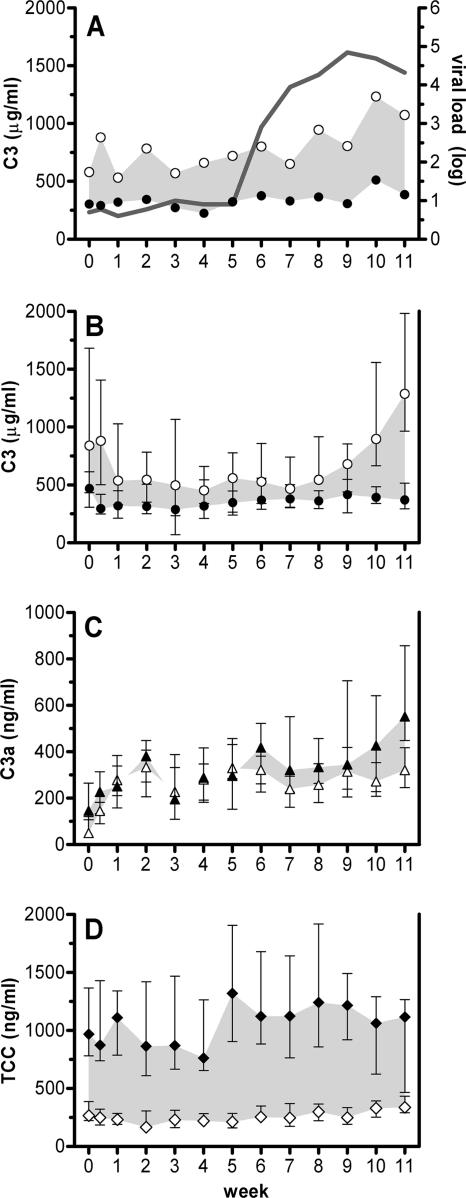
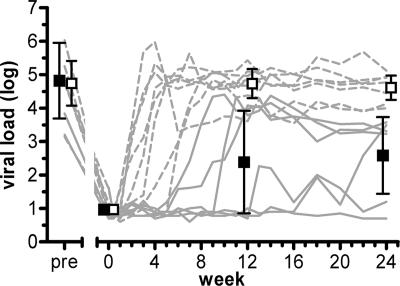
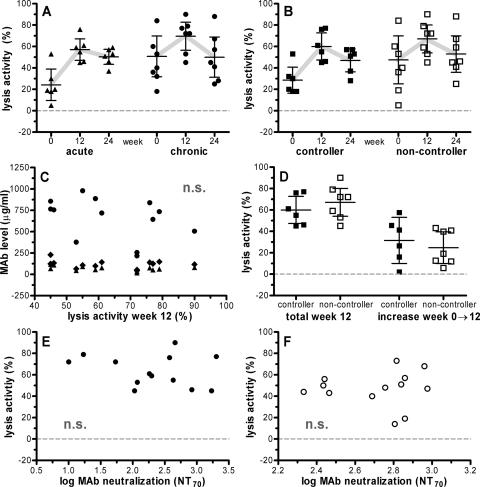
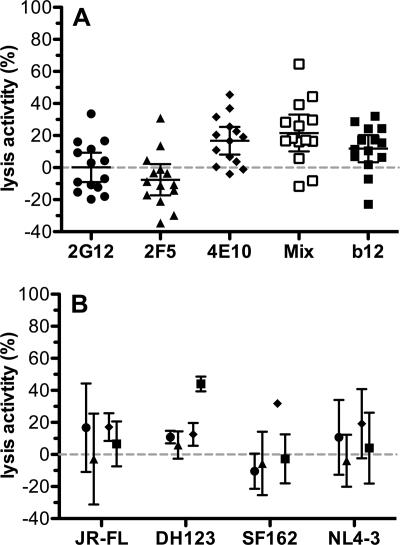
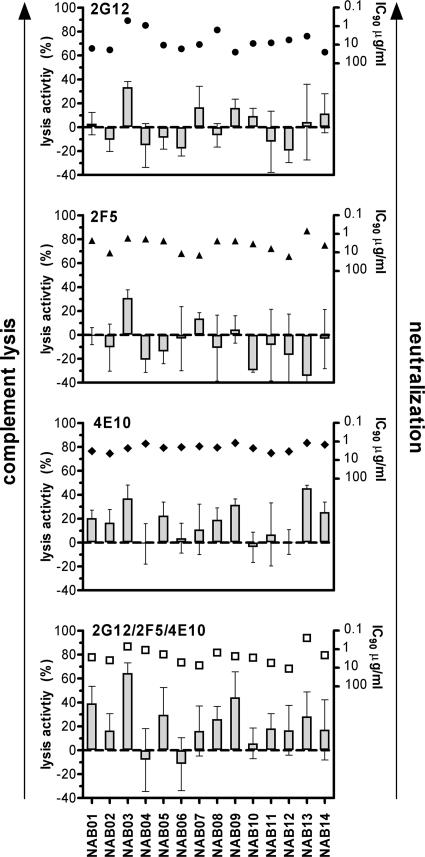
To evaluate the contribution of complement-mediated lysis to the in vivo activities of neutralizing antibodies, we analyzed the influence of complement activation on treatment success in a recent passive immunization trial with the neutralizing monoclonal antibodies 2G12, 2F5, and 4E10. Administration of monoclonal antibodies led to an immediate, high activation of the complement system even in the absence of viremia in the 14 participating human immunodeficiency virus-infected individuals. Lysis activity measured in patient plasma increased during passive immunization; however, the increases were modest and only partially attributable to the administration of antibodies. We found that unlike neutralization activity, lysis activity was not associated with treatment success in this trial. Compared to complement lysis mounted by the polyclonal antibody response in vivo, monoclonal antibodies were weak inducers of this activity, suggesting that polyclonal responses are more effective in reaching the required threshold of complement activation. Importantly, strong neutralization activity of the monoclonal antibodies did not predict complement lysis activity against patient and reference viruses, suggesting that these activities are not linked. In summary, our data support the notion that the in vivo activities of 2G12, 2F5, and 4E10 are likely due to direct neutralization or Fc receptor-mediated mechanisms such as phagocytosis and antibody-dependent cellular cytotoxicity.
Figures
References
-
- Aasa-Chapman, M. M., S. Holuigue, K. Aubin, M. Wong, N. A. Jones, D. Cornforth, P. Pellegrino, P. Newton, I. Williams, P. Borrow, and A. McKnight. 2005. Detection of antibody-dependent complement-mediated inactivation of both autologous and heterologous virus in primary human immunodeficiency virus type 1 infection. J. Virol. 792823-2830. - PMC - PubMed
-
- Albert, J., B. Abrahamsson, K. Nagy, E. Aurelius, H. Gaines, G. Nystrom, and E. M. Fenyo. 1990. Rapid development of isolate-specific neutralizing antibodies after primary HIV-1 infection and consequent emergence of virus variants which resist neutralization by autologous sera. AIDS 4107-112. - PubMed
-
- Arendrup, M., C. Nielsen, J. E. Hansen, C. Pedersen, L. Mathiesen, and J. O. Nielsen. 1992. Autologous HIV-1 neutralizing antibodies: emergence of neutralization-resistant escape virus and subsequent development of escape virus neutralizing antibodies. J. Acquir. Immune Defic. Syndr. 5303-307. - PubMed
-
- Baba, T. W., V. Liska, R. Hofmann-Lehmann, J. Vlasak, W. Xu, S. Ayehunie, L. A. Cavacini, M. R. Posner, H. Katinger, G. Stiegler, B. J. Bernacky, T. A. Rizvi, R. Schmidt, L. R. Hill, M. E. Keeling, Y. Lu, J. E. Wright, T. C. Chou, and R. M. Ruprecht. 2000. Human neutralizing monoclonal antibodies of the IgG1 subtype protect against mucosal simian-human immunodeficiency virus infection. Nat. Med. 6200-206. - PubMed
-
- Bajtay, Z., C. Speth, A. Erdei, and M. P. Dierich. 2004. Cutting edge: productive HIV-1 infection of dendritic cells via complement receptor type 3 (CR3, CD11b/CD18). J. Immunol. 1734775-4778. - PubMed
Publication types
MeSH terms
Substances
LinkOut - more resources
Full Text Sources
Other Literature Sources
Medical
