


The elastic properties of the structurally characterized myosin II S2 subdomain: a molecular dynamics and normal mode analysis
- PMID: 18234833
- PMCID: PMC2367198
- DOI: 10.1529/biophysj.107.122028
The elastic properties of the structurally characterized myosin II S2 subdomain: a molecular dynamics and normal mode analysis
Abstract
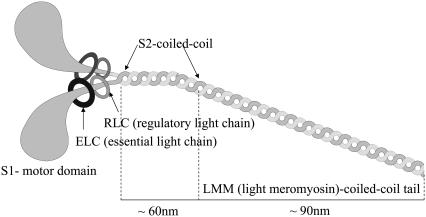
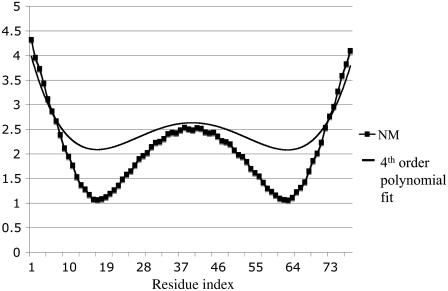
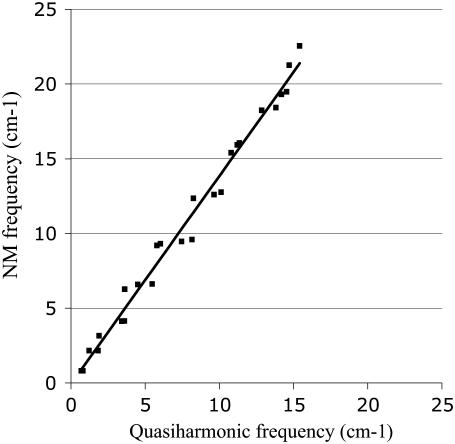
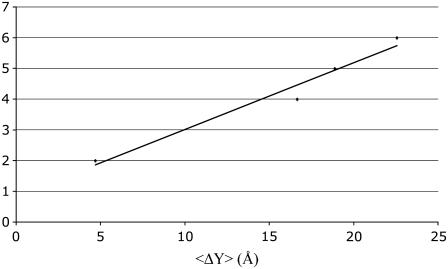
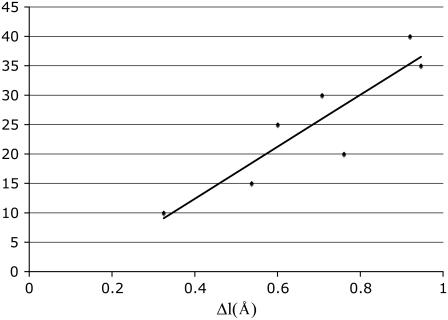
The elastic properties (stretching and bending moduli) of myosin are expected to play an important role in its function. Of particular interest is the extended alpha-helical coiled-coil portion of the molecule. Since there is no high resolution structure for the entire coiled-coil, a study is made of the scallop myosin II S2 subdomain for which an x-ray structure is available (Protein Data Bank 1nkn). We estimate the stretching and bending moduli of the S2 subdomain with an atomic level model by use of molecular simulations. Results were obtained from nonequilibrium molecular dynamics simulations in the presence of an external force, from the fluctuations in equilibrium molecular dynamics simulations and from normal modes. In addition, a poly-Ala (78 amino acid residues) alpha-helix model was examined to test the methodology and because of its interest as part of the lever arm. As expected, both the alpha-helix and coiled-coil S2 subdomain are very stiff for stretching along the main axis, with the stretching stiffness constant in the range 60-80 pN/nm (scaled to the 60 nm long S2). Both molecules are much more flexible for bending with a lateral stiffness of approximately 0.010 pN/nm for the S2 and 0.0055 pN/nm for the alpha-helix (scaled to 60 nm). These results are expected to be useful in estimating cross-bridge elasticity, which is required for understanding the strain-dependent transitions in the actomyosin cycle and for the development of three-dimensional models of muscle contraction.
Figures
References
-
- Craig, R., and R. Padron. 2004. The structure of contractile filaments. In Myology, A. G. Engel and C. Franzini-Armstrong, editors. McGraw-Hill, New York. 129–166.
-
- Huxley, H. E., and J. Hanson. 1954. Changes in the cross-striations of muscle during contraction and stretch and their structural interpretation. Nature. 173:973–976. - PubMed
-
- Huxley, A. F., and R. Niedergerke. 1954. Structural changes in muscle during contraction: interference microscopy of living muscle fibers. Nature. 173:971–973. - PubMed
-
- Huxley, A. F. 1957. Muscle structure and theories of contraction. Prog. Biophys. Biophys. Chem. 7:255–318. - PubMed
-
- Huxley, A. F., and R. M. Simmons. 1971. Proposed mechanism of force generation in striated muscle. Nature. 233:533–538. - PubMed
Publication types
MeSH terms
Substances
Grants and funding
LinkOut - more resources
Full Text Sources
Other Literature Sources
