Comparative Study
. 2008 Jan 30;28(5):1185-97.
doi: 10.1523/JNEUROSCI.3908-07.2008.

Differential tonic GABA conductances in striatal medium spiny neurons

Affiliations
Comparative Study

Differential tonic GABA conductances in striatal medium spiny neurons

Kristen K Ade et al. J Neurosci. .

Abstract

Medium spiny neurons (MSNs) provide the principal output for the dorsal striatum. Those that express dopamine D2 receptors (D2+) project to the globus pallidus external and are thought to inhibit movement, whereas those that express dopamine D1 receptors (D1+) project to the substantia nigra pars reticulata and are thought to facilitate movement. Whole-cell and outside-out patch recordings in slices from bacterial artificial chromosome transgenic mice examined the role of GABA(A) receptor-mediated currents in dopamine receptor D1+ striatonigral and D2+ striatopallidal MSNs. Although inhibitory synaptic currents were similar between the two neuronal populations, D2+ MSNs showed greater GABA(A) receptor-mediated tonic currents. TTX application abolished the tonic current to a similar extent as GABA(A) antagonists, suggesting a synaptic origin of the ambient GABA. Low GABA concentrations produced larger whole-cell responses and longer GABA channel openings in D2+ than in D1+ MSNs. Recordings from MSNs in alpha1-/- mice and pharmacological analysis of tonic currents suggested greater expression of alpha5-containing GABA(A) receptors in D2+ than in D1+ MSNs. As a number of disorders such as Parkinson's disease, Huntington's chorea, and tardive dyskinesia arise from an imbalance between these two pathways, the GABA(A) receptors responsible for tonic currents in D2+ MSNs may be a potential target for therapeutic intervention.


Figures
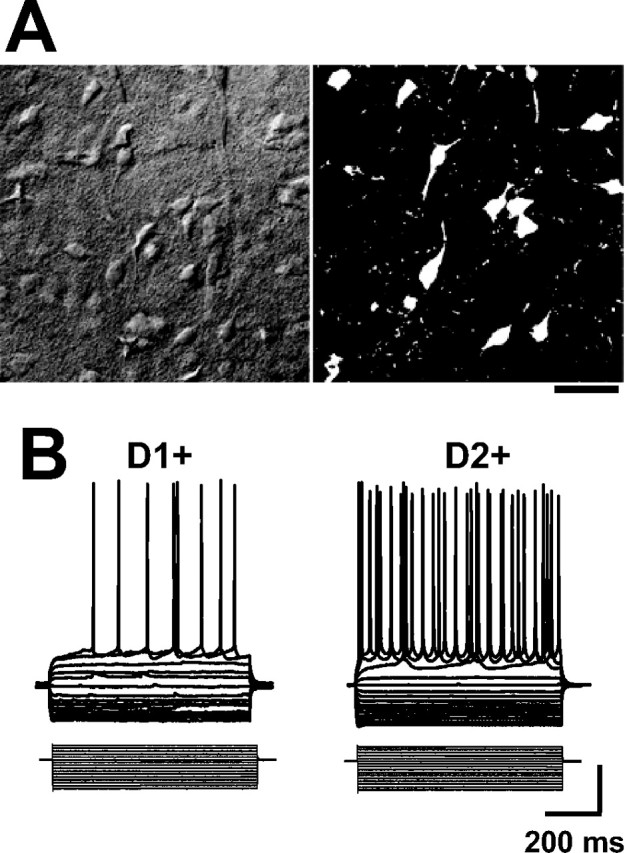
Figure 1.
Figure 1.
Characteristics of D1+ and D2+ medium spiny neurons. A, Examples of differential interference contrast (left) and fluorescence (right) confocal micrographs of a corticostriatal slice prepared from a BAC D2 EGFP mouse. EGFP expression was used to classify MSNs as D1+ or D2+. Scale bar, 20 μm. B, Examples of current-clamp recordings with K-gluconate internal, demonstrating responses to a series of hyperpolarizing and depolarizing current injections (20 pA steps) from RMPs of −65 mV in a D1+ and D2+ MSN. Calibration: 20 mV, 100 pA.
Figure 2.
Figure 2.
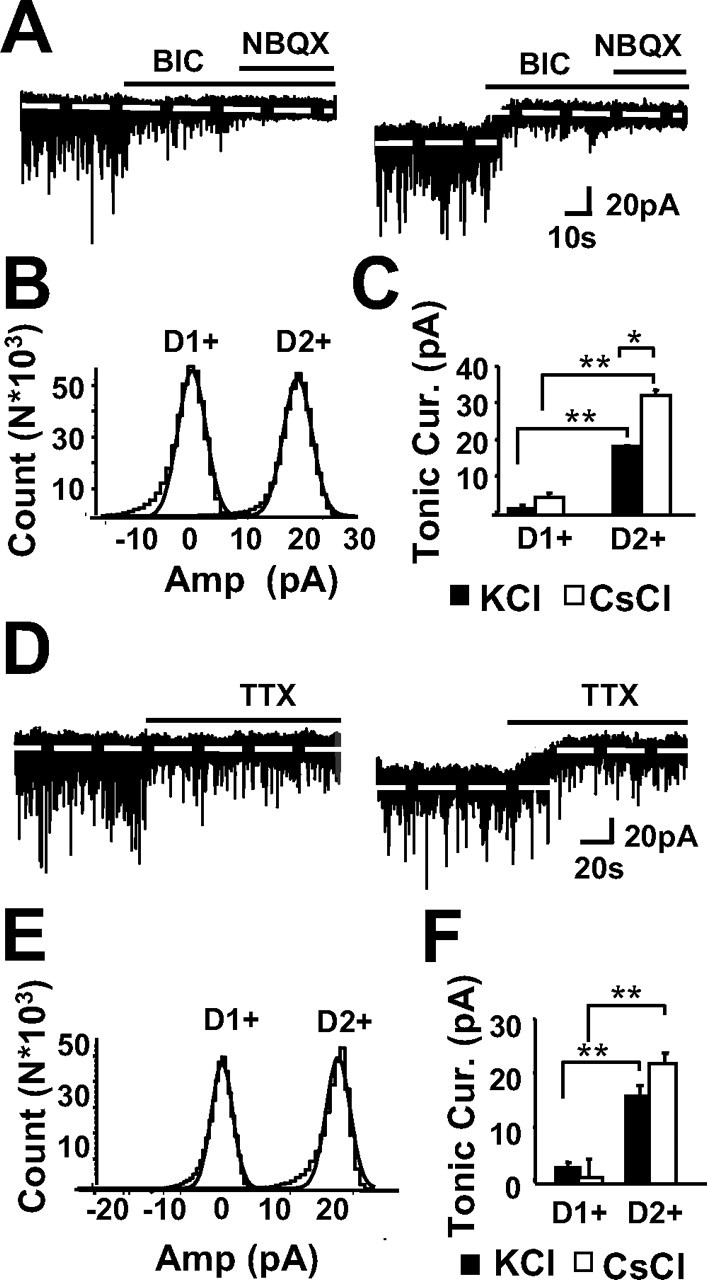
D2+ MSNs demonstrate larger GABAA receptor-mediated tonic currents than D1+ MSNs. A, Representative traces from a D1+ MSN (left) and a D2+ MSN (right) demonstrate that BIC (25 μm) blocked sIPSCs in both cell types but only revealed an endogenous GABA-mediated tonic current in the D2+ MSN. The remaining sEPSCs in both cell types were blocked by NBQX (5 μm) with no effects on the tonic current. B, The mean of the baseline current during BIC application from the representative traces in A were adjusted to 0, and the amplitude distributions were drawn from segments immediately preceding BIC application. The non-skewed sides of the amplitude histograms were fit with a Gaussian, the peak of which was used to determine the absolute magnitude of tonic current blocked by BIC. C, Summary of tonic currents blocked by BIC (25 μm) with KCl internal (black bars; n = 23 and 44) and with CsCl internal (white bars; n = 7 and 9) in D1+ and D2+ MSNs, respectively. D, Representative traces from a D1+ MSN (left) and a D2+ MSN (right) demonstrate that blockade of voltage-gated Na+ channels with TTX (0.5 μm) reduces the frequency and amplitude of postsynaptic events in both cell types but only alters the amount of holding current required to maintain the holding voltage at −60 mV in the D2+ MSN. E, Amplitude distributions representing the tonic current abolished by TTX, drawn from segments in D as described above for BIC (B). F, Summary of tonic current blocked by TTX (0.5 μm) from recordings with KCl internal (black bars; n = 11 and 32) and with CsCl internal (white bars; n = 6 and 7) in D1+ and D2+ MSNs, respectively.
Figure 3.
Figure 3.
GABAA receptor-mediated sIPSCs and mISPCs do not differ between D1+ and D2+ MSNs. A, Representative traces showing sIPSCs in a D1+ MSN (top) and a D2+ MSN (bottom). Calibration: 1 s, 25 pA. Summary of the mean amplitude (B), frequency of events (C), tau values (D), and rise time (E) for sIPSCs in D1+ and D2+ MSNs. sIPSC values were measured using KCl internal (black bars; n = 6 and 12) and with CsCl internal (white bars; n = 8 and 10) from D1+ and D2+ MSNs, respectively. G, Representative traces demonstrate mIPSCs in a D1+ MSN (top) and a D2+ MSN (bottom). Calibration: 1 s, 25 pA. Summary of the mean amplitude (H), frequency of events (I), tau values (J), and rise time (K) for mIPSCs in D1+ and D2+ MSNs. mIPSCs values were measured from the same cells represented in B–D using KCl internal (black bars) and CsCl internal (white bars) by subsequent application of TTX (500 nm), NBQX (5 μm), and strychnine (500 nm). Cumulative probability plots for the average mIPSC (F), amplitude, and interevent interval (L) from D1+ MSNs (dashed black line; n = 9) and D2+ MSNs (solid gray line; n = 10) recorded with CsCl internal.
Figure 4.
Figure 4.
Greater sensitivity to exogenously applied GABA in D2+ than in D1+ MSNs. Representative traces (A) and summary dose–response data (B) of the whole-cell currents elicited by increasing doses of GABA applied in the presence of TTX (0.5 μm), NBQX (5 μm), and strychnine (0.5 μm) in D1+ and D2+ MSNs. The EC50 for GABA was 107.3 ± 0.5 and 18.2 ± 1.9 μm and the Hill coefficient was 1.04 ± 0.05 and 1.75 ± 0.18 for D1+ and D2+ MSNs, respectively. All recordings were performed with KCl internal solution, and data were derived from at least sixteen cells in each group. Data on whole-cell currents induced by 0.5 μm and 5 μm GABA (C) for D1+ MSNs (white bar) and D2+ MSNs (black bar) are illustrated for clarity. D, A summary of whole-cell currents elicited by 0.5 μm and 5 μm THIP in D1+ MSNs (white bars) and D2+ MSNs (black bars). E, Dose–response data of whole-cell recordings of THIP elicited currents normalized to currents elicited by a saturating dose of GABA (2 mm; GABAsat) in each cell. For both D and E, recordings were performed in the presence of TTX (0.5 μm), NBQX (5 μm), and strychnine (0.5 μm), and data were derived from at least six MSNs in each group.
Figure 5.
Figure 5.
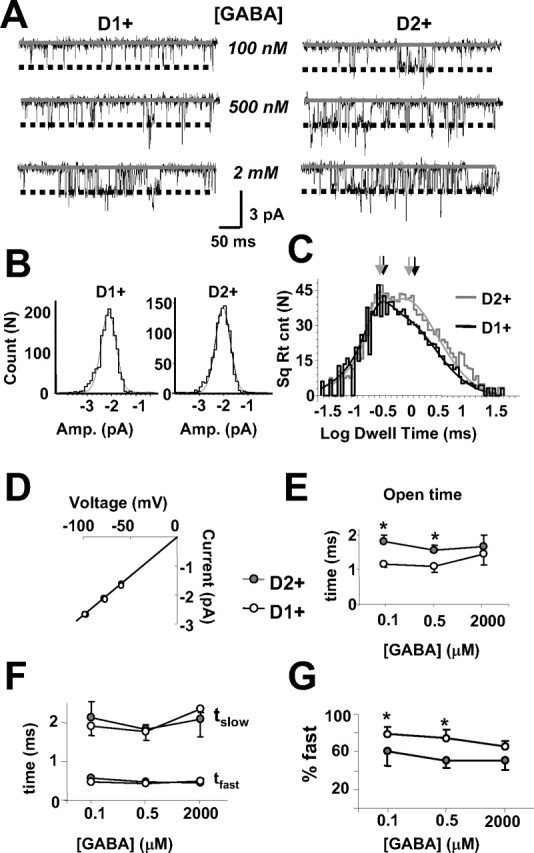
GABA channel currents in excised patches from D1+ and D2+ MSNs. A, Representative examples of currents elicited by three concentrations of GABA (100 nm, 500 nm, and 2 mm) in patches excised from a D1+ and a D2+ MSN and held at −80 mV. Dashed lines illustrate the main conductance level derived from channel current histograms shown in B. Histograms were fit with a Gaussian, and the peak of the curve defined the main conductance level. The main opening levels for the channel currents elicited by 500 nm GABA in the patches represented in A were 2.18 ± 0.09 pA for the D1+ MSN and 2.19 ± 0.08 pA for the D2+ MSN. C, Overlapping open time distributions with a multiple Gaussian fit on a logarithmic scale for the patches illustrated in A elicited by 500 nm GABA. Time constants of the distributions indicated by arrows were 0.41 ms (fast) and 1.9 ms (slow) (81% fast component) and 0.39 ms (fast) and 1.85 ms (slow) (59% fast component) for the D1+ and the D2+ MSN, respectively. D, Current to voltage relationship for the main open state of GABA-elicited currents in patches excised from D1+ (n = 9) and D2+ (n = 8) MSNs. The slope conductance from the linear fits illustrated was 27.9 ± 0.4 and 27.5 ± 0.4 pS for the D1+ and the D2+ MSNs, respectively. E, Summary of mean open times for the channel openings at the main conductance for three GABA concentrations. F, Summary of the open time distributions for the two main open time constants as in C at each concentration tested. G, Summary of the percentage contribution of the fast open time to the fit constant at the three concentrations of GABA.
Figure 6.
Figure 6.
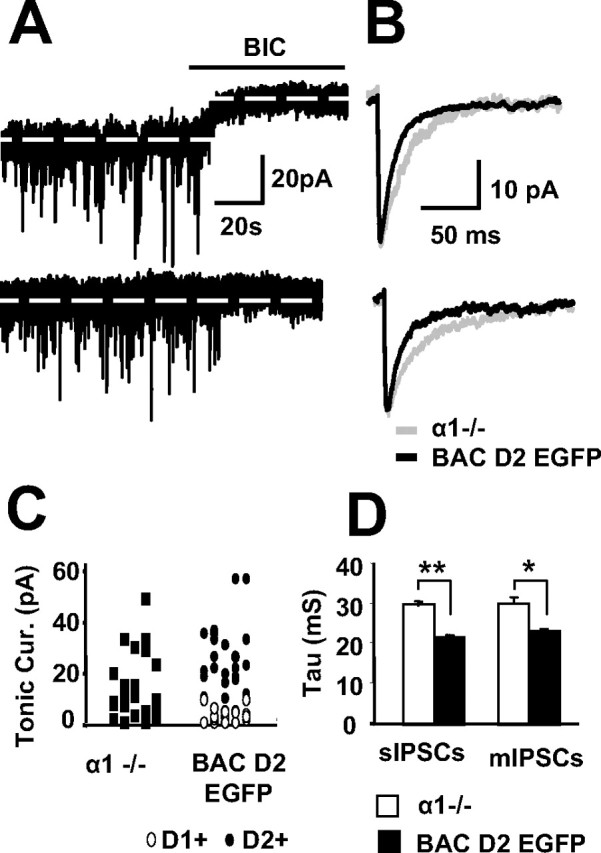
The role of the α1 subunit in MSN tonic and phasic inhibition. A, Representative traces demonstrate the occurrence of sIPSCs and the response to BIC in two examples of MSNs in striatal slices derived from a postnatal day 19 α1−/− mouse. B, Overlaying representative traces of sIPSCs (top) and mIPSCs (bottom) from MSNs in α1−/− (gray) and BAC D2 EGFP (black) mice. C, Comparison of the distributions of BIC-sensitive tonic currents in 21 MSNs from α1−/− mice and a sample of 15 D1+ and 15 D2+ MSNs from BAC D2 EGFP mice illustrates a similar scatter. D, Summary of mean tau values for sIPSCs and mIPSCs in MSNs from 12 α1−/− (white bars) and a pool of six D1+ and six D2+ MSNs from age-matched BAC D2 EGFP mice (black bars).
Figure 7.
Figure 7.
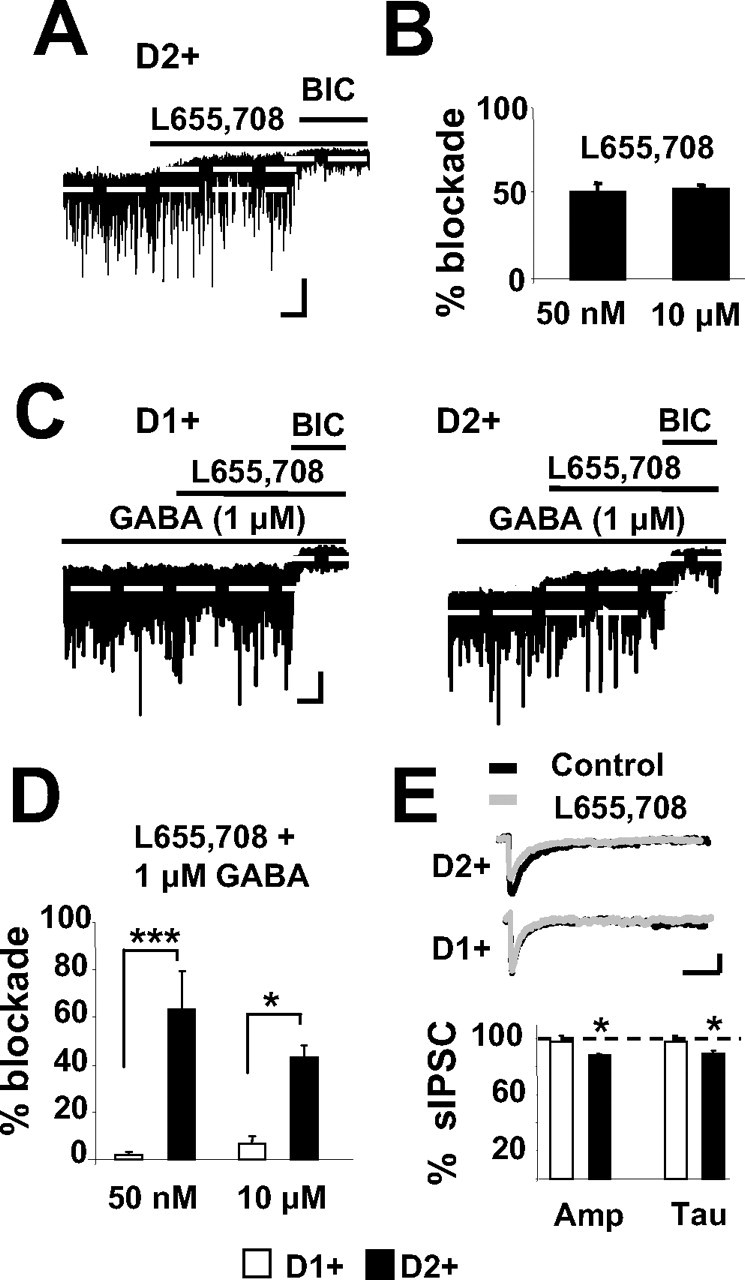
L655,703 antagonizes GABAA receptor-mediated tonic currents in D2+ MSNs. A, Representative trace showing the effects of L655,703 (10 μm) on sIPSCs and on BIC-sensitive tonic current in a D2+ MSN. Calibration: 20 ms, 30 pA. B, Summary of tonic current blocked by L655,703 (50 nm, n = 4; 10 μm, n = 8) in D2+ MSNs. C, Representative traces showing the effects of L655,703 (10 μm) on sIPSCs and BIC-sensitive tonic currents elicited by bath application of 1 μm GABA in a D1+ MSN and a D2+ MSN. Calibration: 20 ms, 30 pA. D, Summary of the percentage blockade by L655,708 of the BIC-sensitive tonic current elicited by bath application of 1 μm GABA in D1+ MSNs (100 nm, n = 3; 10 μm, n = 5) and in D2+ MSNs (50 nm, n = 2; 10 μm, n = 4). E, Representative traces showing overlapping sIPSCs recorded in a D1+ MSN (top) and a D2+ MSN (middle) in the presence (gray trace) and the absence (black trace) of 10 μm L655,703, as well as the summary of the changes in sIPSC amplitude (Amp) and decay time (Tau) produced by 10 μm L655,703 in six D1+ and seven D2+ MSNs (bottom) represented as percentage of baseline values. Calibration: 20 ms, 30 pA.
Figure 8.
Figure 8.
Blocking GABAA receptor currents reduces action potential firing frequency in D2+ MSNs. A, Representative example of a current-clamp recording from a D2+ MSN illustrating the responses to a series of hyperpolarizing and depolarizing current injections (20 pA steps) recorded with K-gluconate internal in the absence and the presence of 10 μm gabazine. Calibration: 15 mV, 80 pA. B, Summary of action potential firing frequency in response to increasing depolarizing current injections recorded with K-gluconate internal solution in D1+ (■) and D2+ (▲) MSNs the absence or the presence [D1+ (□) and D2+ (△)] of 10 μm gabazine. Data derive from six D1+ and seven D2+ MSNs. C, Representative example of a D2+ MSN demonstrates action potential firing evoked by stimulation of glutamatergic afferents and assessed using extracellular recording in cell-attached configuration in the absence (left) or the presence (right) of 50 nm L655,703. Calibration: 3 ms, 40 pA.

References

    1. Ade KK, Lovinger DM. Anandamide regulates postnatal development of long-term synaptic plasticity in the rat dorsolateral striatum. J Neurosci. 2007;27:2403–2409. - PMC - PubMed
    1. Alexi T, Borlongan CV, Faull RL, Williams CE, Clark RG, Gluckman PD, Hughes PE. Neuroprotective strategies for basal ganglia degeneration: Parkinson's and Huntington's diseases. Prog Neurobiol. 2000;60:409–470. - PubMed
    1. Augood SJ, Herbison AE, Emson PC. Localization of GAT-1 GABA transporter mRNA in rat striatum: cellular coexpression with GAD67 mRNA, GAD67 immunoreactivity, and parvalbumin mRNA. J Neurosci. 1995;15:865–874. - PMC - PubMed
    1. Barberis A, Mozrzymas JW, Ortinski PI, Vicini S. Desensitization and binding properties determine distinct alpha1beta2gamma2 and alpha3beta2gamma2 GABA(A) receptor channel kinetic behavior. Eur J Neurosci. 2007;25:2726–2740. - PMC - PubMed
    1. Belelli D, Peden DR, Rosahl TW, Wafford KA, Lambert JJ. Extrasynaptic GABAA receptors of thalamocortical neurons: a molecular target for hypnotics. J Neurosci. 2005;25:11513–11520. - PMC - PubMed

Publication types