. 2008 Apr;19(4):812-24.
doi: 10.1681/ASN.2007070736. Epub 2008 Jan 30.

Antibody-mediated rejection of the kidney after simultaneous pancreas-kidney transplantation

Affiliations

Antibody-mediated rejection of the kidney after simultaneous pancreas-kidney transplantation

Julio Pascual et al. J Am Soc Nephrol. 2008 Apr.

Abstract

The prevalence, risk factors, and outcome of antibody-mediated rejection (AMR) of the kidney after simultaneous pancreas-kidney transplantation are unknown. In 136 simultaneous pancreas-kidney recipients who were followed for an average of 3.1 yr, 21 episodes of AMR of the kidney allograft were identified. Eight episodes occurred early (</=90 d) after transplantation, and 13 occurred later. Histologic evidence of concomitant acute cellular rejection was noted in 12 cases; the other nine had evidence only of humoral rejection. In 13 cases, clinical rejection of the pancreas was diagnosed simultaneously, and two of these were biopsy proven and were positive for C4d immunostaining. Multivariate analysis identified only one significant risk factor: Female patients were three times more likely to experience AMR. Nearly all early episodes resolved with treatment and did not predict graft loss, but multivariate Cox models revealed that late AMR episodes more than tripled the risk for kidney and pancreas graft loss; therefore, new strategies are needed to prevent and to treat late AMR in simultaneous pancreas-kidney transplant recipients.


Figures
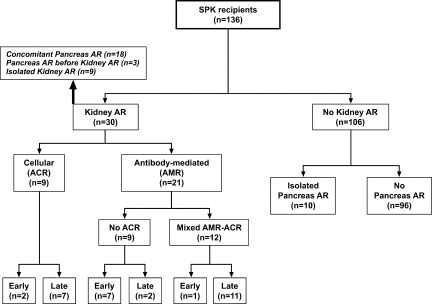
Figure 1.
Figure 1.
Patient distribution according to kidney and pancreas acute rejection.
Figure 2.
Figure 2.
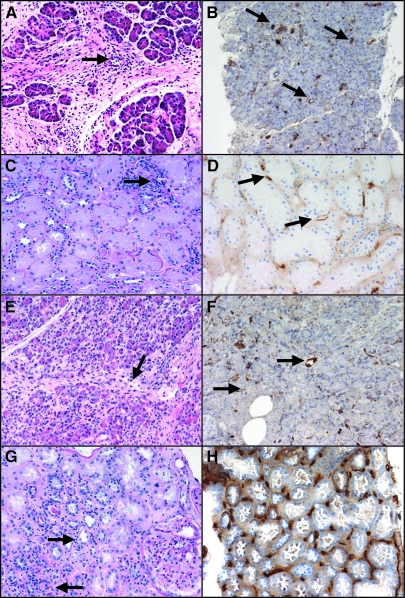
Histopathology of the allografts in a patient with kidney and pancreas AMR. (A) Light micrograph of the transplant pancreas (postoperative day [POD] 155) shows moderate septal mononuclear inflammatory infiltrate with eosinophils and venous endothelialitis (arrow), grade II pancreas acute rejection (hematoxylin and eosin). (B) C4d immunolabeling of the same POD 155 pancreas biopsy reveals interacinar capillaries diffusely positive for C4d (arrows). (C) Periodic acid-Schiff stain section of the transplant kidney (POD 376) shows mild acute tubular injury, mild interstitial mononuclear inflammation (i1), and no tubulitis (t0). There is focal mild capillary margination of leukocytes (PTC score 1, arrows23). (D) C4d focally positive in the same POD 376 kidney biopsy (arrows). (E) Light micrograph of the transplant pancreas (POD 467) shows moderate septal and interacinar (arrows) mononuclear infiltrates with focal endothelialitis (arrow), grade III pancreas acute rejection (hematoxylin and eosin). (F) Interacinar capillaries diffusely positive for C4d in the same POD 467 pancreas biopsy). (G) Light micrograph of the transplant kidney 4 d later (POD 471) shows again mild interstitial inflammation with leukocyte margination (arrows) and no tubulitis. (H) Same POD 471 biopsy shows peritubular capillaries diffusely positive for C4d. Magnifications: ×200 in A and C through G; ×100 in B.
Figure 3.
Figure 3.
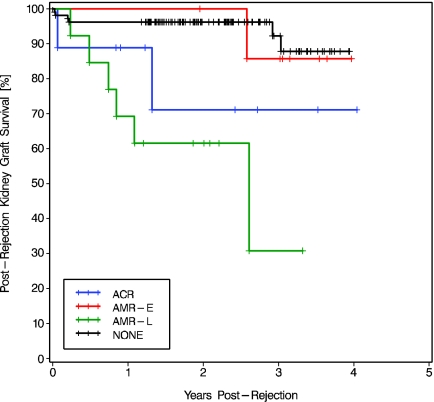
Kaplan Meier postrejection kidney graft survival in patients who developed ACR, early AMR (AMR-E), or late AMR (AMR-L), compared with posttransplantation kidney graft survival in nonrejectors (NONE). The overall comparison was significantly different (log rank P < 0.0001, Wilcoxon P < 0.0001). Two-stratum comparisons ACR versus AMR-E and ACR versus AMR-L were NS. Patients with ACR had lower kidney graft survival than no rejectors (log-rank P = 0.059, Wilcoxon P = 0.028). Patients with AMR-L showed lower kidney graft survival than those with AMR-E (log-rank P = 0.035, Wilcoxon P = 0.041) or without rejection (log-rank P < 0.0001, Wilcoxon P < 0.0001).
Figure 4.
Figure 4.
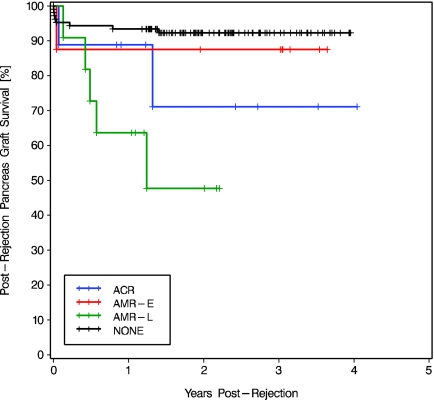
Kaplan Meier postrejection pancreas graft survival in patients who developed ACR, AMR-E, or AMR-L, compared with posttransplantation pancreas graft survival in nonrejectors (NONE). The overall comparison was significantly different (log rank P = 0.001, Wilcoxon P = 0.002). Two-stratum comparisons ACR versus AMR-E, ACR versus AMR-L, AMR-E versus AMR-L, and ACR versus NONE were NS. Patients with AMR-L had significantly lower pancreas survival than nonrejectors (log-rank P < 0.0001, Wilcoxon P = 0.0001).
Figure 5.
Figure 5.
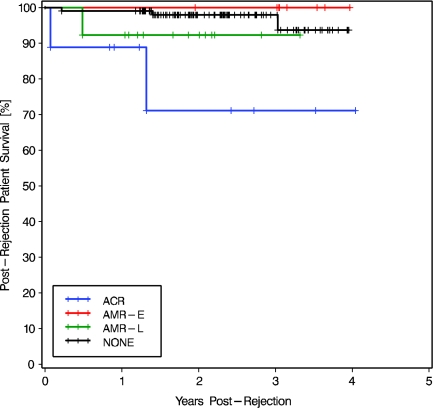
Kaplan Meier postrejection patient survival in patients who developed ACR, AMR-E, or AMR-L, compared with posttransplantation patient survival in nonrejectors (NONE). The overall comparison was significantly different (log rank P = 0.016, Wilcoxon P = 0.006). Two-stratum comparisons ACR versus AMR-E and ACR versus AMR-L were NS, whereas patients with ACR had lower survival than nonrejectors (log-rank P = 0.002, Wilcoxon P = 0.0003).

References

    1. Rayhill SC, D'Alessandro AM, Odorico JS, Knechtle SJ, Pirsch JD, Heisey DM, Kirk AD, Van der Werf W, Sollinger HW: Simultaneous pancreas-kidney transplantation and living related donor renal transplantation in patients with diabetes: Is there a difference in survival? Ann Surg 231: 417–423, 2000 - PMC - PubMed
    1. Sollinger HW, Odorico JS, Knechtle SJ, D'Alessandro AM, Kalayoglu M, Pirsch JD: Experience with 500 simultaneous pancreas-kidney transplants. Ann Surg 228: 284–296, 1998 - PMC - PubMed
    1. Di Carlo A, Odorico JS, Leverson GE, Fernandez LA, Chin LT, Becker YT, Knechtle SJ, Pirsch JD, D'Alessandro AM, Sollinger HW. Long-term outcomes in simultaneous pancreas-kidney transplantation: Lessons relearned. Clin Transpl 215–220, 2003 - PubMed
    1. Fernandez LA, Di Carlo A, Odorico JS, Leverson GE, Shames BD, Becker YT, Chin LT, Pirsch JD, Knechtle SJ, Foley DP, Sollinger HW, D'Alessandro AM: Simultaneous pancreas-kidney transplantation from donation after cardiac death: Successful long-term outcomes. Ann Surg 242: 716–723, 2005 - PMC - PubMed
    1. Salvalaggio PR, Schnitzler MA, Abbott KC, Brennan DC, Irish W, Takemoto SK, Axelrod D, Santos LS, Kocak B, Willoughby L, Lentine KL: Patient and graft survival implications of simultaneous pancreas kidney transplantation from old donors. Am J Transplant 7: 1561–1571, 2007 - PubMed

Publication types