


Heterozygous CAV1 frameshift mutations (MIM 601047) in patients with atypical partial lipodystrophy and hypertriglyceridemia
- PMID: 18237401
- PMCID: PMC2276215
- DOI: 10.1186/1476-511X-7-3
Heterozygous CAV1 frameshift mutations (MIM 601047) in patients with atypical partial lipodystrophy and hypertriglyceridemia
Abstract
Background: Mice with a deleted Cav1 gene encoding caveolin-1 develop adipocyte abnormalities and insulin resistance. From genomic DNA of patients with atypical lipodystrophy and hypertriglyceridemia who had no mutations in any known lipodystrophy gene, we used DNA sequence analysis to screen the coding regions of human CAV1 (MIM 601047).
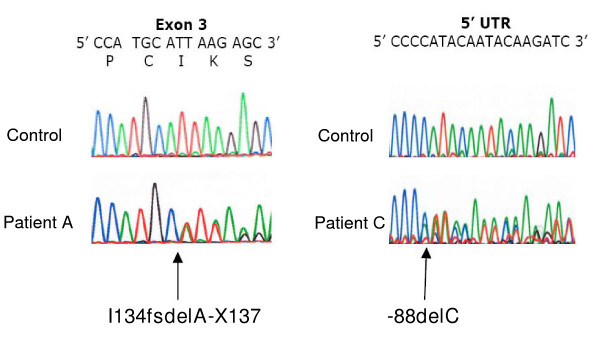
Results: We found a heterozygous frameshift mutation in CAV1, designated I134fsdelA-X137, in a female patient who had atypical partial lipodystrophy, with subcutaneous fat loss affecting the upper part of her body and face, but sparing her legs, gluteal region and visceral fat stores. She had severe type 5 hyperlipoproteinemia, with recurrent pancreatitis. In addition, she had some atypical features, including congenital cataracts and neurological findings. Her father was also heterozygous for this mutation, and had a similar pattern of fat redistribution, hypertriglyceridemia and congenital cataracts, with milder neurological involvement. An unrelated patient had a different heterozygous frameshift mutation in the CAV1 gene, designated -88delC. He also had a partial lipodystrophy phenotype, with subcutaneous fat loss affecting the arms, legs and gluteal region, but sparing his face, neck and visceral fat stores. He also had severe type 5 hyperlipoproteinemia, with recurrent pancreatitis; however he had no clinically apparent neurological manifestations. The mutations were absent from the genomes of 1063 healthy individuals.
Conclusion: Thus, very rare CAV1 frameshift mutations appear to be associated with atypical lipodystrophy and hypertriglyceridemia.
Figures
References
Publication types
MeSH terms
Substances
LinkOut - more resources
Full Text Sources
Other Literature Sources
Medical
Molecular Biology Databases
