


Cholecalciferol (vitamin D3) therapy and vitamin D insufficiency in patients with chronic kidney disease: a randomized controlled pilot study
- PMID: 18238736
- PMCID: PMC2654595
- DOI: 10.4158/EP.14.1.10
Cholecalciferol (vitamin D3) therapy and vitamin D insufficiency in patients with chronic kidney disease: a randomized controlled pilot study
Abstract
Objective: To investigate the efficacy of cholecalciferol (vitamin D3) in raising serum 25-hydroxyvitamin D (25[OH)]D) levels and reducing parathyroid hormone (PTH) levels in patients with chronic kidney disease (CKD).
Methods: In this double-blind, randomized controlled pilot study, participants with CKD stage 3 and 4 (estimated glomerular filtration rate, 15-59 mL/min/1.73 m2), vitamin D insufficiency (serum 25[OH]D <30 ng/mL), and serum intact PTH levels >70 pg/mL were randomly assigned to receive either 50 000 IU of cholecalciferol or placebo once weekly for 12 weeks. Primary outcomes (25[OH]D and PTH levels) were measured at baseline, week 6, and week 12. Secondary outcomes (1,25-dihydroxvitamin D and bone turnover markers) were measured at baseline and week 12. Because of skewed data distribution, statistical analyses were performed on a logarithmic scale. The difference between the group means was exponentiated to provide the geometric mean ratio. A linear mixed model using an unstructured variance-covariance matrix was used to examine change in the primary and secondary outcomes over time.
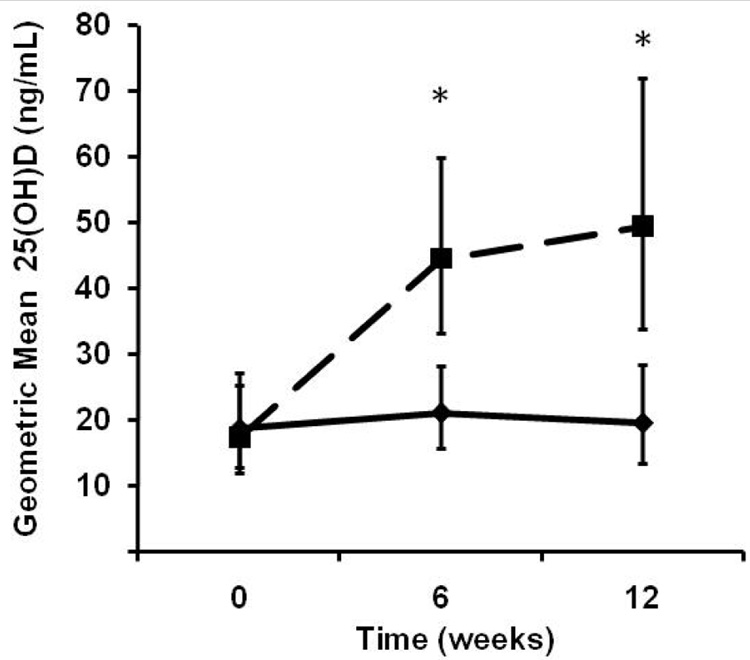
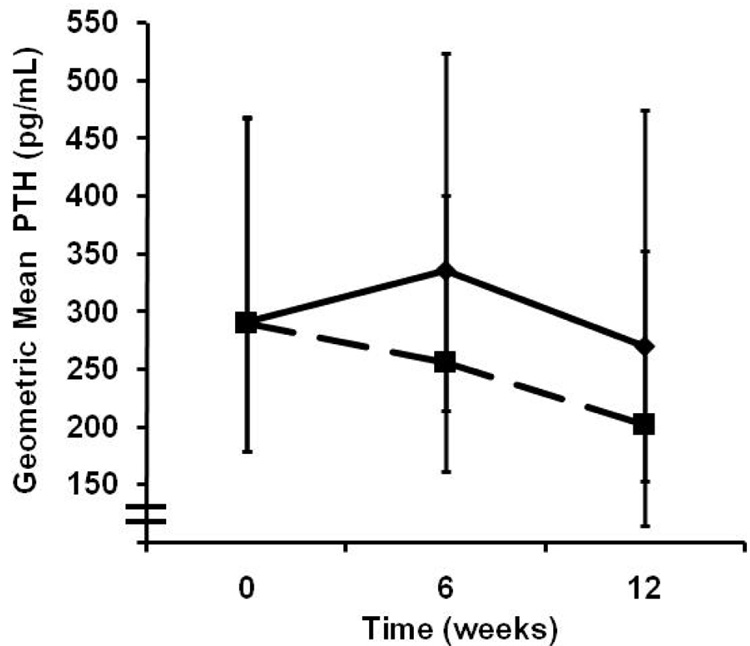
Results: Geometric mean serum 25(OH)D concentrations of the study groups were similar at baseline (P = .77). At week 6, a significant difference between the treatment and placebo groups was detected (P = .001); this difference was maintained at week 12 (P = .002). Among cholecalciferol-treated participants, serum 25(OH)D concentration increased on average from 17.3 ng/mL (95% confidence interval [CI], 11.8-25.2) at baseline to 49.4 ng/mL (95% CI, 33.9-72.0) at week 12. As-treated analysis indicated a trend toward lower PTH levels among cholecalciferol-treated participants (P = .07).
Conclusion: Weekly cholecalciferol supplementation appears to be an effective treatment to correct vitamin D status in patients with CKD.
Conflict of interest statement
The authors have no conflicts of interest to disclose.
Figures
References
-
- Holick MF. Sunlight and vitamin D for bone health and prevention of autoimmune diseases, cancers, and cardiovascular disease. Am J Clin Nutr. 2004;80 Suppl 6:1678–1688. - PubMed
-
- Heaney RP. The Vitamin D requirement in health and disease. J Steroid Biochem Mol Biol. 2005;97:13–19. - PubMed
-
- DeLuca HF. Overview of general physiologic features and functions of vitamin D. Am J Clin Nutr. 2004;80 Suppl 6:1689–1696. - PubMed
-
- Lips P. Vitamin D deficiency and secondary hyperparathyroidism in the elderly: consequences for bone loss and fractures and therapeutic implications. Endocr Rev. 2001;22:477–501. - PubMed
-
- Slatopolsky E, Brown A, Dusso A. Pathogenesis of secondary hyperparathyroidism. Kidney Int Suppl. 1999;73:14–19. - PubMed
Publication types
MeSH terms
Substances
Grants and funding
LinkOut - more resources
Full Text Sources
Other Literature Sources
Medical
Research Materials
