. 2008 Jan;20(1):25-34.
doi: 10.1105/tpc.107.057083. Epub 2008 Jan 31.

Epigenetic modification of centromeric chromatin: hypomethylation of DNA sequences in the CENH3-associated chromatin in Arabidopsis thaliana and maize

Affiliations

Epigenetic modification of centromeric chromatin: hypomethylation of DNA sequences in the CENH3-associated chromatin in Arabidopsis thaliana and maize

Wenli Zhang et al. Plant Cell. 2008 Jan.

Abstract

The centromere in eukaryotes is defined by the presence of a special histone H3 variant, CENH3. Centromeric chromatin consists of blocks of CENH3-containing nucleosomes interspersed with blocks of canonical H3-containing nucleosomes. However, it is not known how CENH3 is precisely deposited in the centromeres. It has been suggested that epigenetic modifications of the centromeric chromatin may play a role in centromere identity. The centromeres of Arabidopsis thaliana are composed of megabase-sized arrays of a 178-bp satellite repeat. Here, we report that the 178-bp repeats associated with the CENH3-containing chromatin (CEN chromatin) are hypomethylated compared with the same repeats located in the flanking pericentromeric regions. A similar hypomethylation of DNA in CEN chromatin was also revealed in maize (Zea mays). Hypomethylation of the DNA in CEN chromatin is correlated with a significantly reduced level of H3K9me2 in Arabidopsis. We demonstrate that the 178-bp repeats from CEN chromatin display a distinct distribution pattern of the CG and CNG sites, which may provide a foundation for the differential methylation of these repeats. Our results suggest that DNA methylation plays an important role in epigenetic demarcation of the CEN chromatin.


Figures
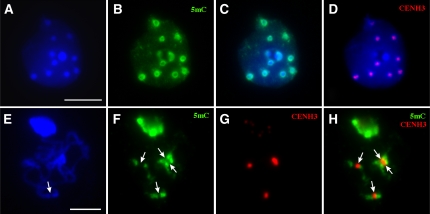
Figure 1.
Figure 1.
Cytological Mapping of 5mC in the Interphase Nucleus and Meiotic Pachytene Chromosomes in Arabidopsis. (A) DAPI staining of an interphase nucleus. Bar = 10 μm. (B) Detection of 5mC (green). (C) Merge of (A) and (B). (D) Detection of CENH3 (red) in the same nucleus. The hollow centers of the 5mC signals in (B) are occupied by the CENH3 signals. (E) DAPI staining of chromosomes from a meiotic cell at early pachytene stage. The arrow points to a centromeric region that shows reduced DAPI staining than its flanking regions. Bar = 5 μm. (F) Detection of 5mC (green). Arrows point to the significantly less stained domains that divide each of the bright centromeric signals into two sections. (G) Detection of CENH3 (red). (H) Merge of (F) and (G). Note that the less-stained domains in (F) are occupied by the CENH3 signals (arrows).
Figure 2.
Figure 2.
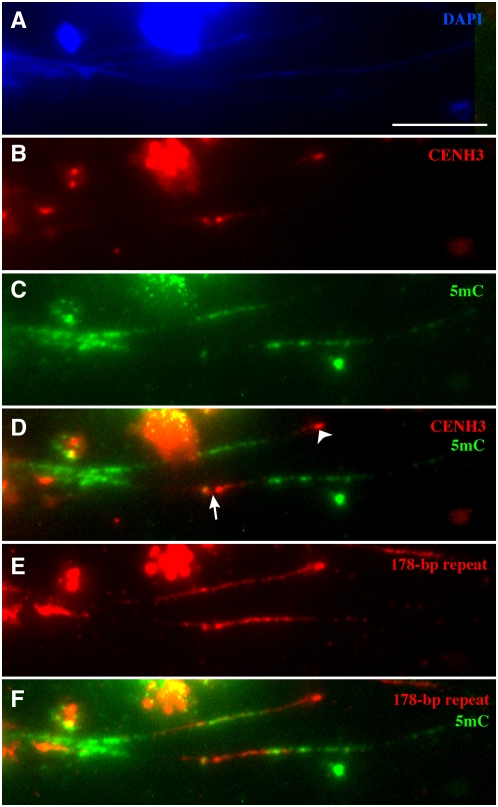
Mapping of CENH3, 5mC, and the 178-bp Repeats on Extended Chromatin Fibers in Arabidopsis. (A) DAPI staining of extended chromatin fibers. Bar = 10 μm. (B) Detection of CENH3 (red) on the extended chromatin fibers. (C) Detection of 5mC (green) on the extended chromatin fibers. (D) Merge of (B) and (C). The CENH3 signal (arrowhead) on one fiber is flanked by 5mC signals on one side only. The second CENH3 signal (arrow) is flanked by 5mC signals on both sides. (E) FISH mapping of the 178-bp repeat on the same chromatin fibers. (F) Digital merge of (C) and (E). Note that only some of the 178-bp repeat sections are associated with the 5mC signals.
Figure 3.
Figure 3.
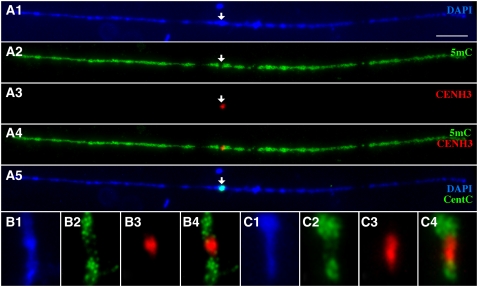
Cytological Mapping of 5mC and the Centromeric Satellite Repeat CentC (Ananiev et al., 1998) in the Centromeric and Pericentromeric Regions on Stretched Pachytene Chromosomes of Maize. (A1) DAPI staining of a mechanically stretched pachytene chromosome. Bar = 10 μm. (A2) Detection of 5mC (green). (A3) Detection of CENH3 (red). (A4) Merge of (A2) and (A3). The arrows in (A1) to (A3) point to the same position on the stretched pachytene chromosome. (A5) FISH mapping of the centromeric satellite repeat CentC (green) on the same pachytene chromosome after immunofluorescence assay. The arrows in (A1) to (A3) and (A5) point to the same position on the pachytene chromosome. (B1) and (C1) DAPI staining of the centromeric segments from two different stretched maize pachytene chromosomes. (B2) and (C2) Detection of 5mC (green). (B3) and (C3) Detection of CENH3 (red). (B4) and (C4) Merges of 5mC and CENH3 signals from (B2) and (B3) and from (C2) and (C3).
Figure 4.
Figure 4.
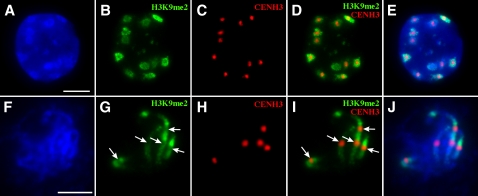
Mapping of H3K9me2 Associated with Centromeric and Pericentromeric Chromatin in Arabidopsis. (A) DAPI staining of an interphase nucleus. Bar = 10 μm. (B) Detection of H3K9me2 (green). (C) Detection of CENH3 (red). (D) Merge of (B) and (C). The hollow centers of the signals in (B) are occupied by the CENH3 signals. (E) Merge of (A) to (C). (F) DAPI staining of chromosomes from a meiotic cell at the early pachytene stage. Bar = 5 μm. (G) Detection of H3K9me2 (green). Arrows point to the domains with reduced immunofluorescence signals. (H) Detection of CENH3 (red). (I) Merge of (G) and (H). The domains with reduced signals in (G) are corresponding to the regions with CENH3 signals. (J) Merge of (F) to (H).
Figure 5.
Figure 5.
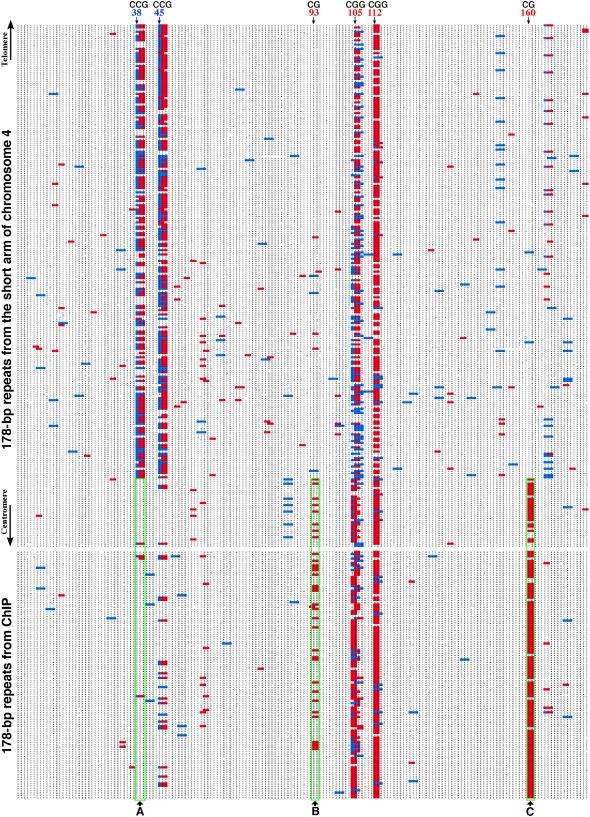
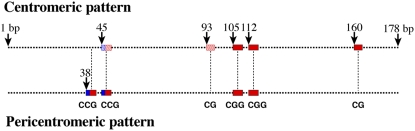
Distribution of CG and CNG Sites within the 178-bp Repeats of Arabidopsis. Top panel: CG and CNG sites located in the 178-bp repeats from the short arm of Arabidopsis chromosome 4. Only the proximal (centromeric side) 244 monomers are included in the figure; the distal (telomeric side) 194 monomers are not included. Bottom panel: CG and CNG sites located in the 108 monomers derived from ChIP. These repeats are derived from different centromeres and are randomly arranged in the alignment. All CG sites are marked in red. CAG and CTG sites are marked in blue. The CG from each CGG is marked in red and the second G is not marked. For CCG sites, the first C is marked in blue and the CG is marked in red. The green square A covers a CCG site (38 to 40 bp) that is missing from the ChIPed repeats. The green squares B and C cover two CG sites (93 to 94 bp; 160 to 161 bp) that are highly enriched in the ChIPed repeats.
Figure 6.
Figure 6.
Diagrammatic Illustration of the Two Distinct CG and CNG Distribution Patterns in the 178-bp Centromeric Satellite Repeats from Arabidopsis. The two CG sites, 93 to 94th bp and 160 to 161th, are unique to the centromeric pattern. The CCG site at 38 to 40th bp is missing in the centromeric pattern. The shaded squares indicated two less frequently occurring CCG (at 45 to 47th bp) and CG (93 to 94th bp) sites.

References

    1. Ahmad, K., and Henikoff, S. (2002). Histone H3 variants specify modes of chromatin assembly. Proc. Natl. Acad. Sci. USA 99 16477–16484. - PMC - PubMed
    1. Allshire, R.C., Javerzat, J.P., Redhead, N.J., and Cranston, G. (1994). Position effect variegation at fission yeast centromeres. Cell 76 157–169. - PubMed
    1. Allshire, R.C., Nimmo, E.R., Ekwall, K., Javerzat, J.P., and Cranston, G. (1995). Mutations derepressing silent centromeric domains in fission yeast disrupt chromosome segregation. Genes Dev. 9 218–233. - PubMed
    1. Alonso, A., Fritz, B., Hasson, D., Abrusan, G., Cheung, F., Yoda, K., Radlwimmer, B., Ladurner, A.G., and Warburton, P.E. (2007). Co-localization of CENP-C and CENP-H to discontinuous domains of CENP-A chromatin at human neocentromeres. Genome Biol. 8 R148. - PMC - PubMed
    1. Amor, D.J., Kalitsis, P., Sumer, H., and Choo, K.H.A. (2004). Building the centromere: From foundation proteins to 3D organization. Trends Cell Biol. 14 359–368. - PubMed

Publication types

Associated data

LinkOut - more resources