


Serum type I interferon activity is dependent on maternal diagnosis in anti-SSA/Ro-positive mothers of children with neonatal lupus
- PMID: 18240214
- PMCID: PMC2755051
- DOI: 10.1002/art.23191
Serum type I interferon activity is dependent on maternal diagnosis in anti-SSA/Ro-positive mothers of children with neonatal lupus
Abstract
Objective: The type I interferon (IFN) pathway is activated in many patients with systemic lupus erythematosus (SLE), and high serum levels of IFN are associated with anti-SSA/Ro autoantibodies. To investigate the clinical features associated with type I IFN production in vivo, we compared serum IFN activity in individuals with anti-SSA/Ro antibodies who were asymptomatic with that in individuals with clinical manifestations of SLE or Sjögren's syndrome (SS).
Methods: Antibody-positive sera from 84 mothers of children with manifestations of neonatal lupus were studied for type I IFN activity, using a functional reporter cell assay. Maternal health status was characterized as asymptomatic, SS, SLE, pauci-SLE, or pauci-SS, based on a screening questionnaire, telephone interview, and review of medical records. The prefix "pauci-" indicates symptoms insufficient for a formal classification of the disease.
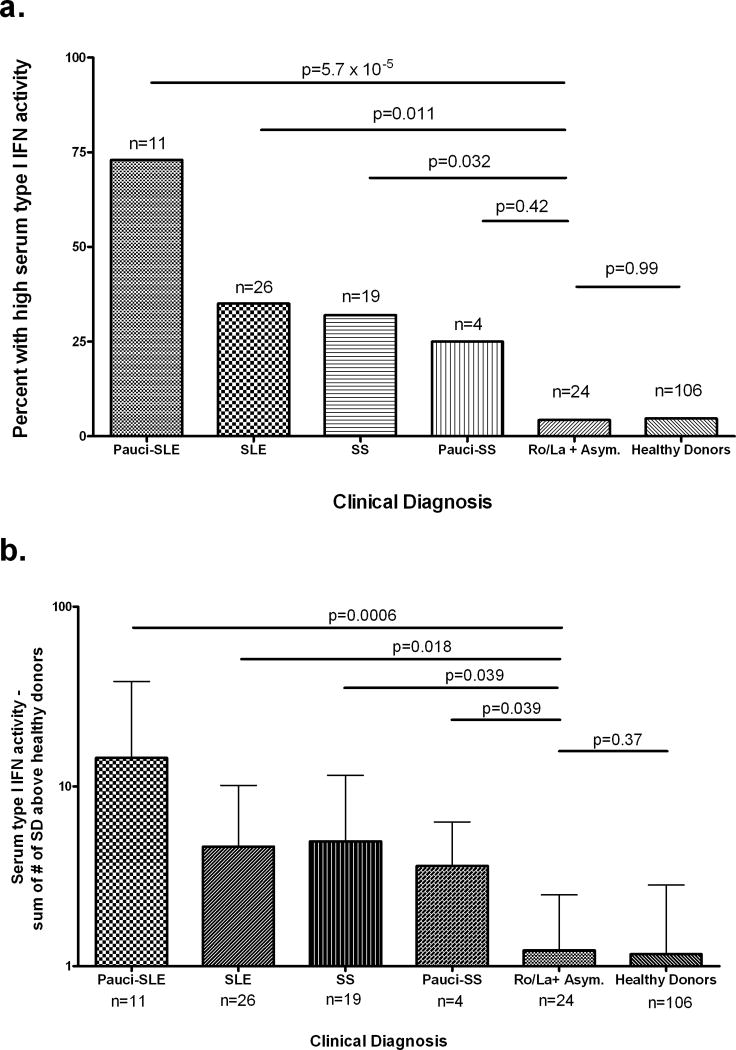
Results: Only 4% of asymptomatic mothers had high serum type I IFN activity, compared with 73% with pauci-SLE (P = 5.7 x 10(-5)), 35% with SLE (P = 0.011), and 32% of patients with SS (P = 0.032). One of the 4 patients with pauci-SS had high levels of IFN. The majority of patients for whom longitudinal data were available had stable type I IFN activity over time, and changes in IFN activity were not clearly accompanied by changes in the clinical diagnosis.
Conclusion: Patients with SLE, patients with pauci-SLE, and patients with SS are more likely to have high serum IFN activity than asymptomatic individuals with SSA/Ro autoantibodies, suggesting that these autoantibodies are insufficient for activation of the type I IFN pathway, and that disease-specific factors are important for type I IFN generation in vivo.
Figures
References
-
- Bave U, Nordmark G, Lovgren T, Ronnelid J, Cajander S, Eloranta ML, et al. Activation of the type I interferon system in primary Sjögren's syndrome: a possible etiopathogenic mechanism. Arthritis Rheum. 2005;52:1185–95. - PubMed
-
- Kirou KA, Lee C, George S, Louca K, Peterson MG, Crow MK. Activation of the interferon-α pathway identifies a subgroup of systemic lupus erythematosus patients with distinct serologic features and active disease. Arthritis Rheum. 2005;52:1491–503. - PubMed
-
- Gottenberg JE, Cagnard N, Lucchesi C, Letourneur F, Mistou S, Lazure T, et al. Activation of IFN pathways and plasmacytoid dendritic cell recruitment in target organs of primary Sjögren's syndrome [published erratum appears in Proc Natl Acad Sci U S A 2006;103:5242] Proc Natl Acad Sci U S A. 2006;103:2770–5. - PMC - PubMed
Publication types
MeSH terms
Substances
Grants and funding
LinkOut - more resources
Full Text Sources
Medical
Research Materials
