


Turning k on its head: comments on use of an ED50 in delay discounting research
- PMID: 18243583
- PMCID: PMC2435271
- DOI: 10.1016/j.drugalcdep.2007.12.011
Turning k on its head: comments on use of an ED50 in delay discounting research
Abstract
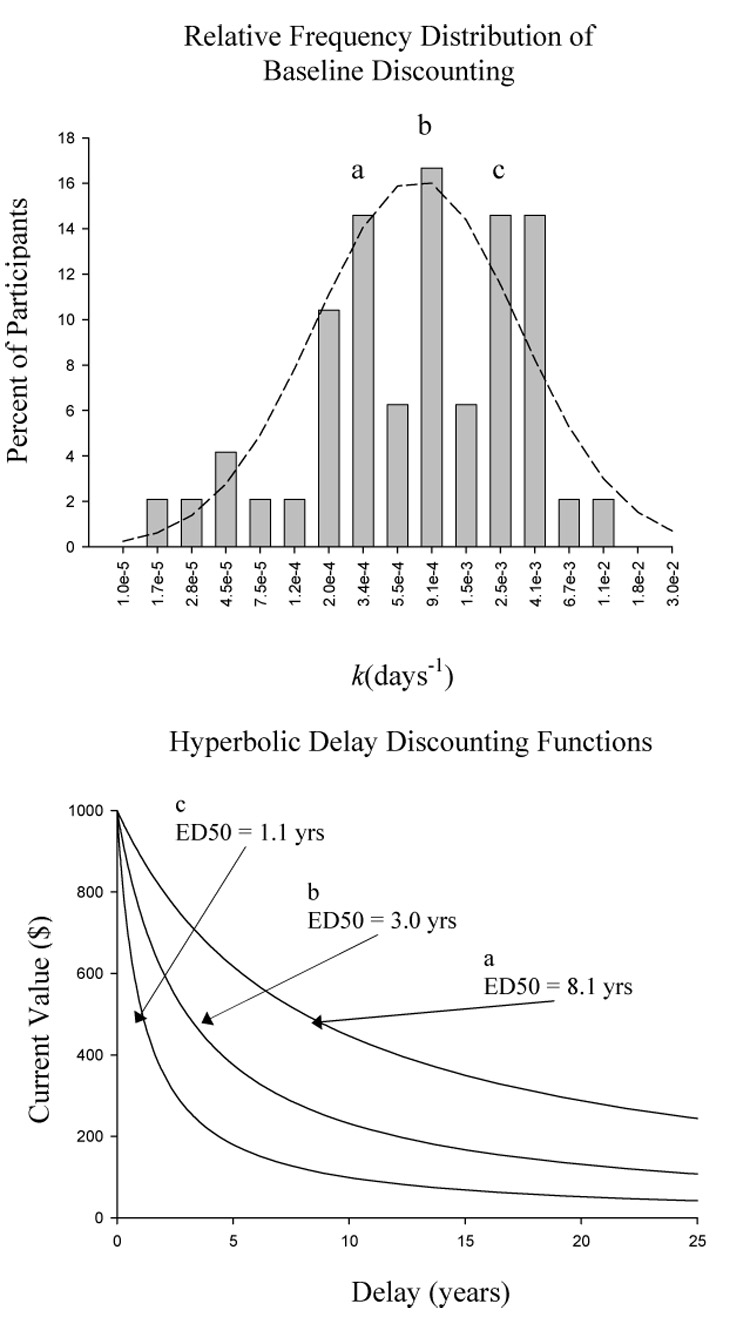
Delay discounting (DD) describes how the value of a reinforcer decreases as delay to its delivery increases. Relationships between DD and various aspects of drug abuse have been demonstrated reliably. A potential barrier to wider adoption of DD techniques is that results are often expressed in terms that may be too abstract or unfamiliar to a broader audience, particularly when describing or comparing hyperbolic DD functions or values of k. In an effort to potentially make DD results more accessible, the current report explores use of an ED50 value in characterizing DD functions, similar to that used in pharmacology research for characterizing dose-effect functions. The ED50 proposed with regard to DD is the delay that is effective in discounting the subjective value of the delayed reinforcer by 50%. Additionally, a convenient method for calculating ED50 values for DD is discussed.
Figures
References
-
- Baker F, Johson MW, Bickel WK. Delay discounting in current and never-before cigarette smokers: Similarities and differences across commodity, sign, and magnitude. J Abnorm Psychol. 2003;112:382–392. - PubMed
-
- Bickel WK, Marsch L. Toward a behavioral economic understanding of drug dependence: Delay discounting processes. Addiction. 2001;96:73–86. - PubMed
-
- Bickel WK, Odum AL, Madden GJ. Impulsivity and cigarette smoking: Delay discounting in current, never, and ex-smokers. Psychopharmacology (Berl) 1999;146:477–454. - PubMed
-
- Coffey SF, Gudleski GD, Saldin ME, Brady KT. Impulsivity and rapid discounting of delayed hypothetical rewards in cocaine-dependent individuals. Exp Clin Psychopharmacol. 2003;11:18–25. - PubMed
-
- Dallery J, Raiff BR. Delay discounting predicts cigarette smoking in a laboratory model of abstinence reinforcement. Psychopharmacology (Berl) 2007;190:485–496. - PubMed
