


Global screening of genes essential for growth in high-pressure and cold environments: searching for basic adaptive strategies using a yeast deletion library
- PMID: 18245339
- PMCID: PMC2248370
- DOI: 10.1534/genetics.107.083063
Global screening of genes essential for growth in high-pressure and cold environments: searching for basic adaptive strategies using a yeast deletion library
Abstract
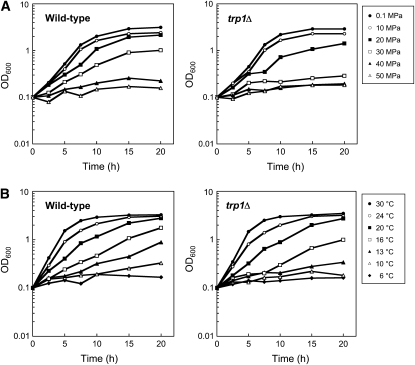
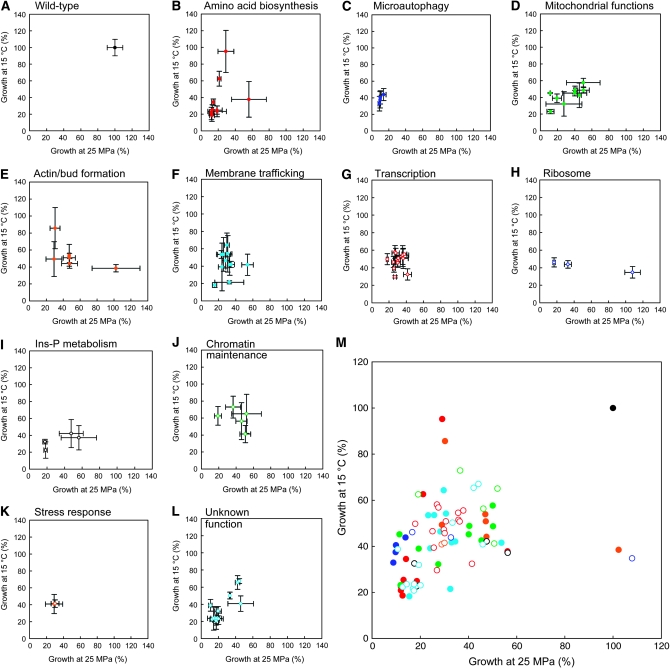
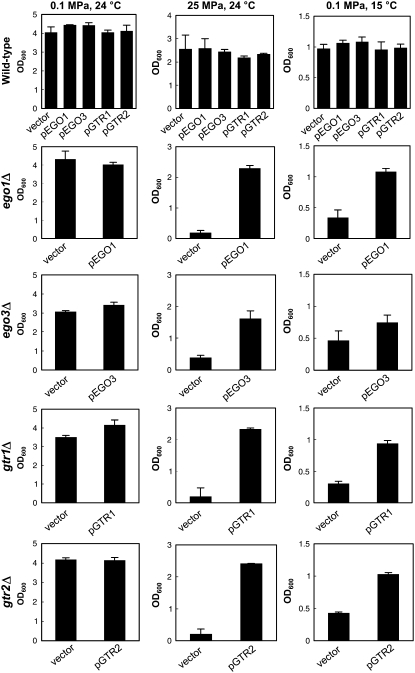
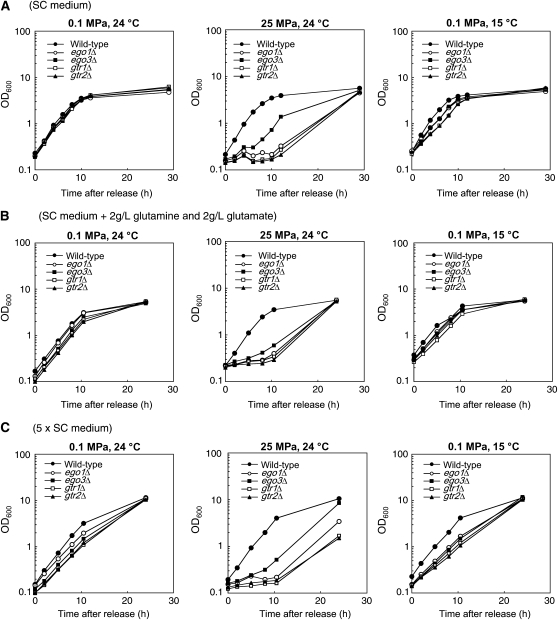
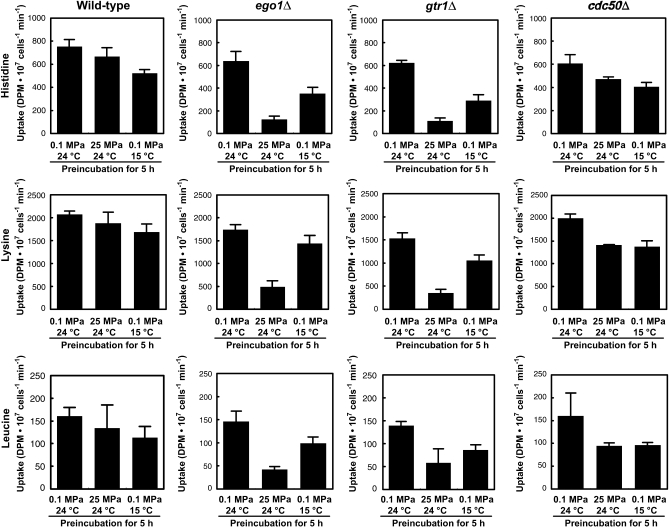
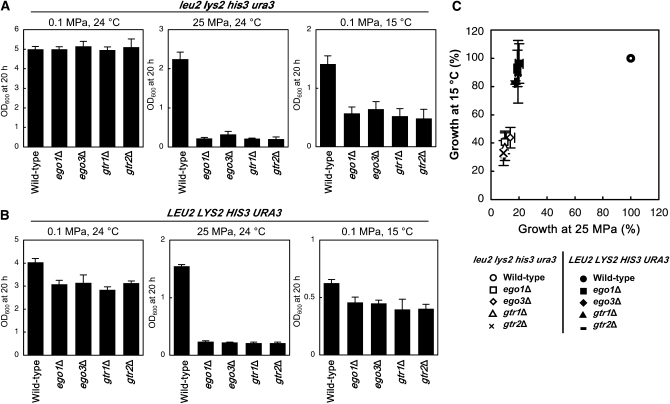
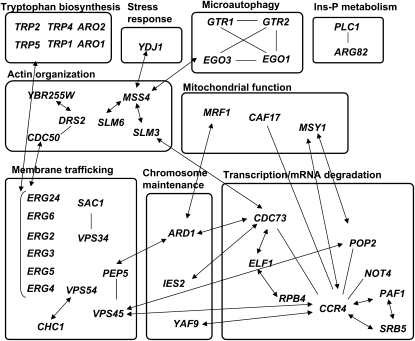
Microorganisms display an optimal temperature and hydrostatic pressure for growth. To establish the molecular basis of piezo- and psychroadaptation, we elucidated global genetic defects that give rise to susceptibility to high pressure and low temperature in Saccharomyces cerevisiae. Here we present 80 genes including 71 genes responsible for high-pressure growth and 56 responsible for low-temperature growth with a significant overlap of 47 genes. Numerous previously known cold-sensitive mutants exhibit marked high-pressure sensitivity. We identified critically important cellular functions: (i) amino acid biosynthesis, (ii) microautophagy and sorting of amino acid permease established by the exit from rapamycin-induced growth arrest/Gap1 sorting in the endosome (EGO/GSE) complex, (iii) mitochondrial functions, (iv) membrane trafficking, (v) actin organization mediated by Drs2-Cdc50, and (vi) transcription regulated by the Ccr4-Not complex. The loss of EGO/GSE complex resulted in a marked defect in amino acid uptake following high-pressure and low-temperature incubation, suggesting its role in surface delivery of amino acid permeases. Microautophagy and mitochondrial functions converge on glutamine homeostasis in the target of rapamycin (TOR) signaling pathway. The localization of actin requires numerous associated proteins to be properly delivered by membrane trafficking. In this study, we offer a novel route to gaining insights into cellular functions and the genetic network from growth properties of deletion mutants under high pressure and low temperature.
Figures
References
-
- Abe, F., 2007. a Induction of DAN/TIR yeast cell wall mannoprotein genes in response to high hydrostatic pressure and low temperature. FEBS Lett. 581 4993–4998. - PubMed
-
- Abe, F., 2007. b Exploration of the effects of high hydrostatic pressure on microbial growth, physiology and survival: perspectives from piezophysiology. Biochem. Biosci. Biotechnol. 71 2347–2357. - PubMed
Publication types
MeSH terms
Substances
LinkOut - more resources
Full Text Sources
Other Literature Sources
Medical
Molecular Biology Databases
