


Clinical utility of echocardiography for the diagnosis and management of pulmonary vascular disease in young children with chronic lung disease
- PMID: 18245423
- PMCID: PMC3121163
- DOI: 10.1542/peds.2007-1583
Clinical utility of echocardiography for the diagnosis and management of pulmonary vascular disease in young children with chronic lung disease
Abstract
Objective: The goal was to determine the clinical utility of Doppler echocardiography in predicting the presence and severity of pulmonary hypertension in patients with chronic lung disease who subsequently underwent cardiac catheterization.
Methods: A retrospective review of data for all patients < 2 years of age with a diagnosis of bronchopulmonary dysplasia, congenital diaphragmatic hernia, or lung hypoplasia who underwent echocardiography and subsequently underwent cardiac catheterization for evaluation of pulmonary hypertension was performed. The accuracy of echocardiography in diagnosing pulmonary hypertension, on the basis of estimated systolic pulmonary artery pressure, was compared with the detection of pulmonary hypertension with the standard method of cardiac catheterization.
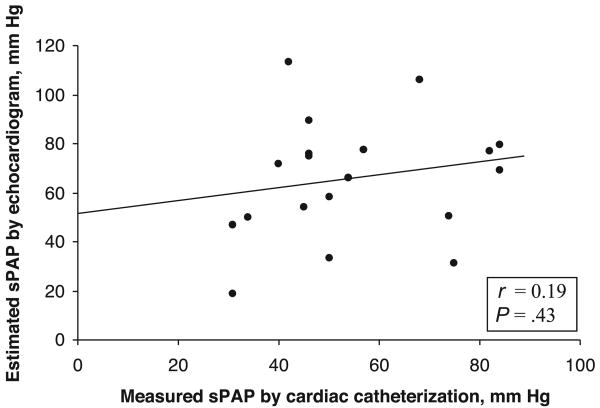
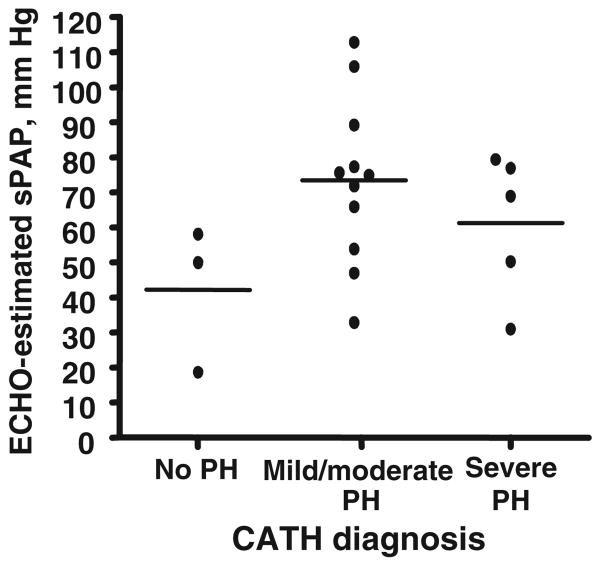
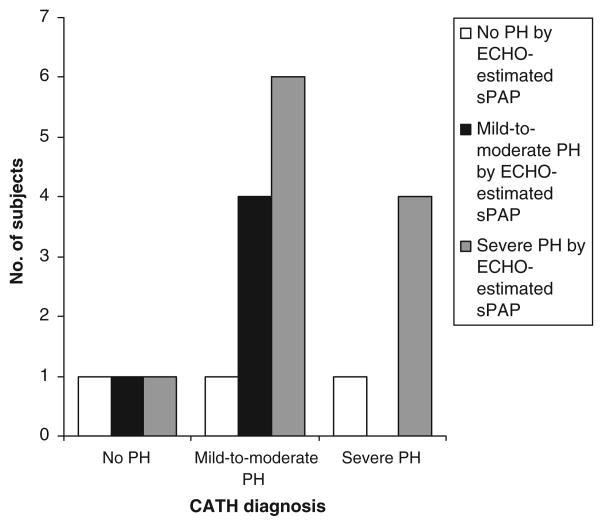
Results: Thirty-one linked measurements for 25 children were analyzed. Systolic pulmonary artery pressure could be estimated in 61% of studies, but there was poor correlation between echocardiography and cardiac catheterization measures of systolic pulmonary artery pressure in these infants. Compared with cardiac catheterization measurements, echocardiographic estimates of systolic pulmonary artery pressure diagnosed correctly the presence or absence of pulmonary hypertension in 79% of the studies in which systolic pulmonary artery pressure was estimated but determined the severity of pulmonary hypertension (severe pulmonary hypertension was defined as pulmonary/systemic pressure ratio of > or = 0.67) correctly in only 47% of those studies. Seven (58%) of 12 children without estimated systolic pulmonary artery pressure demonstrated pulmonary hypertension during subsequent cardiac catheterization. In the absence of estimated systolic pulmonary artery pressure, qualitative echocardiographic findings, either alone or in combination, had worse predictive value for the diagnosis of pulmonary hypertension.
Conclusion: As used in clinical practice, echocardiography often identifies pulmonary hypertension in young children with chronic lung disease; however, estimates of systolic pulmonary artery pressure were not obtained consistently and were not reliable for determining the severity of pulmonary hypertension.
Figures
References
-
- Hislop AA, Haworth SG. Pulmonary vascular damage and the development of cor pulmonale following hyaline membrane disease. Pediatr Pulmonol. 1990;9(3):152–161. - PubMed
-
- Abman S, Sondheimer H. Pulmonary circulation and cardiovascular sequelae of BPD. In: Weir EK, Archer SL, Reeves JT, editors. Diagnosis and Treatment of Pulmonary Hypertension. New York, NY: Futura; 1992. pp. 155–180.
-
- Goodman G, Perkin RM, Anas NG, Sperling DR, Hicks DA, Rowen M. Pulmonary hypertension in infants with bronchopulmonary dysplasia. J Pediatr. 1988;112(1):67–72. - PubMed
-
- Dillon PW, Cilley RE, Mauger D, Zachary C, Meier A. The relationship of pulmonary artery pressure and survival in congenital diaphragmatic hernia. J Pediatr Surg. 2004;39(3):307–312. - PubMed
-
- Yock PG, Popp RL. Noninvasive estimation of right ventricular systolic pressure by Doppler ultrasound in patients with tricuspid regurgitation. Circulation. 1984;70(4):657–662. - PubMed
Publication types
MeSH terms
Grants and funding
LinkOut - more resources
Full Text Sources
Medical
