Review
. 2008 Feb;118(2):439-44.
doi: 10.1172/JCI33944.

Molecular targets for tendon neoformation

Affiliations
Review

Molecular targets for tendon neoformation

Hadi Aslan et al. J Clin Invest. 2008 Feb.

Abstract

Tendons and ligaments are unique forms of connective tissue that are considered an integral part of the musculoskeletal system. The ultimate function of tendon is to connect muscles to bones and to conduct the forces generated by muscle contraction into movements of the joints, whereas ligaments connect bone to bone and provide joint stabilization. Unfortunately, the almost acellular and collagen I-rich structure of tendons and ligaments makes them very poorly regenerating tissues. Injured tendons and ligaments are considered a major clinical challenge in orthopedic and sports medicine. This Review discusses the several factors that might serve as molecular targets that upon activation can enhance or lead to tendon neoformation.


Figures
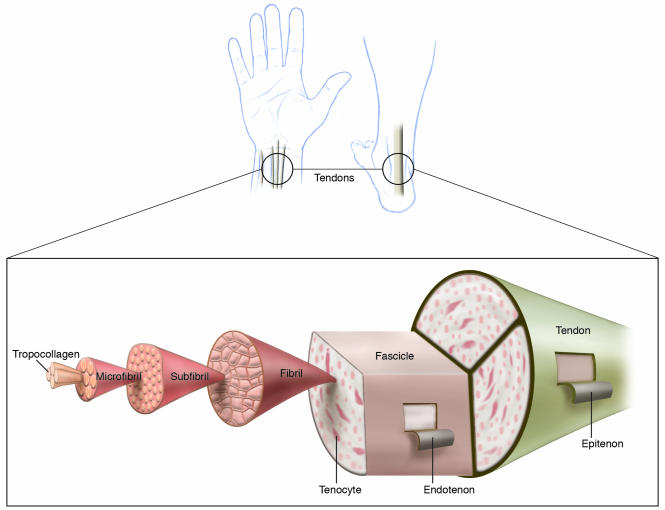
Figure 1
Figure 1. Tendon structure and composition.
The structure of tendons is organized such that they provide resistance against the longitudinal stress generated by muscles. Chains of tropocollagen are longitudinally arranged and united into fibers that together form fibrils. Fibrils are organized and held in a linear direction by loose connective tissue called the endotenon such that they form fascicles. Fascicles are also packed by a loose connective tissue continuous with the endotenon that is called epitenon. The epitenon holds the structure of the tendon and provides its microvasculature. Reproduced from ref. .
Figure 2
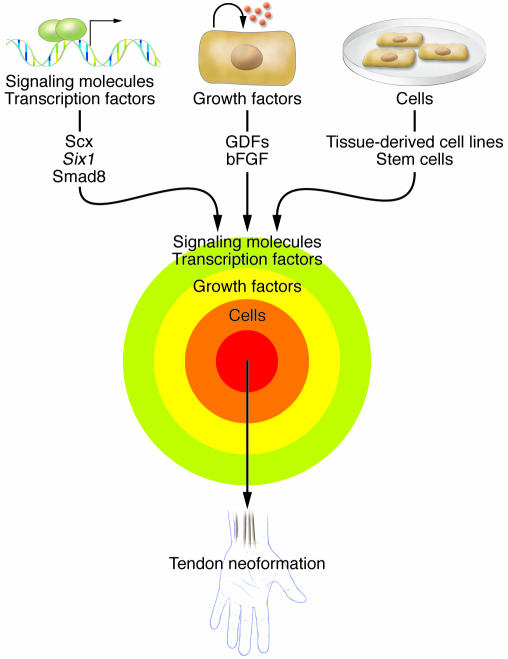
Figure 2. A proposed integrative approach toward achieving successful tendon neoformation.
To achieve successful tendon neoformation or regeneration, three main approaches have been described in the literature. Through activation of some transcription factors and signaling molecules (for example, Scx, Six1, and Smad8) that are involved in tendon/ligament morphogenesis, tendon neoformation might be successful. Growth factors such as GDFs have also been described as inducers or enhancers for tendon regeneration. Cells provide the progenitors or stem cells that respond to signals such as growth factors and, through activation of signaling molecules and transcription factors, differentiate into tendon/ligament. We propose that combining these three approaches is necessary to successfully achieve tendon neoformation.

References

    1. Roeleveld K., Baratta R.V., Solomonow M., van Soest A.G., Huijing P.A. Role of tendon properties on the dynamic performance of different isometric muscles. J. Appl. Physiol. 1993;74:1348–1355. - PubMed
    1. Sharma M., Langrana N.A., Rodriguez J. Role of ligaments and facets in lumbar spinal stability. Spine. 1995;20:887–900. - PubMed
    1. Aspenberg P. Stimulation of tendon repair: mechanical loading, GDFs and platelets. A mini-review. Int. Orthop. 2007;31:783–789. - PMC - PubMed
    1. Chang J., et al. Molecular studies in flexor tendon wound healing: the role of basic fibroblast growth factor gene expression. J. Hand Surg. [Am]. 1998;23:1052–1058. - PubMed
    1. Biundo J.J., Jr., Irwin R.W., Umpierre E. Sports and other soft tissue injuries, tendinitis, bursitis, and occupation-related syndromes. Curr. Opin. Rheumatol. 2001;13:146–149. - PubMed