


Review
. 2008 Sep 1;298 Suppl 1(Suppl 1):257-67.
doi: 10.1016/j.ijmm.2007.09.004.
Epub 2008 Jan 11.
Lyme borreliosis spirochete Erp proteins, their known host ligands, and potential roles in mammalian infection
Affiliations
- PMID: 18248770
- PMCID: PMC2596196
- DOI: 10.1016/j.ijmm.2007.09.004
Item in Clipboard
Review
Lyme borreliosis spirochete Erp proteins, their known host ligands, and potential roles in mammalian infection
Int J Med Microbiol.
.
Abstract
Lyme borreliae naturally maintain numerous distinct DNA elements of the cp32 family, each of which carries a mono- or bicistronic erp locus. The encoded Erp proteins are surface-exposed outer membrane lipoproteins that are produced at high levels during mammalian infection but largely repressed during colonization of vector ticks. Recent studies have revealed that some Erp proteins can serve as bacterial adhesins, binding host proteins such as the complement regulator factor H and the extracellular matrix component laminin. These results suggest that Erp proteins play roles in multiple aspects of mammalian infection.
Figures
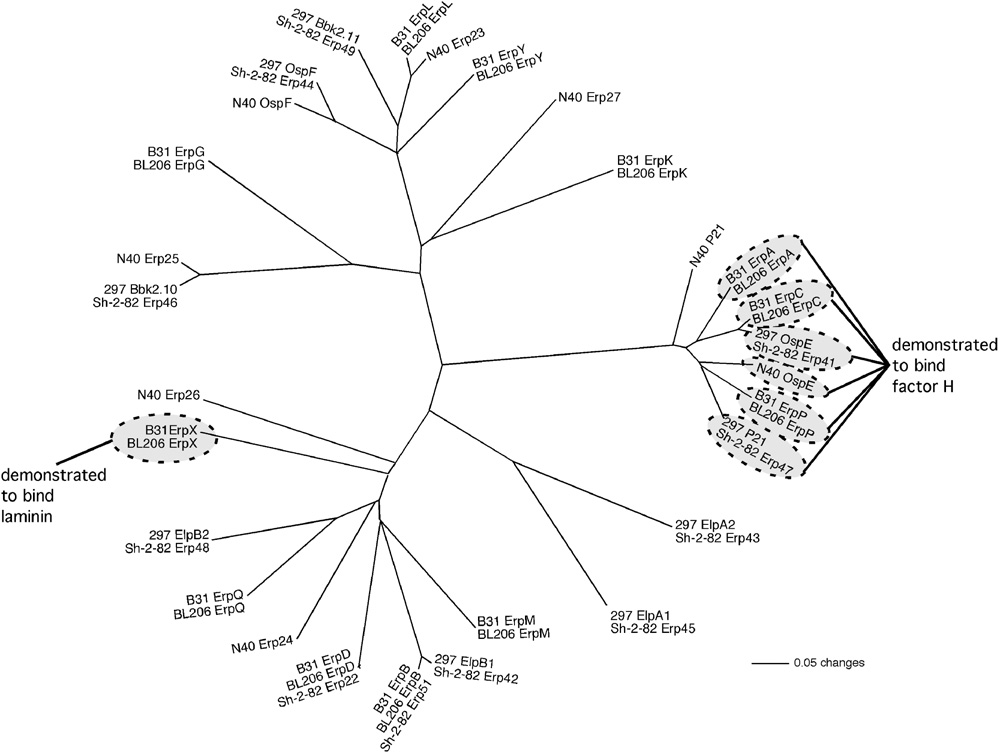
Unrooted phylogram of predicted amino acid sequences of the Erp proteins encoded by the fully-characterized B. burgdorferi strains B31, BL206, N40, Sh-2-82, and 297 (Table 1) and prepared using PAUP* version 4.0b10 (Swofford, 2000). Most of the erp genes of strains Sh-2-82 and 297 are completely identical to each other, as are also the erp genes of strains B31 and BL206 (our unpublished results and Stevenson and Miller, 2003). A closely-related subset of Erp proteins have been shown to bind mammalian factor H in vitro under physiologically relevant conditions. Of those, the B31/BL206 ErpA, ErpC, and ErpP proteins have also been demonstrated to bind human FHR-1. Only the B31/BL206 ErpX protein is known to bind mammalian laminin. Please see text for details and references. Functions for other Erp proteins have yet to be determined.
References
-
- Akins DR, Porcella SF, Popova TG, Shevchenko D, Baker SI, Li M, Norgard MV, Radolf JD. Evidence for in vivo but not in vitro expression of a Borrelia burgdorferi outer surface protein F (OspF) homologue. Mol. Microbiol. 1995;18:507–520. - PubMed
-
- Alitalo A, Meri T, Lankinen H, Seppälä I, Lahdenne P, Hefty PS, Akins D, Meri S. Complement inhibitor factor H binding to Lyme disease spirochetes is mediated by inducible expression of multiple plasmid-encoded outer surface protein E paralogs. J. Immunol. 2002;169:3847–3853. - PubMed
-
- Alitalo A, Meri T, Chen T, Lankinen H, Cheng Z-Z, Jokiranta TS, Seppälä IJT, Lahdenne P, Hefty PS, Akins DR, Meri S. Lysine-dependent multipoint binding of the Borrelia burgdorferi virulence factor outer surface protein E to the C terminus of factor H. J. Immunol. 2004;172:6195–6201. - PubMed
Publication types
MeSH terms
Substances
Grants and funding
LinkOut - more resources
Full Text Sources
