


Probing the mechanism of recognition of ssDNA by the Cdc13-DBD
- PMID: 18250086
- PMCID: PMC2275150
- DOI: 10.1093/nar/gkn017
Probing the mechanism of recognition of ssDNA by the Cdc13-DBD
Abstract
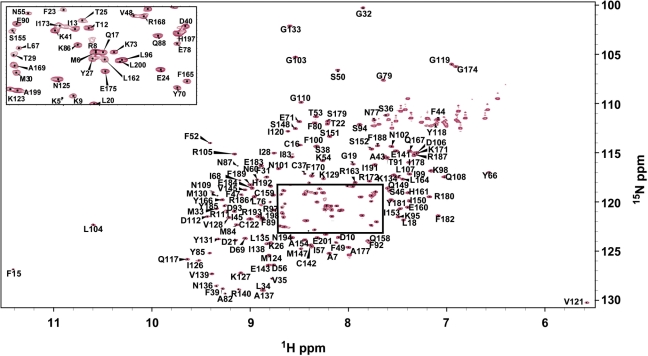
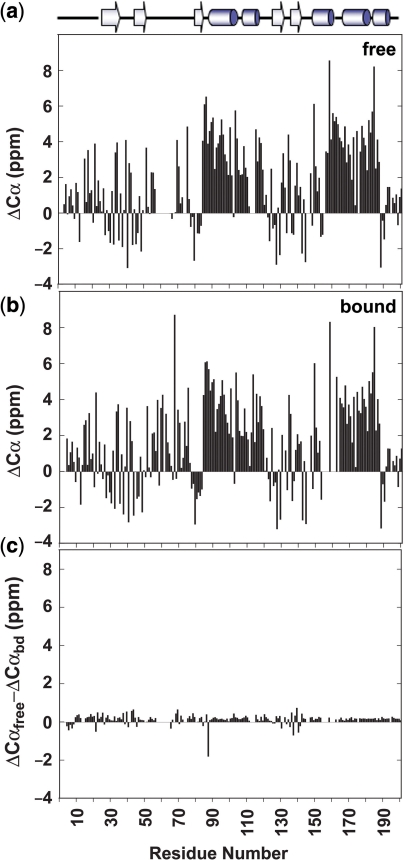
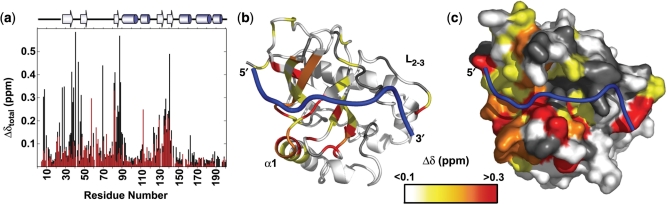
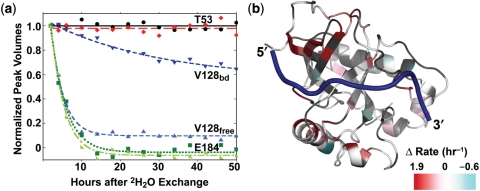
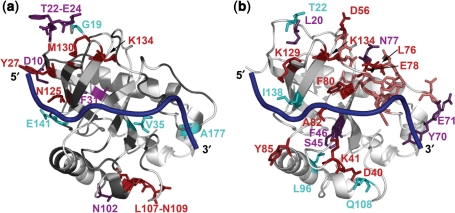
The Saccharomyces cerevisiae protein Cdc13 tightly and specifically binds the conserved G-rich single-stranded overhang at telomeres and plays an essential role in telomere end-protection and length regulation. The 200 residue DNA-binding domain of Cdc13 (Cdc13-DBD) binds an 11mer single-stranded representative of the yeast telomeric sequence [Tel11, d(GTGTGGGTGTG)] with a 3 pM affinity and specificity for three bases (underlined) at the 5' end. The structure of the Cdc13-DBD bound to Tel11 revealed a large, predominantly aromatic protein interface with several unusual features. The DNA adopts an irregular, extended structure, and the binding interface includes a long ( approximately 30 amino acids) structured loop between strands beta2-beta3 (L(2-3)) of an OB-fold. To investigate the mechanism of ssDNA binding, we studied the free and bound states of Cdc13-DBD using NMR spectroscopy. Chemical shift changes indicate that the basic topology of the domain, including L(2-3), is essentially intact in the free state. Changes in slow and intermediate time scale dynamics, however, occur in L(2-3), while conformational changes distant from the DNA interface suggest an induced fit mechanism for binding in the 'hot spot' for binding affinity and specificity. These data point to an overall binding mechanism well adapted to the heterogeneous nature of yeast telomeres.
Figures
References
-
- Croy JE, Wuttke DS. Themes in ssDNA recognition by telomere-end protection proteins. Trends Biochem. Sci. 2006;31:516–525. - PubMed
-
- Schuermann JP, Prewitt SP, Davies C, Deutscher SL, Tanner JJ. Evidence for structural plasticity of heavy chain complementarity-determining region 3 in antibody-ssDNA recognition. J. Mol. Biol. 2005;347:965–978. - PubMed
-
- Lei M, Podell E, Cech TR. Structure of human Pot1 bound to telomeric DNA single-stranded DNA provides a model for chromosome end-protection. Nat. Struct. Mol. Biol. 2004;11:1223–1229. - PubMed
-
- Lei M, Podell ER, Baumann P, Cech TR. DNA self-recognition in the crystal structure of the Pot1 (Protection of Telomeres)-ssDNA complex. Nature. 2003;426:198–204. - PubMed
Publication types
MeSH terms
Substances
Grants and funding
LinkOut - more resources
Full Text Sources
Molecular Biology Databases
Miscellaneous
