Familial risk of oral clefts by morphological type and severity: population based cohort study of first degree relatives
- PMID: 18250102
- PMCID: PMC2249683
- DOI: 10.1136/bmj.39458.563611.AE
Familial risk of oral clefts by morphological type and severity: population based cohort study of first degree relatives
Abstract
Objective: To estimate the relative risk of recurrence of oral cleft in first degree relatives in relation to cleft morphology.
Design: Population based cohort study.
Setting: Data from the medical birth registry of Norway linked with clinical data on virtually all cleft patients treated in Norway over a 35 year period.
Participants: 2.1 million children born in Norway between 1967 and 2001, 4138 of whom were treated for an oral cleft.
Main outcome measure: Relative risk of recurrence of isolated clefts from parent to child and between full siblings, for anatomic subgroups of clefts.
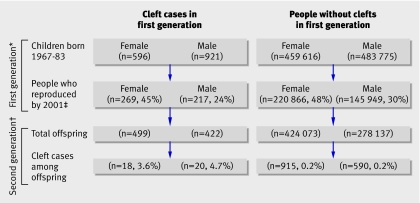
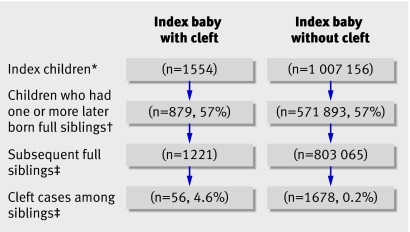
Results: Among first degree relatives, the relative risk of recurrence of cleft was 32 (95% confidence interval 24.6 to 40.3) for any cleft lip and 56 (37.2 to 84.8) for cleft palate only (P difference=0.02). The risk of clefts among children of affected mothers and affected fathers was similar. Risks of recurrence were also similar for parent-offspring and sibling-sibling pairs. The "crossover" risk between any cleft lip and cleft palate only was 3.0 (1.3 to 6.7). The severity of the primary case was unrelated to the risk of recurrence.
Conclusions: The stronger family recurrence of cleft palate only suggests a larger genetic component for cleft palate only than for any cleft lip. The weaker risk of crossover between the two types of cleft indicates relatively distinct causes. The similarity of mother-offspring, father-offspring, and sibling-sibling risks is consistent with genetic risk that works chiefly through fetal genes. Anatomical severity does not affect the recurrence risk in first degree relatives, which argues against a multifactorial threshold model of causation.
Conflict of interest statement
Competing interests: None declared.
Figures
Comment in
-
Familial risks of oral clefts.BMJ. 2008 Feb 23;336(7641):399. doi: 10.1136/bmj.39470.657685.80. Epub 2008 Feb 4. BMJ. 2008. PMID: 18250101 Free PMC article.
References
-
- Mossey PA, Little J. Epidemiology of oral clefts: an international perspective. In: Wyszynski DF, ed. Cleft lip and palate: from origin to treatment New York: Oxford University Press, 2002:127-58.
-
- Sivertsen Å, Wilcox A, Johnson G, Åbyholm F, Vindenes H, Lie R. Prevalence of major anatomic variations in oral clefts. Plast Reconstr Surg (in press). - PubMed
-
- Skjaerven R, Wilcox AJ, Lie RT. A population-based study of survival and childbearing among female subjects with birth defects and the risk of recurrence in their children. N Engl J Med 1999;340:1057-62. - PubMed
-
- Mitchell LE, Christensen K. Analysis of the recurrence patterns for nonsyndromic cleft lip with or without cleft palate in the families of 3,073 Danish probands. Am J Med Genet 1996;61:371-6. - PubMed
-
- Harper PS. Practical genetic counselling 5th ed. Oxford: Butterworth-Heinemann, 1998
Publication types
MeSH terms
Grants and funding
LinkOut - more resources
Full Text Sources
Medical