Mesenchymal cell targeting by TNF as a common pathogenic principle in chronic inflammatory joint and intestinal diseases
- PMID: 18250193
- PMCID: PMC2271010
- DOI: 10.1084/jem.20070906
Mesenchymal cell targeting by TNF as a common pathogenic principle in chronic inflammatory joint and intestinal diseases
Abstract
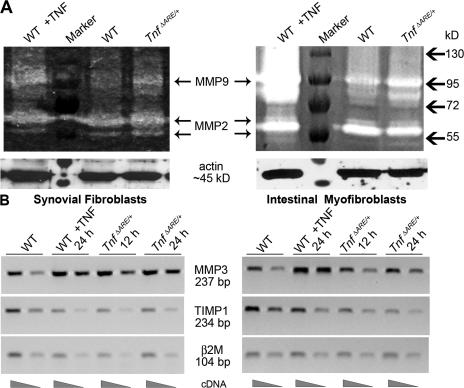
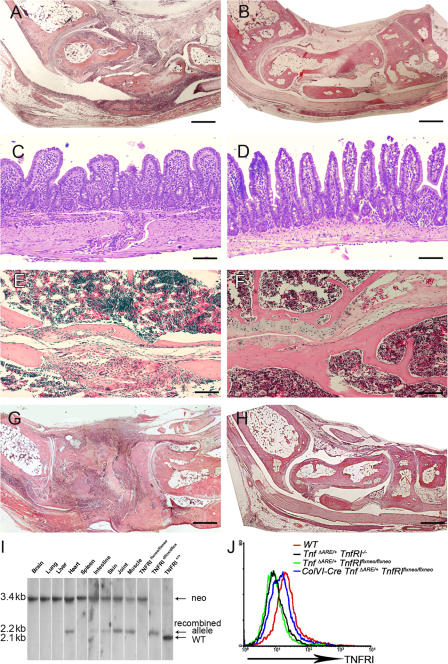
Tumor necrosis factor (TNF) is key to the pathogenesis of various arthritic diseases and inflammatory bowel disease (IBD). Anti-TNF therapies have proved successful in the clinical treatment of these diseases, but a mechanistic understanding of TNF function is still lacking. We have investigated early cellular mechanisms of TNF function in these diseases using an established TNF transgenic model, which develops a spondyloarthritis-like disease characterized by peripheral joint arthritis, sacroiliitis, enthesitis, and Crohn's-like IBD. Bone marrow grafting experiments demonstrated that development of arthritis requires TNF receptor I (TNFRI) expression in the radiation-resistant compartment, which is also known to be a sufficient target of TNF in the development of Crohn's-like IBD in the same model. Early activation of synovial fibroblasts and intestinal myofibroblasts could also be demonstrated by perturbed expression of matrix metalloproteases and their inhibitors. Notably, selective Cre/loxP-mediated TNFRI expression in mesenchymal cells resulted in a fully arthritic-spondyloarthritic and intestinal phenotype, indicating that mesenchymal cells are primary and sufficient targets of TNF in these pathologies. Our results offer a novel mechanistic perspective for TNF function in gut and joint pathologies and indicate early common cellular pathways that may also explain the often observed synovial-gut axis in human disease.
Figures
References
-
- Mielants, H., E.M. Veys, C. Cuvelier, and M. de Vos. 1988. Ileocolonoscopic findings in seronegative spondylarthropathies. Br. J. Rheumatol. 27(Suppl. 2):95–105. - PubMed
-
- Mielants, H., E.M. Veys, C. Cuvelier, M. De Vos, S. Goemaere, L. De Clercq, L. Schatteman, and D. Elewaut. 1995. The evolution of spondyloarthropathies in relation to gut histology. II. Histological aspects. J. Rheumatol. 22:2273–2278. - PubMed
-
- de Vlam, K., H. Mielants, C. Cuvelier, F. De Keyser, E.M. Veys, and M. De Vos. 2000. Spondyloarthropathy is underestimated in inflammatory bowel disease: prevalence and HLA association. J. Rheumatol. 27:2860–2865. - PubMed
-
- Khan, M.A. 2002. Update on spondyloarthropathies. Ann. Intern. Med. 136:896–907. - PubMed
-
- Feldmann, M., and L. Steinman. 2005. Design of effective immunotherapy for human autoimmunity. Nature. 435:612–619. - PubMed
Publication types
MeSH terms
Substances
LinkOut - more resources
Full Text Sources
Other Literature Sources
Medical
Molecular Biology Databases