. 2008 Mar 25;105(12):4587-94.
doi: 10.1073/pnas.0709851105. Epub 2008 Feb 4.

Biosynthetic origin of natural products isolated from marine microorganism-invertebrate assemblages

Affiliations

Biosynthetic origin of natural products isolated from marine microorganism-invertebrate assemblages

T Luke Simmons et al. Proc Natl Acad Sci U S A. .

Abstract

In all probability, natural selection began as ancient marine microorganisms were required to compete for limited resources. These pressures resulted in the evolution of diverse genetically encoded small molecules with a variety of ecological and metabolic roles. Remarkably, many of these same biologically active molecules have potential utility in modern medicine and biomedical research. The most promising of these natural products often derive from organisms richly populated by associated microorganisms (e.g., marine sponges and ascidians), and often there is great uncertainty about which organism in these assemblages is making these intriguing metabolites. To use the molecular machinery responsible for the biosynthesis of potential drug-lead natural products, new tools must be applied to delineate their genetic and enzymatic origins. The aim of this perspective is to highlight both traditional and emerging techniques for the localization of metabolic pathways within complex marine environments. Examples are given from the literature as well as recent proof-of-concept experiments from the authors' laboratories.


Conflict of interest statement

The authors declare no conflict of interest.

Figures
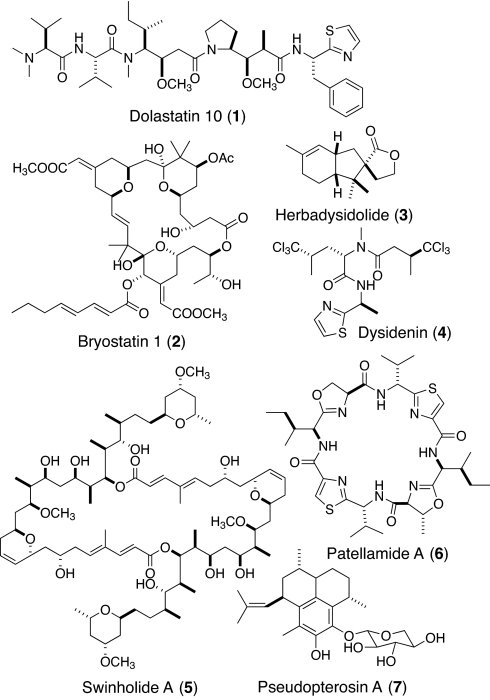
Fig. 1.
Fig. 1.
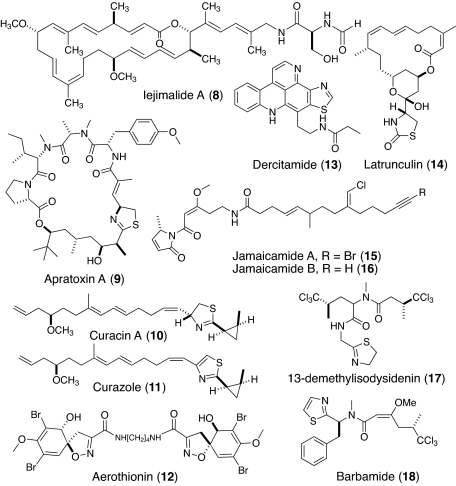
Structures 17.
Fig. 2.
Fig. 2.
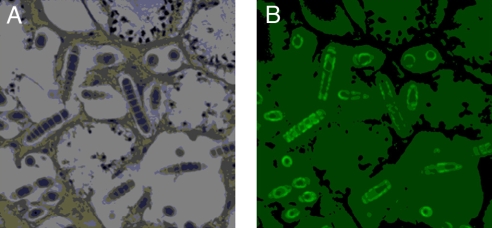
Photomicrographs of a thin section of sponge tissue showing embedded cyanobacterial cells. (A) Cross-section of the sponge Dysidea herbacea stained with O-toluidine showing composition of cells types. (B) Autofluorescence (522 nm) of cyanobacterial cells due to chlorophyll. [Reprinted with permission from ref. (Copyright 2005, Springer).]
Fig. 3.
Fig. 3.
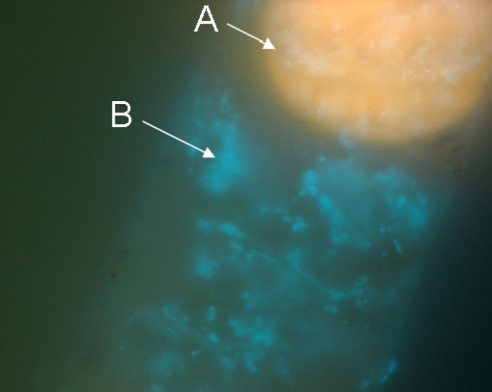
Trichome structure of the filamentous marine cyanobacterium Lyngbya majuscula-3L. Shown is DAPI staining and epifluorescent imaging at ×1,000 magnification using a Zeiss Axioskop (filter set #2, emission 420 nm+). A, cyanobacterial phycoerythrin in filament tip (orange); B, filament sheath-associated bacterial DNA (blue).
Fig. 4.
Fig. 4.
Structures 818.
Fig. 5.
Fig. 5.
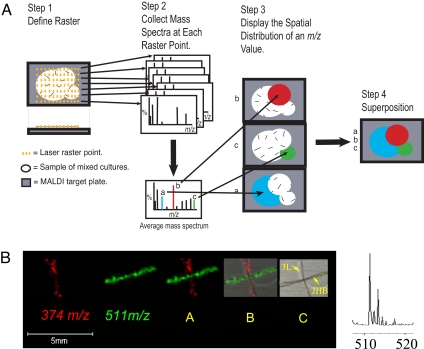
MALDI-TOF imaging to map the distribution of natural products in biological tissues. (A) Schematic for procedure of MALDI-TOF imaging. (B) From left to right, MALDI-TOF imaging of protonated curacin A (12) at m/z 374 (red), sodiated jamaicamide B (19) at m/z 511 (green), the simultaneous superposition of both m/z 374 and 511, superposition of both masses plus photograph of filaments, photograph of both filaments identified as strains “3L” (= curacin A producer) and JHB[ = jamaicamide A (18) and B (19) producer], and partial mass spectrum of JHB strain showing the molecular ion cluster of jamaicamide B with its distinctive chlorine isotope pattern.
Fig. 6.
Fig. 6.
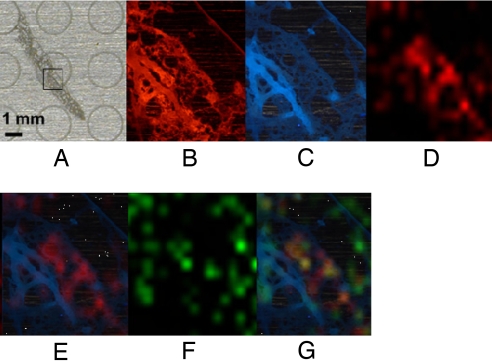
MALDI-TOF imaging of the marine sponge Dysidea herbaceae. (A) MALDI target plate with thin section in place. (B) Autofluorescence of D. herbaceae thin section at 590 nm+. (C) Autofluorescence of D. herbaceae thin section at 420 nm+. (D) MALDI image of m/z 530. This mass and the complex molecular ion isotope cluster suggests its identity as the hexachlorinated peptide 13-demethylisodysidenin (20). (E) Autofluorescence (420 nm) image overlaid by MALDI image at m/z 530 indicating localization of compound with this mass. (F) MALDI image of unknown compound m/z 1,028. (G) Autofluorescence (420 nm) image overlaid with m/z 530 (red) and m/z 1,028 (green) showing the differential localization of these two molecules.
Fig. 7.
Fig. 7.
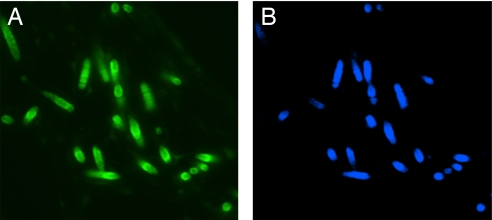
CARD-FISH analysis of Dysidea herbacea showing autofluorescence (522 nm) of cyanobacterial cells due to chlorophyll (A) and probe-specific hybridization with the complimentary oligonucleotide to dysB1, a homolog of the barbamide barB1 biosynthetic gene (B). [Reprinted with permission from ref. (Copyright 2005, Springer).]

References

    1. Newman DJ, Cragg GM. J Nat Prod. 2007;70:461–477. - PubMed
    1. Ramaswamy AV, Flatt PM, Edwards DJ, Simmons TL, Han B, Gerwick WH. In: Frontiers in Marine Biotechnology. Proksch P, Müller WEG, editors. Norfolk, England: Horizon Bioscience; 2006. pp. 175–224.
    1. Simmons TL, Andrianasolo E, McPhail K, Flatt P, Gerwick WH. Mol Cancer Ther. 2005;4:333–342. - PubMed
    1. Piel J. Curr Med Chem. 2006;13:39–50. - PubMed
    1. Simmons TL, Gerwick WH. In: Oceans and Human Health. Walsh P, Solo-Gabriele H, Fleming LE, Smith SL, Gerwick WH, editors. New York: Elsevier; 2008. in press.

Publication types

MeSH terms

Substances