


Pupil dilation reflects perceptual selection and predicts subsequent stability in perceptual rivalry
- PMID: 18250340
- PMCID: PMC2234208
- DOI: 10.1073/pnas.0707727105
Pupil dilation reflects perceptual selection and predicts subsequent stability in perceptual rivalry
Abstract
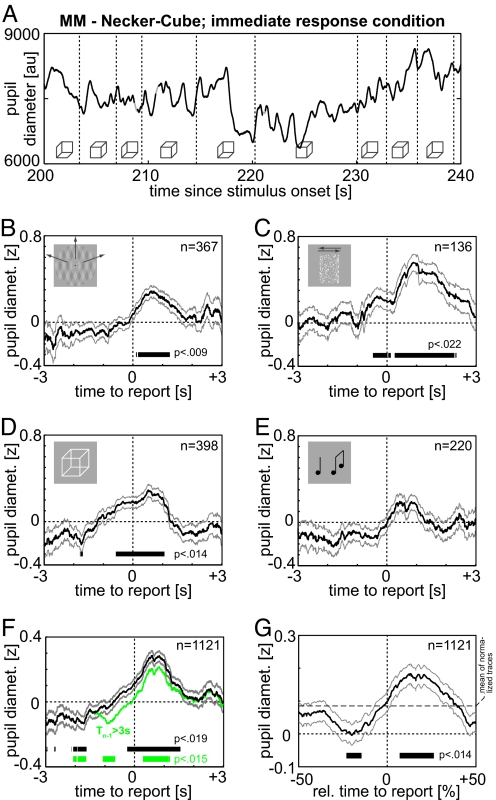
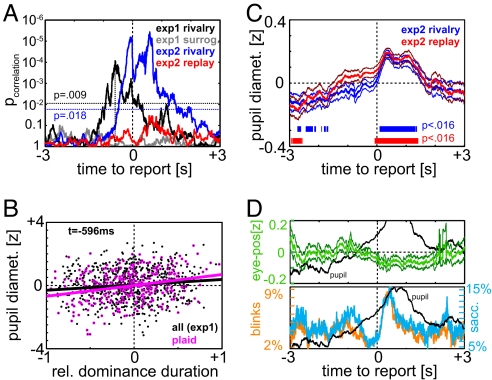
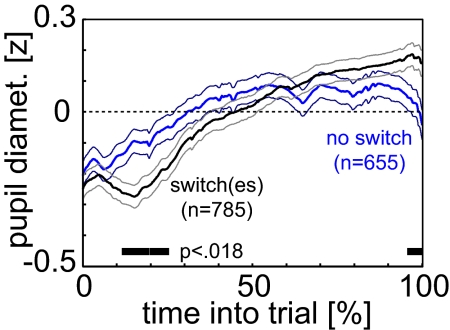
During sustained viewing of an ambiguous stimulus, an individual's perceptual experience will generally switch between the different possible alternatives rather than stay fixed on one interpretation (perceptual rivalry). Here, we measured pupil diameter while subjects viewed different ambiguous visual and auditory stimuli. For all stimuli tested, pupil diameter increased just before the reported perceptual switch and the relative amount of dilation before this switch was a significant predictor of the subsequent duration of perceptual stability. These results could not be explained by blink or eye-movement effects, the motor response or stimulus driven changes in retinal input. Because pupil dilation reflects levels of norepinephrine (NE) released from the locus coeruleus (LC), we interpret these results as suggestive that the LC-NE complex may play the same role in perceptual selection as in behavioral decision making.
Conflict of interest statement
The authors declare no conflict of interest.
Figures
Comment in
-
Pupil dilation does not predict subsequent stability in perceptual rivalry.Proc Natl Acad Sci U S A. 2008 Jul 15;105(28):E43; author reply E44. doi: 10.1073/pnas.0803456105. Epub 2008 Jul 2. Proc Natl Acad Sci U S A. 2008. PMID: 18599464 Free PMC article. No abstract available.
References
-
- Blake R, Logothetis N. Visual competition. Nat Rev Neurosci. 2002;3:13–21. - PubMed
-
- Leopold D, Logothetis N. Multistable phenomena: Changing views in perception. Trends Cogn Sci. 1999;3:254–264. - PubMed
-
- Pettigrew J. Searching for the switch: Neural bases for perceptual rivalry alternations. Brain Mind. 2001;2:85–118.
-
- Tong F, Meng M, Blake R. Neural bases of binocular rivalry. Trends Cogn Sci. 2006;10:502–511. - PubMed
Publication types
MeSH terms
Substances
LinkOut - more resources
Full Text Sources
Other Literature Sources
