Review
. 2008 Feb;7(1):55-74.
doi: 10.1586/14760584.7.1.55.

Analysis of epitope information related to Bacillus anthracis and Clostridium botulinum

Affiliations
Review

Analysis of epitope information related to Bacillus anthracis and Clostridium botulinum

Laura M Zarebski et al. Expert Rev Vaccines. 2008 Feb.

Abstract

We have reviewed the information about epitopes of immunological interest from Clostridium botulinum and Bacillus anthracis, by mining the Immune Epitope Database and Analysis Resource. For both pathogens, the vast majority of epitopes reported to date are derived from a single protein: the protective antigen of B. anthracis and the neurotoxin type A of C. botulinum. A detailed analysis of the data was performed to characterize the function, localization and conservancy of epitopes identified as neutralizing and/or protective. In order to broaden the scope of this analysis, we have also included data describing immune responses against defined fragments (over 50 amino acids long) of the relevant antigens. The scarce information on T-cell determinants and on epitopes from other antigens besides the toxins, highlights a gap in our knowledge and identifies areas for future research. Despite this, several distinct structures at the epitope and fragment level are described herein, which could be potential additions to future vaccines or targets of novel immunotherapeutics and diagnostic reagents.


Conflict of interest statement

Financial & competing interests disclosure

The authors have no other relevant affiliations or financial involvement with any organization or entity with a financial interest in or financial conflict with the subject matter or materials discussed in the manuscript apart from those disclosed.

No writing assistance was utilized in the production of this manuscript.

Figures
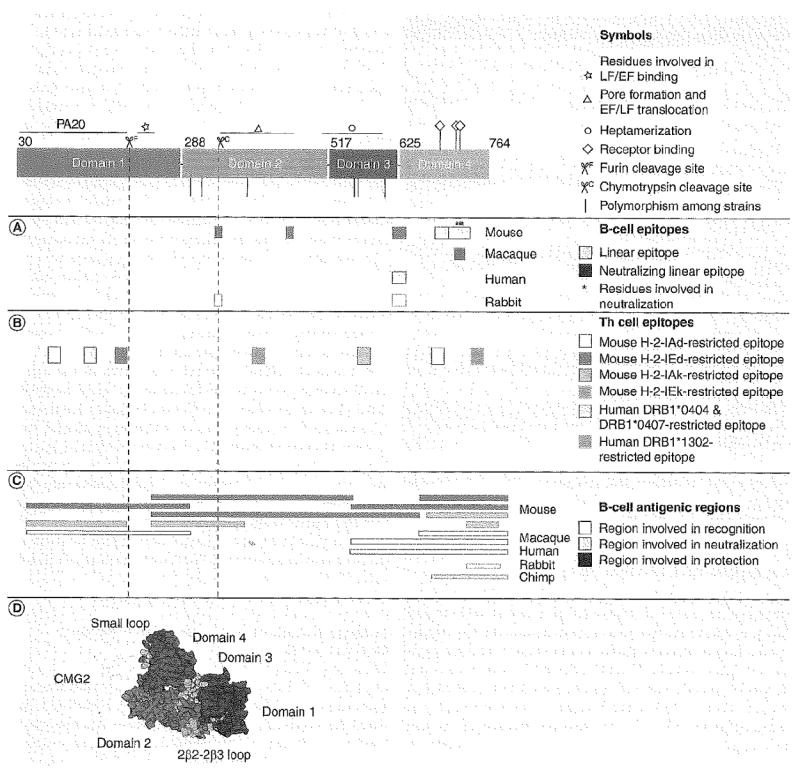
Figure 1
Figure 1. Bacillus anthracis protective antigen (PA) structure and its immunological recognition
Top panel: schematic representation of PA primary structure, its different domains and most relevant features, including the strain-related polymorphism. (A) Representation of the location of the antibody (B-cell) epitopes described in the literature. A separate color is used for each host species, and the individual features of each epitope are represented as in the legend. (B) Representation of the T-cell epitopes described in the literature, coded similarly as the B-cell epitopes. (C) Representation of the fragments described in the literature involved in antibody recognition, coded similarly as the B-cell epitopes. (D) Neutralizing epitopes from PA depicted in the 3D structure. A monomer from the heptamer prepore structure (PDB 1TZN) is shown, in complex with its cellular receptor, CMG2, which is shown in gray lines with white background. The PA domains and epitope coloring corresponds to that of the top panels.
Figure 2
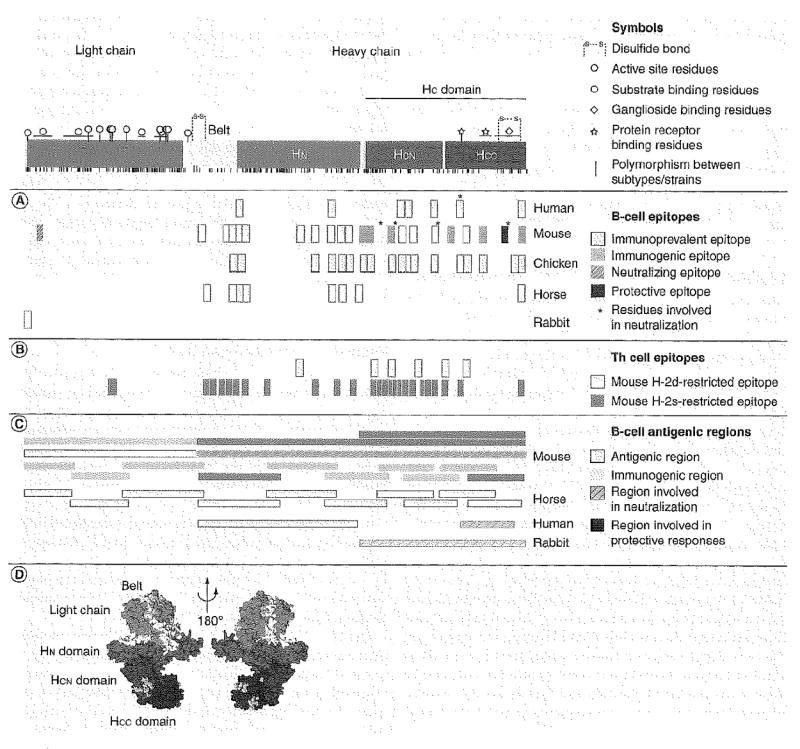
Figure 2. Clostridium botulinum botulinum neurotoxin type A (BoNT/A) structure and its Immunological recognition
Top panel: schematic representation of BoNT/A primary structure, its different domains and most relevant features, including the subtype- and strain-related polymorphic sites. (A) Representation of the location of the most prevalent antibody (B-cell) epitopes described in the literature. A separate color is used for each host species and the individual features of each epitope are represented as in the legend. For the human antigenic epitopes, only those recognized by more than 50% of the donors are shown. For mice, those recognized in all the three strains tested are included, whereas for chicken and horse, only those highly reactive (radioimmunoassay values > 15,000 counts per min). (B) Representation of the T-cell epitopes described in the literature, coded similarly as the B-cell epitopes in panel A. Only the most prevalent epitopes (stimulation index >2.5) are shown. (C) Representation of the fragments described in the literature involved in antibody recognition, coded similarly as the B-cell epitopes in (A). (D) Neutralizing epitopes from BoNT/A depitcted in the 3D structure (PDB 3BTA). Two views of the molecule – rotated by 180° – are shown to accommodate the different epitopes. The coloring of BoNT/A domains and epitopes corresponds to that of the top panels.

References

    1. Albrecht MT, Li H, Williamson ED, et al. Human monoclonal antibodies against anthrax lethal factor and protective antigen act independently to protect against Bacillus anthracis infection and enhance endogenous immunity to anthrax. Infect Immun. 2007;75(11):5425–5433. - PMC - PubMed
    1. Arnon SS, Schechter R, Maslanka SE, Jewell NP, Hatheway CL. Human botulism immune globulin for the treatment of infant botulism. N Engl J Med. 2006;354(2):462–471. - PubMed
    1. Casadevall A. Passive antibody administration (immediate immunity) as a specific defense against biological weapons. Emerg Infect Dis. 2002;8(8):833–841. - PMC - PubMed
    1. Casadevall A. Antibodies for defense against biological attack. Nat Biotechnol. 2002;20(2):114. - PubMed
    1. Eubanks LM, Dickerson TJ, Janda KD. Technological advancements for the detection of and protection against biological and chemical warfare agents. Chem Soc Rev. 2007;36:458–470. - PubMed

Websites

    1. Immune Epitope Database and Analysis Resource. www.immuneepitope.org.
    1. NIAID Category A, B and C Priority Pathogens. www3.niaid.nih.gov/biodefense/PDF/cat.pdf.

Publication types

MeSH terms